Workwize vs GroWrk: Operational Gaps Neither Covers in 2026
You must have gone through dozens of Workwize vs GroWrk comparisons by now. They all read like feature checklists, don't they? They line up all the integrations, country counts, and pricing tiers. Then, they finally…
 Ahmad ZakariaJuly 21, 2026
Table of contents
- Workwize, GroWrk, and Firstbase at a Glance
- Workwize vs GroWrk: Who Are They For?
- Where Workwize and GroWrk Actually Differ
- What Workwize and GroWrk Customers Actually Report
- What Are the Gaps That Workwize and Growrk Share
- How Firstbase Closes the Gaps Workwize and GroWrk Leave Open
- FAQs
- Which Platform Is Right for Your Team?
- What Would Your IT Operations Look Like With Zero Gaps?
You must have gone through dozens of Workwize vs GroWrk comparisons by now.
They all read like feature checklists, don't they? They line up all the integrations, country counts, and pricing tiers. Then, they finally declare a winner based on company size.
But they skip the question that is very important for IT teams, where two or three people manage 500+ devices across a dozen countries without any regional IT staff.
What happens when the infrastructure behind these platforms isn't ready for your region, your timeline, or your offboarding volume?
Both Workwize and GroWrk run on partner logistics networks. And both have documented patterns of friction when those networks fall short, from delayed shipments to inconsistent account support. Also, the IT teams on sales calls describe as a retrieval process as time-consuming and painful because the devices are still with former employees for months. And there's no clear audit trail to show for it.
This blog uses sourced reviews and published platform data to show where each platform delivers, where each one stalls, and where Firstbase fills the operational gaps that neither addresses.
Workwize, GroWrk, and Firstbase at a Glance
| Platform | Best for | Infrastructure | Key gap |
|---|---|---|---|
| Firstbase | Distributed teams (500+ employees) across 150+ countries | Owned warehouse + managed 3PL network | Value scales with fleet size and geographic complexity |
| Workwize | Mid-to-enterprise teams (150+) with structured IT ops | Global supplier network + local warehouses | Delivery slips outside EU/NA; markup + platform fees add up |
| GroWrk | Startups to enterprise; fast-scaling remote-first teams | Partner network + local warehouses | Procurement markup 2-3x; account manager rotation |
Workwize vs GroWrk: Who Are They For?
Let's get straight into a side-by-side comparison.
Workwize
Workwize is a hardware lifecycle management platform built for central IT teams running distributed workforces. It covers procurement, deployment, retrieval, and disposal across 100+ countries through a global vendor network, with local warehouses for regional storage and faster delivery.
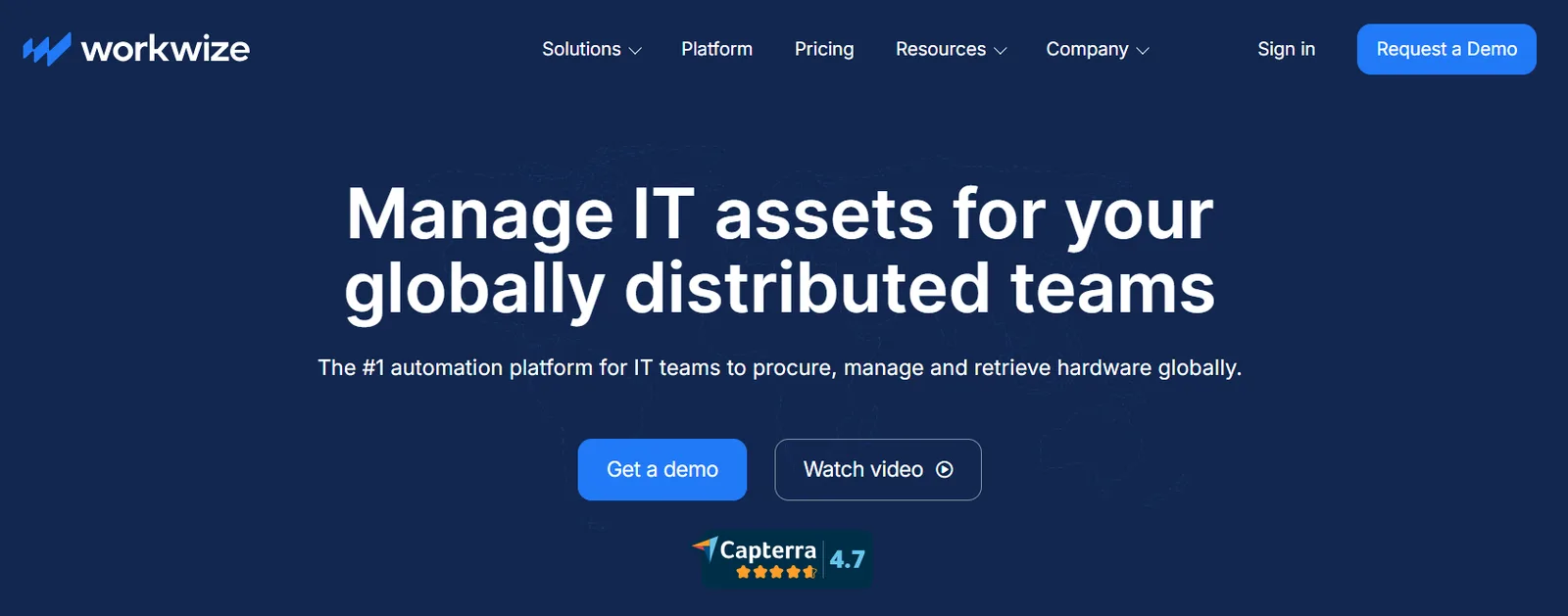
The platform connects to 72 HRIS and 7 Mobile Device Management integrations (including Apple Business Manager and Microsoft Intune) and offers zero-touch deployment so devices arrive preconfigured. Workwize targets mid-sized to enterprise organizations, typically 150+ employees, that need structured lifecycle automation and are managing multiple country operations from a single IT team. Customers include Elastic, HelloFresh, and Pleo.
GroWrk
GroWrk covers similar ground but positions itself more broadly across company sizes, from startups to enterprise. It operates in 150+ countries with 40+ integrations and offers an à la carte pricing model alongside its premium tier, so smaller teams can pay per transaction instead of committing to a subscription upfront.
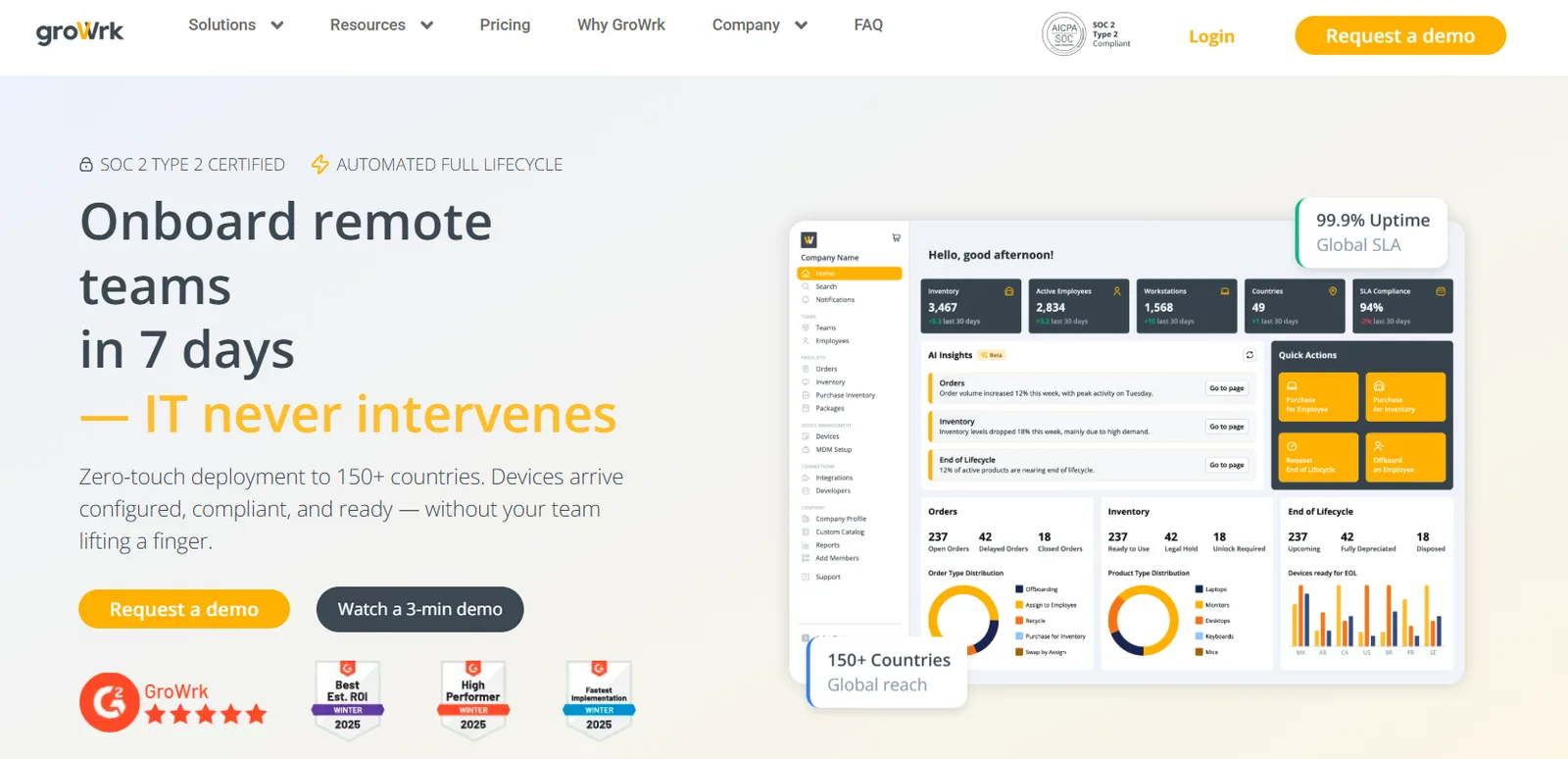
The platform also includes AI-powered support and a depreciation tracker for IT asset management and value monitoring. Its customer base skews toward fast-scaling remote-first companies; Upwork and RemotePass are among its verified customers.
On paper, the overlap is significant. Both handle the same lifecycle stages, both support MDM enrollment, and both promise centralized dashboards with real-time tracking. The differences show up in how each one delivers on those promises, which is what the rest of this blog breaks down.
Where Workwize and GroWrk Actually Differ
Let's make the comparison easy for you. We've reviewed the features of both Workwize and Growrk, along with an operational layer, Firstbase, so you get a thorough understanding of how each platform handles your needs and beyond.
| Feature | Workwize | GroWrk | Firstbase |
|---|---|---|---|
| Best for | Mid-to-enterprise teams (150+ employees) with structured IT ops | Startups to enterprise; fast-scaling remote teams | Lean IT and Finance teams managing 500+ global workforce |
| Global coverage | 100+ countries | 150+ countries | 150+ countries |
| Pricing model | Per-employee-per-month; custom quotes | Three tiers: A la carte (pay-per-use), Flex, and All-in | Transparent, flat per-seat; all logistics included |
| Infrastructure model | Global supplier network + local warehouses | Partner network + local warehouses | Owned warehouse + 3PL network |
| Published retrieval rate | No verified retrieval rate | Not published | 97% retrieval rates |
| Legacy fleet ingestion | Can track existing assets in the platform | Can import existing inventory | Yes: ship existing devices to Firstbase warehouse for grading, wiping, and redeployment |
| ITAD / data destruction | NIST 800-88, SOC 2 Type II, ISO 27001 | SOC 2 Type 2, secure data wiping | NIST 800-88 with auto-generated CoDs stored in-platform; ITAD Center with office pickup |
| Native integrations | 80+ (HRIS, MDM, including ABM and Intune) | 40+ (HRIS, MDM, SSO) | HRIS + MDM native, plus AI Workflows with 400+ integration nodes |
| Apple Authorized Reseller | No (procures through authorized suppliers) | No (sources through certified resellers) | Yes (one of ~200 in the US) |
The infrastructure model is the biggest structural difference between all three. Workwize and GroWrk both rely on partner networks to handle logistics, so delivery speed and retrieval consistency are tied to how well those partners perform in a given region. Firstbase operates its own warehouses, which gives it more direct control over SLAs and turnaround times.
Firstbase customers save $125 per departing employee on offboarding logistics and cut 5,000 IT staff hours annually for every 1,000 employees managed.
See Firstbase in action
Map Firstbase to your global fleet
Take a self-guided product tour and see how owned infrastructure across 150+ countries compares to partner-network logistics.
Take a Self-Guided Tour →What Workwize and GroWrk Customers Actually Report
The feature table tells you what each platform is designed to do. Reviews tell you what happens after you sign. Here's what users are saying across G2, Capterra, and Reddit.
Workwize
Here is what actual customers have to say about Workwize after seeing how they work firsthand.
Shipment reliability outside core geographies
This is the most frequent complaint across multiple review sources. Workwize's partner network performs well in Europe and North America, but coverage thins out beyond those regions.
Multiple users describe delays of weeks (not days) when shipping to the Middle East, LATAM, APAC, and parts of the EU. One reported regularly having to fall back on local retailers after orders stalled or missed SLA windows.
For example, a global IT team summarized the pattern on G2,
"If you are trying to use these services in the EU, Australia, India, or South America, you should wait until their product and processes are more mature."
Global IT team, G2 review
Others flag a depot coverage gap, noting that more warehouses are needed worldwide to consistently meet delivery timelines.
Portal accuracy and communication gaps
A Reddit thread listed four recurring issues: portal data that doesn't match actual equipment status, delivery delays communicated after the fact, asset discrepancies across records, and cost creep beyond the original quote.
On review platforms, users have also observed a similar pattern. The portal doesn't always reflect shipment activity, and updates often require chasing the account rep directly.
Pricing and markup structure
An IT Manager broke down the costs: a 30% markup on products plus separate platform fees. There were also multiple other users who reported that the final costs exceeded the amounts quoted during sales.
Others flag that pricing scales steeply with device volume and regional coverage, with limited visibility into the source of the markup.
GroWrk
Let's see what Growrk users describe the experience.
Account management continuity
This is GroWrk's most distinctive pain point. Multiple reviews describe being cycled through account managers, which breaks context and slows issue resolution.
A mid-market user put it plainly,
"They rotate you through an account manager quite regularly, and sometimes they are in vastly different time zones."
Mid-market user, G2 review
Others describe a support team that responds quickly but doesn't always have context on a specific customer's situation. It further leads to repeated back-and-forth on issues that should already be tracked.
Retrieval tracking and dashboard reliability
Several reviewers describe difficulty understanding where a device is in the retrieval process, with dashboard updates lagging behind actual status. One noted that follow-ups arrive for information already entered in the system.
A user on Reddit cited transparency, responsiveness, and portal accuracy as the three areas where the platform fell short.
Procurement pricing vs. self-sourcing
The most specific complaint on pricing is that buying through GroWrk can cost "2-3 times more than buying it yourself and shipping it to their warehouse." That gap is hard to justify for teams that already have vendor relationships in place.
The opinion is split on the subscription model. Some prefer the à la carte option for lighter usage; others find the per-seat fee hard to justify without full lifecycle coverage.
Delivery timelines in certain regions
A user reported waiting nearly 8 weeks for a single device order.
Another acknowledged that retrieval friction is partly structural, calling GroWrk "the middle man in between the local vendors and you."
What Are the Gaps That Workwize and Growrk Share
Most guides compare Workwize and GroWrk on what they offer. But the comparison that matters for IT operations is the one that neither covers. Four structural gaps show up across both platforms, and none of the existing comparison content addresses them.
Both Workwize and GroWrk procure Apple hardware through third-party authorized resellers in their partner networks. Neither is itself an Apple Business Partner. The distinction has a practical cost. When Apple procurement goes through an intermediary, you typically absorb an additional markup on the hardware. You also lose the ability to enroll devices directly into Apple Business at the point of purchase. Without it, IT teams must handle that step manually or coordinate it through a third party, adding friction and time to every device that ships.
Workwize self-reports a 100% hardware retrieval rate on its website. GroWrk doesn't publish a specific retrieval rate. In neither case is there an independent third-party verification: no customer survey with a named methodology, or an audited data set backing the number. For context, the industry average for device recovery in distributed companies sits around 50%, according to Gartner benchmarks cited across multiple analyses.
Both platforms operate through partner logistics networks, which means your account team is coordinating execution through third parties rather than controlling it directly. Neither Workwize nor GroWrk publishes SLA-backed account management commitments (dedicated account managers, guaranteed response windows, or named escalation paths) in their public-facing documentation. If your local logistics partner drops the ball on a shipment or retrieval, your account manager is the one who needs to fix it, and how that escalation path works matters.
If you're migrating from another platform or moving off spreadsheets, neither Workwize nor GroWrk offers a documented process for physically ingesting your existing devices into their lifecycle pipeline. Workwize lets you upload inventory records (manually or in bulk) to the platform, which is useful for tracking purposes. But that's a data import and not a physical handoff. On Growrk, there's no published workflow for shipping existing hardware to a warehouse where devices get tagged, wiped, graded, and redeployed. For any company sitting on 100+ laptops across home offices, closets, or regional storage, that means switching platforms could also mean starting fresh with new hardware.
When retrieval performance is the difference between recovering $1,500 per device or writing it off, self-reported figures without external validation make it harder to evaluate what you're actually buying.
And if you've been through this before, you know how it actually plays out. You're chasing hardware from departing employees for months. The credits you get back are smaller than what you expected. And when it's finally over, there's no record of what happened to each device, where it ended up, or whether the data was actually wiped. A retrieval rate on a vendor's website doesn't answer the question you really ask: what happens to my devices, in my countries, when someone doesn't ship back?
How Firstbase Closes the Gaps Workwize and GroWrk Leave Open
The four gaps above are structural limitations of partner-dependent logistics models. Firstbase is built on a different architecture, and the differences connect directly to where both platforms fall short.
Owned infrastructure, not partner networks
Firstbase operates its own warehouses plus a managed 3PL network across 150+ countries, with SLA-backed 48-hour deployment and pickup windows. Delivery consistency doesn't depend on whether a local vendor in Bangalore or São Paulo shows up on time; it's controlled end-to-end.
Customers report 75% less IT time spent on device logistics because device procurement, shipping, retrieval, and ITAD are handled by a single operations layer rather than a patchwork of regional partners.
In practice, that means a lean IT team can absorb a headcount surge without hiring someone just to manage device logistics. The hours that used to go toward coordinating couriers, following up on shipments, and reconciling asset records manually get absorbed by the platform. For a three-person team, that's 10-15 hours a week back.
Apple Business Partner with direct Apple Business enrollment
Firstbase is one of roughly 200 Apple authorized resellers in the US. Apple devices are procured at direct pricing with no reseller markup and enrolled into Apple Business at the point of purchase.
That's what enables true zero-touch MDM deployment from day one. IT teams don't need to coordinate enrollment through a third party or manually register devices after they arrive. The device shows up ready to configure the moment an employee opens the box.
Verified retrieval performance
Firstbase maintains a 90%+ retrieval rate across its customer base, with 97%+ in tier-one countries. These aren't self-reported numbers. A UserEvidence survey of 59 Firstbase customers found 1.6x improved retrieval rates and 1.8x better asset tracking compared to their previous baselines.
The full retrieval cycle, from offboarding trigger to wiped, graded, deploy-ready inventory, takes under 30 days. The industry average for managed service providers is 30 days just to process a device once it's already back in the warehouse.
ITAD with Office Pickup
Most ITAD workflows assume devices are already sitting in a warehouse. But for distributed and hybrid companies, that's rarely the case. Devices pile up in office closets, storage rooms, and regional hubs with no clear retirement path, depreciating as they sit idle.
Firstbase's ITAD Center now includes Office Pickup, a workflow that lets admins create bulk ITAD requests for inventory stored at physical office locations. It handles both tracked and untracked devices; you can submit by category and quantity without needing serial numbers for every item. In supported US regions, Firstbase manages the carrier pickup directly. Globally, admins can coordinate their own shipping into Firstbase's warehouse network.
From there, every device gets a Certificate of Destruction aligned with NIST 800-88 standards, and the platform shows real-time resale estimates. No fee for resale which means recovered hardware value flows back to your IT budget, not vendor margin. The entire process is tracked from request creation through completion in a single platform, which means no more scattered CoDs across inboxes and shared drives.
Legacy fleet ingestion
Companies switching platforms or moving off manual processes can ship their existing devices to Firstbase warehouses. Each device gets tagged, wiped to NIST 800-88 standards, graded for condition, and folded into the lifecycle pipeline as deploy-ready inventory. There's no requirement to buy new hardware through Firstbase to get started.
Instead of writing off that existing inventory or running dual systems during migration, those devices become part of your active fleet from day one. Firstbase's platform tracks the full history of each ingested device, including previous repairs, wipe records, and redeployment status.
Here's what that looks like in numbers:
FAQs
If you've read this far, you're past feature comparisons and into operational due diligence. Three questions come up most at this stage.
Yes. Firstbase accepts existing hardware through legacy fleet ingestion. Ship your current devices to a Firstbase warehouse; they get tagged, wiped to NIST 800-88 standards, graded, and folded into a complete IT asset lifecycle management process.
A 500-device fleet typically migrates in about 12 business days with no need to run dual systems during cutover. You keep your IT hardware. You just move the operations layer.
There are two things: pricing and provisioning. Firstbase procures Apple hardware directly, with no reseller intermediary adding markup. And because it holds Apple Business Partner status (one of roughly 200 in the US), devices get enrolled into your Apple Business account at the point of purchase.
Without direct enrollment, IT teams register devices manually after arrival, which adds time and room for error at scale. Neither Workwize nor GroWrk holds this status; both procure through third-party authorized resellers.
Both Workwize and GroWrk operate through partner networks, so when something breaks, your account manager is coordinating with a third-party vendor to fix it.
Firstbase runs its own warehouse infrastructure, so escalations stay internal. Your account manager isn't calling a vendor in a different time zone; they're working directly with the operations team that handles your devices. Plus, the SLA-backed 48-hour deployment and pickup windows give that team a concrete commitment to deliver and not a best-effort estimate.
Which Platform Is Right for Your Team?
There's no single right answer here. Each platform fits a different operational profile. But here's a simple framework to decide.
Best fit: Teams concentrated in Europe and North America, where the partner network and local warehouses are strongest.Why it works: 80+ HRIS/MDM integrations; strong onboarding/offboarding automation; local warehouse storage for faster regional turnaround.Go in knowing: Delivery timelines outside core geographies can slip; get specifics on total cost (markup + platform fees) before signing.
Best fit: Startups and scaling teams needing coverage in emerging markets (LatAm, Africa, Southeast Asia).Why it works: Freemium and à la carte pricing lowers the entry barrier; a wide geographic reach through local reseller partners.Go in knowing: Hardware procurement markup can run 2-3x above self-sourcing; ask about account manager continuity.
Best fit: Distributed companies (500+ employees) that need SLA-backed reliability across 150+ countries.Why it works: Owned warehouse infrastructure; Apple Business Partner with direct Apple Business enrollment; 90%+ verified retrieval rate; legacy fleet ingestion.Go in knowing: Value scales with device volume and geographic complexity; flat per-seat pricing includes all logistics.
What Would Your IT Operations Look Like With Zero Gaps?
Workwize and GroWrk both handle device lifecycle management for distributed teams, but sourced reviews and published data reveal four structural gaps they share: no Apple Business Partner status, no independently verified retrieval rate, no documented account management structure, and no legacy fleet ingestion.
Firstbase fills those gaps with owned infrastructure, direct Apple procurement, and a physical operations engine that turns device logistics into a predictable, auditable process. The result is IT teams that spend their time on strategy instead of chasing shipments and tracking down unreturned hardware.
Customers have recovered $175,000+ in device reuse value and saved 700+ hours of administrative work during a single workforce reduction. Book a demo to see how Firstbase handles your fleet.
Written by
Ahmad Zakaria
Ahmad Zakaria covers IT operations, hardware lifecycle management, and distributed workforce solutions at Firstbase. His content is built from real customer data, operator interviews, and hands-on experience managing devices across 150+ countries.
Get started with
Firstbase today
Remote and hybrid work aren't going anywhere. It's our mission to make it easier to manage the assets your distributed team needs—from onboarding through offboarding and every repair, replacement, and upgrade in between.
Fill out the form and a member from our team will reach out by phone!
Get a Live Demo