Snipe-IT vs Asset Panda Compared for Distributed Teams
Search "Snipe-IT vs Asset Panda," and you'll find a dozen comparisons of dashboards, mobile apps, and workflow configuration. It's useful if your main question is which tool tracks assets better. But if you're an IT…
 Ahmad ZakariaOctober 8, 2026
Table of contents
- Snipe-IT vs Asset Panda: Who Are They For?
- TL;DR Snipe-IT Vs Asset Panda Vs Firstbase
- What Are the Biggest Limitations of Snipe-IT and Asset Panda?
- How Firstbase Closes the Gaps Snipe-IT and Asset Panda Leave Open
- Which Platform Is the Right Fit for Your Team?
- Should You Rethink Your IT Asset Management Stack?
Search "Snipe-IT vs Asset Panda," and you'll find a dozen comparisons of dashboards, mobile apps, and workflow configuration. It's useful if your main question is which tool tracks assets better.
But if you're an IT Manager or a Procurement Lead, managing hardware across 500+ employees in multiple countries, you already know that tracking record isn't where the hours go. The hours go to physical logistics, for example, getting a laptop to a new hire in São Paulo before day one, or retrieving one from an ex-employee in London who stopped responding three weeks after their last day.
When a device hits end of life, someone still needs to coordinate the wipe and produce disposal documentation that holds up in an audit.
This guide breaks down what each platform does well and where they share the same blind spots. It also covers when a managed platform like Firstbase makes more sense than running another piece of tracking software.
Snipe-IT vs Asset Panda: Who Are They For?
These two platforms solve the same core problem (tracking what you own and who has it), but they're built for different teams with different resources. Let's see how.
Snipe-IT
Snipe-IT is open-source asset management software. The self-hosted version is free with no caps on users or assets. You provide the server; Snipe-IT provides the software. Cloud-hosted plans are available for teams that don't want to manage infrastructure, with a 99.99% SLA uptime guarantee and servers across multiple data centers.
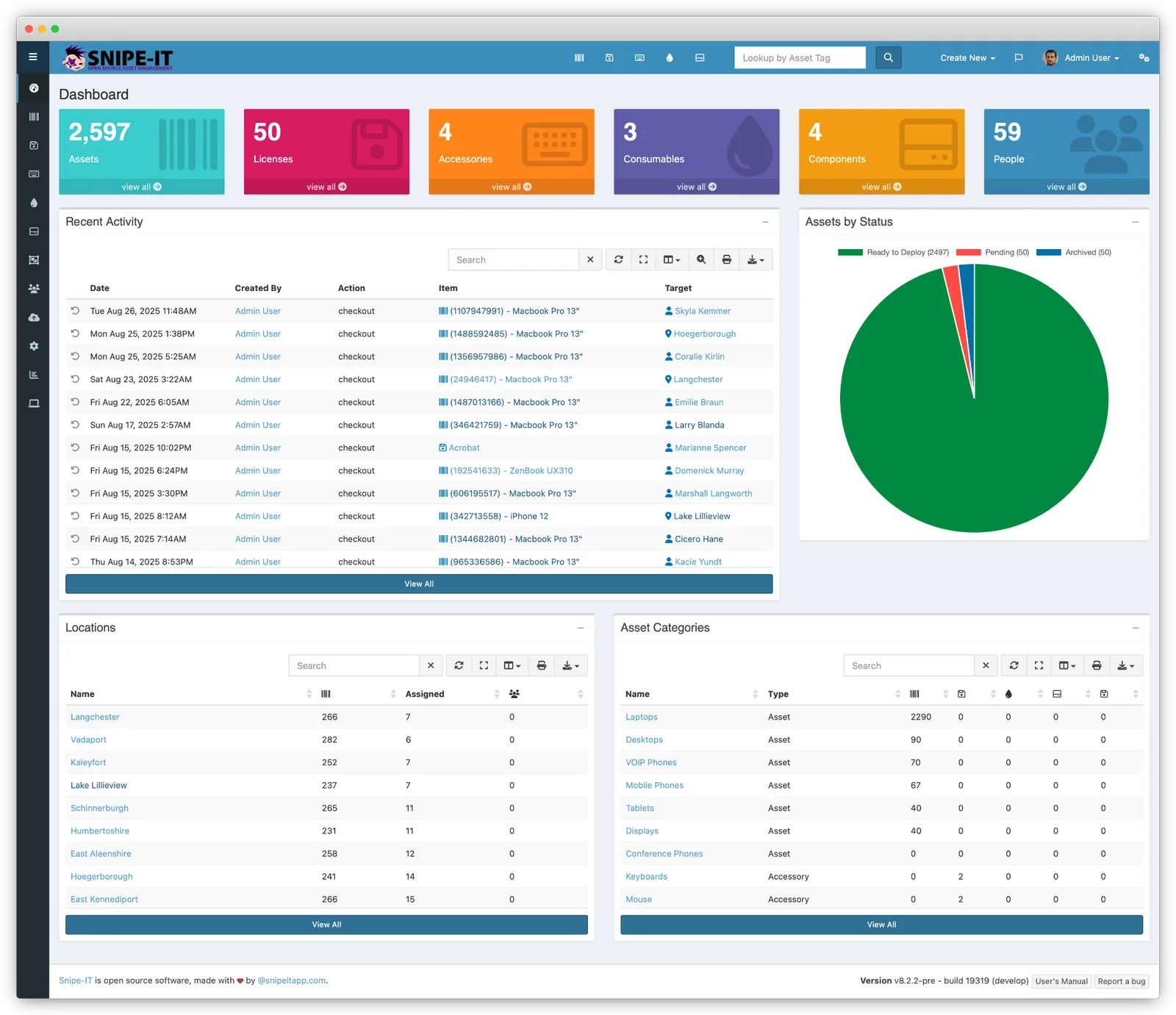
It runs on any Linux, Windows, or Mac web server and works on any device through the browser. For user management, it supports SAML login, LDAP sync, Google Secure LDAP sync, and SCIM for automatic user provisioning.
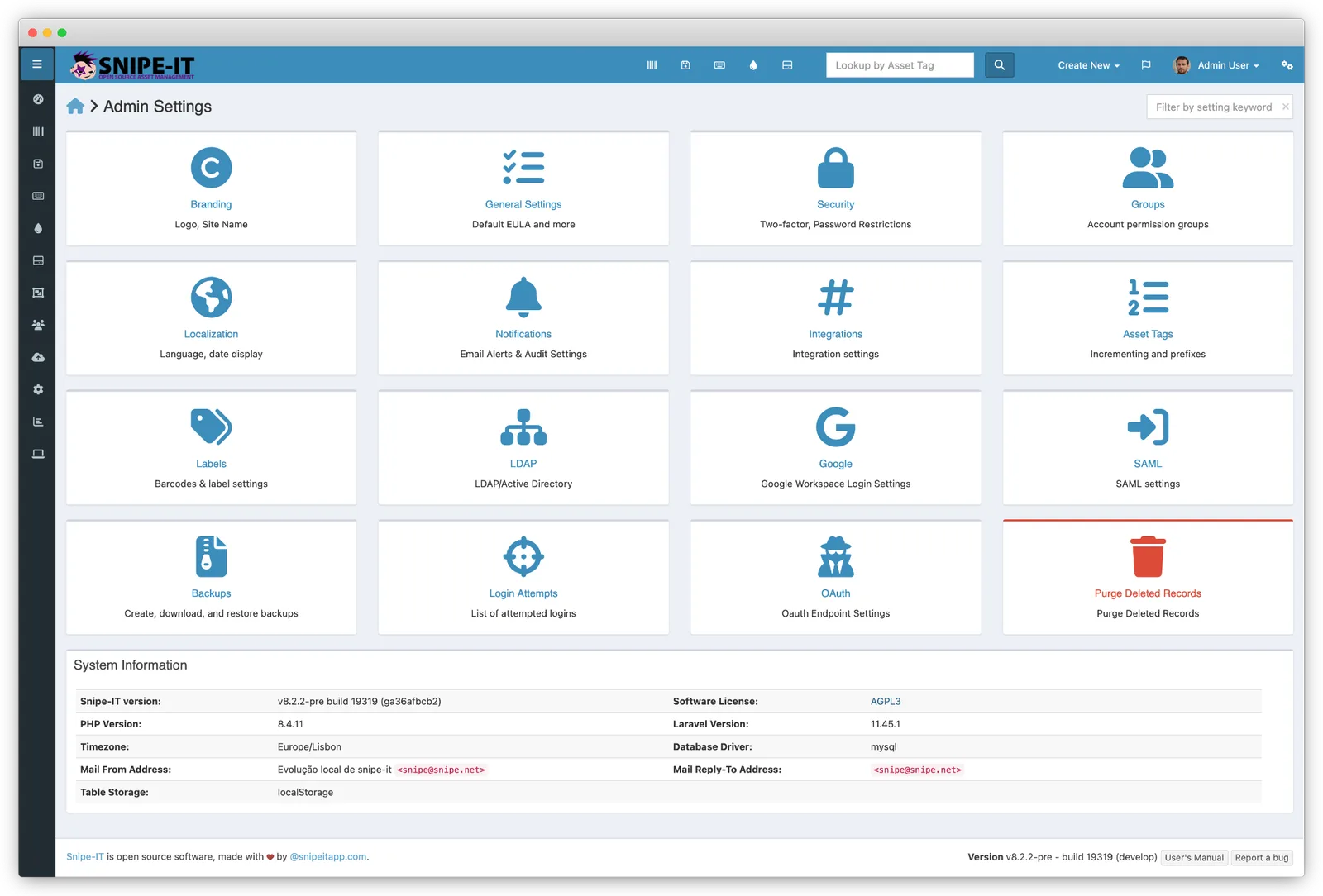
It has first-party integrations with Jamf (via Jamf2Snipe) and Kandji (via Kandji2Snipe), plus a Jira integration through the Atlassian marketplace. Everything else connects through its JSON REST API, which means your team writes and maintains those connections.
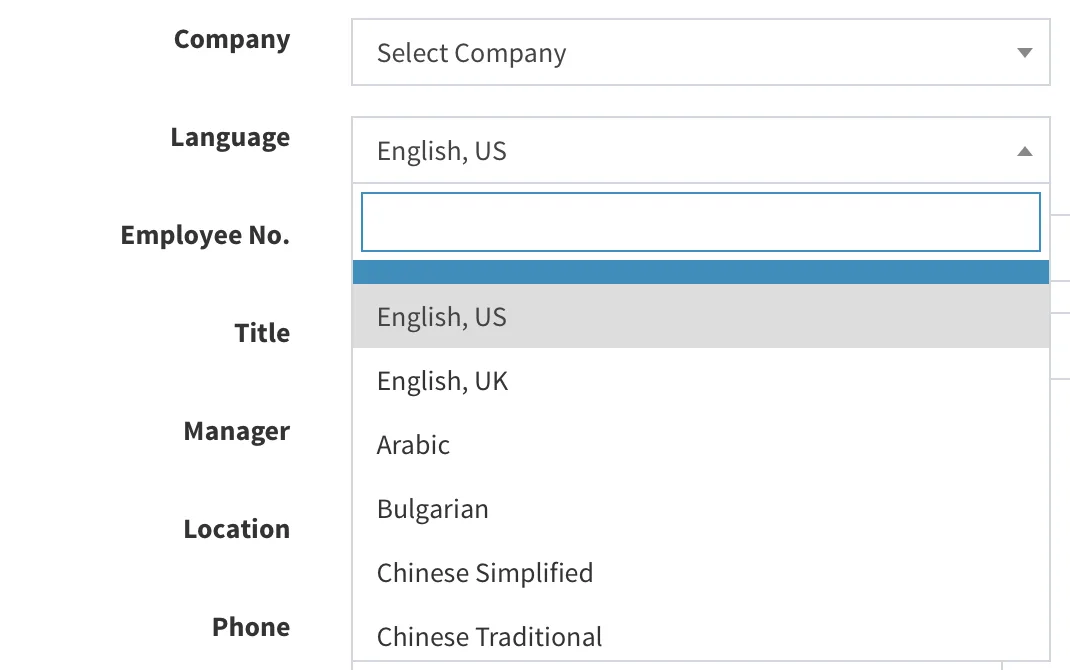
The platform is translated into 55+ languages with per-user language support, which matters if your team spans multiple countries.
Other specifics worth noting are: Slack notifications for check-in/checkout events, pre-defined kits for faster checkouts, one-click backups, email alerts for expiring warranties and licenses, QR code label generation, and full asset history including checkouts, check-ins, and maintenance records.
Asset Panda
Asset Panda is a cloud-based, no-code platform. It's not IT-specific. The platform covers asset tracking, equipment management, maintenance and inspections, field operations, facilities management, and audit readiness from a single system.
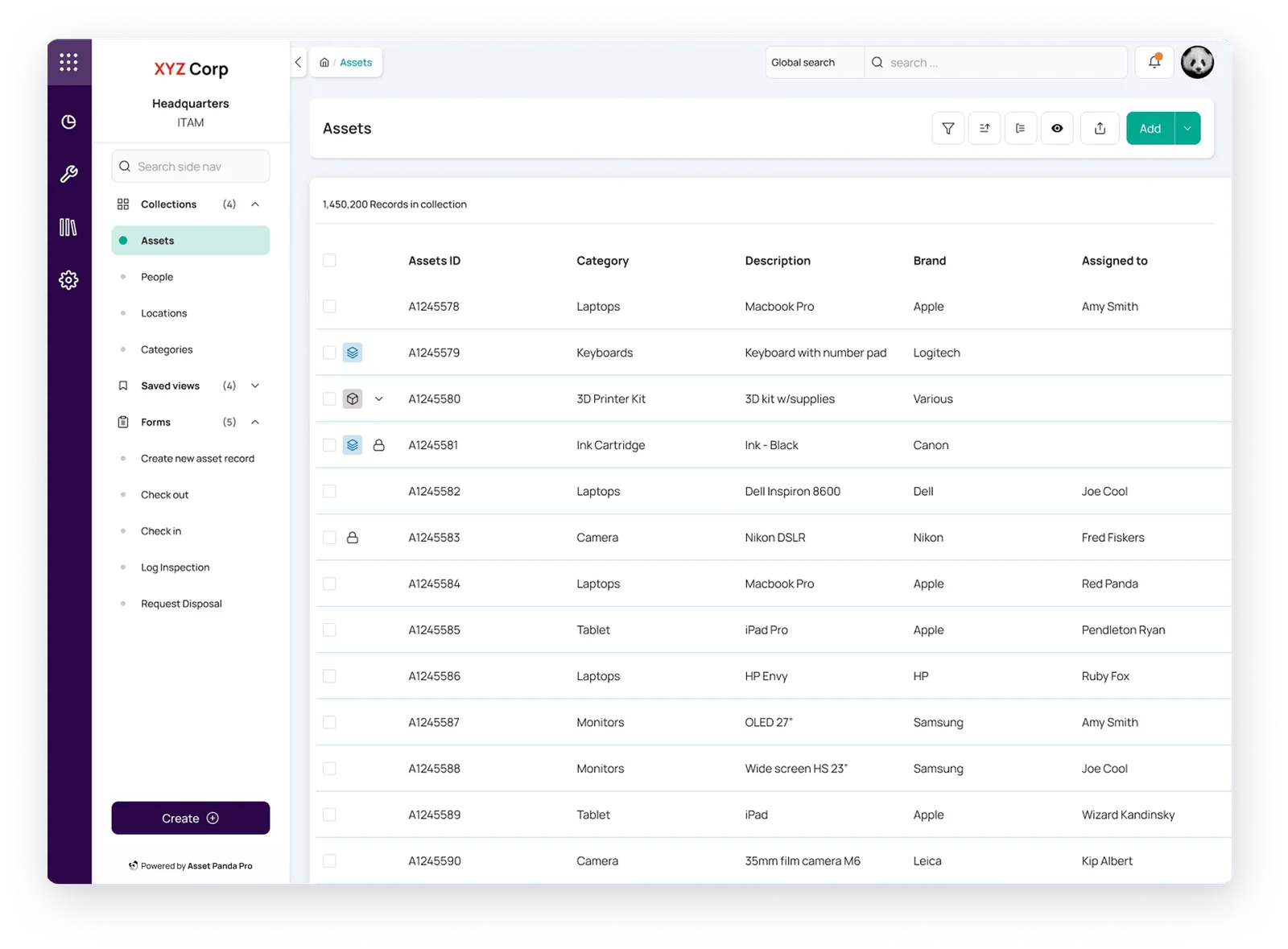
Its mobile app (iOS and Android) supports offline mode, built-in barcode and QR scanning, GPS pindrop for location recording, and the ability to run workflow actions directly from the field. No third-party scanners needed. The web app mirrors full administrative features, so nothing is locked behind a specific device.
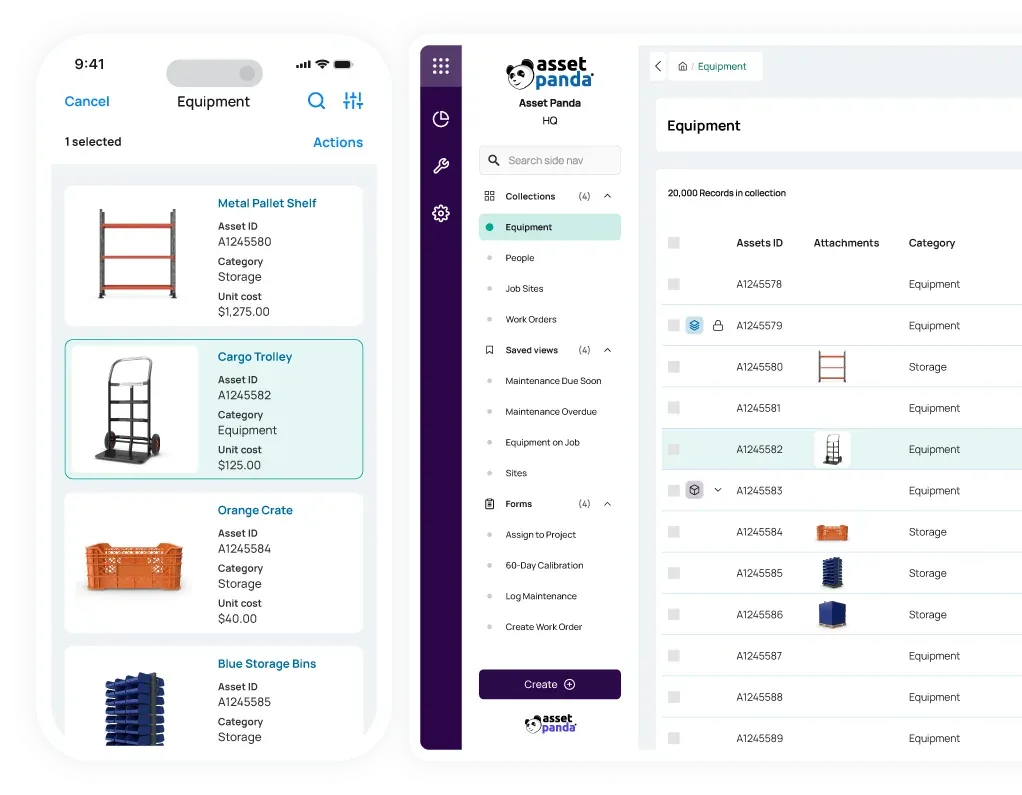
On the configuration side, Asset Panda offers custom fields, conditional automations, action-based forms, custom check-out and maintenance checklists, automated report scheduling (CSV, XLS, PDF), notifications via email or push, and field requirements to enforce data integrity.
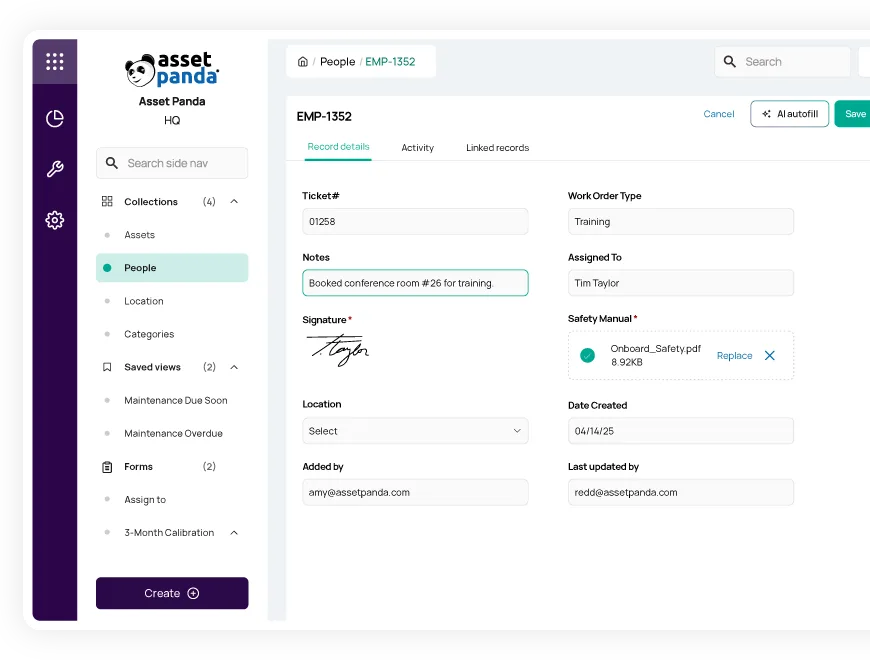
It also includes signature capture, contract management with renewal alerts, asset kitting, repair tracking, and inspection checklists that live with each asset record.
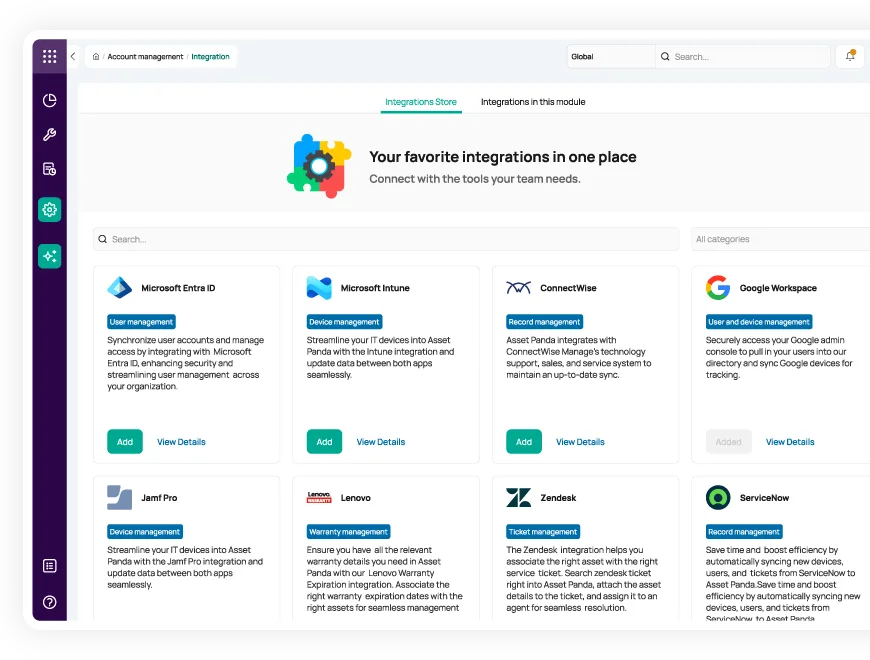
Integrations connect natively with Azure Active Directory, Jamf Pro, ConnectWise, Google Workspace, and Microsoft Intune.
Security runs on Amazon AWS hosting with TLS 1.2 encryption and role-based permissions. The multi-account structure lets you create separate data silos by department, location, or client.
TL;DR Snipe-IT Vs Asset Panda Vs Firstbase
Here's how the three platforms compare across the dimensions that actually affect a buying decision.
| Criteria | Snipe-IT | Asset Panda | Firstbase |
|---|---|---|---|
| Best for |
|
|
|
| Rating | 4.6 | 4.2 | 4.8 |
| Global coverage |
|
|
|
| Pricing model |
|
|
|
| Native integrations |
|
|
|
| Implementation time |
|
|
|
Customer report cutting 75% of the manual work involved in managing their employee equipment lifecycle after switching from a VAR-based setup. Take a self-guided product tour to see how Firstbase offers you that.
What Are the Biggest Limitations of Snipe-IT and Asset Panda?
We've seen how both platforms track assets and ownership well enough. But verified user reviews show where each tool hits its ceiling.
Snipe-IT
The most consistent user complaint is manual data entry. Snipe-IT has no discovery agent, so every asset enters the system because someone typed it in. One user pointed out that there's no agent to auto-push hardware, warranty, or software information into the platform, and flagged a third-party tool (Snipe Agent by Network Architeks) trying to close that gap.
Performance is another issue at scale because the tool lags during use, which slows down operations. It's good for the price, but it takes work.
Reporting also comes up. Multiple users noted that reports are limited and could be more detailed. Some specifically called out the absence of notifications for dual asset holders and license expirations, both of which should be standard for any team managing a fleet of devices across multiple people.
And if you're self-hosting (which most Snipe-IT users are, since that's the free tier), you own the infrastructure. That means server maintenance, backups, patching, and dependency management, all on your team's time.
Asset Panda
Asset Panda's entry process is reportedly slow. Users say they wished all they had to enter was a serial number, with the rest auto-filled from the manufacturer's support site.
Integration gaps also frustrate users. A user flagged the lack of integration with Jamf and Google Workspace specifically, noting it restricted their ability to automate workflows and pull information across platforms. This is worth noting because Jamf and Google Workspace are standard in many IT environments, and their absence creates extra manual work.
On the data side, exporting isn't always clean. Filters break down when searching for older assets, and downloading asset data sometimes requires reports to be emailed rather than exported directly, which slows audits.
It's also one-dimensional for physical assets, lacking depth for things like nested parent-child equipment relationships and any kind of project management layer.
What Gaps Do Snipe IT and Asset Panda Share?
The individual limitations above are solvable with workarounds, configuration, or patience. But there's a category of problems that neither platform addresses at all, because they both stop at the tracking layer.
Snipe-IT and Asset Panda can tell you that a laptop exists and who it's assigned to. Neither one can procure that laptop, ship it to a new hire, or get it back when someone leaves. The record is accurate; the hardware doesn't move.
If you have employees in the UK, Germany, Brazil, and the Philippines, neither tool helps you deal with customs documentation, regional shipping carriers, or country-specific import rules. Your IT team figures that out on their own, per country, per shipment.
Both platforms can mark an employee as offboarded in the system. But that status change doesn't trigger a physical retrieval. The tracking record says "offboarded." The laptop is still sitting on a desk in another country, and your IT team is sending follow-up emails trying to get it back. 30% of enterprise IT assets are unaccounted for, and the industry retrieval average sits between 30-50%.
When a device hits end of life, neither platform handles what comes next: certified data wiping, secure disposal, certificate of destruction documentation, or resale value recovery. That entire process happens outside the tool, usually through a separate vendor or manual coordination.
These aren't feature gaps that a future update will fix. They're outside the scope of what tracking software does. And for distributed teams managing hundreds or thousands of devices across multiple countries, this is where the real operational hours go.
How Firstbase Closes the Gaps Snipe-IT and Asset Panda Leave Open
Firstbase answers the question that comes after Snipe-IT and Asset Panda's tracking processes: "how does it get there, how does it come back, and what happens to it at end of life?"
It's a different category, certainly not a better version of tracking software, but the physical operations layer that sits underneath it. Here's what that looks like in practice.
Global procurement and shipping
Firstbase handles device sourcing and delivery to employees across 150+ countries. Your team doesn't coordinate customs, carriers, or regional suppliers. For example, Cresta, a conversational AI company, expanded into India, Romania, and Germany through Firstbase after running into 10-week provisioning timelines trying to ship internationally on their own. The approach is vendor-neutral: purchase from Firstbase's suppliers, lease, or ship in your own equipment.
Managed retrieval
This is where the biggest cost gap sits. The industry average: 30-50%. Firstbase's retrieval rate is 97%+. The platform automates address confirmation with the departing employee, sends return kits (boxes and prepaid shipping labels) to their home, and tracks the return with real-time delivery updates. The full cycle from offboarding initiation to graded, wiped device back in inventory takes under 30 days. MSPs typically take 30+ days just to process a device after it arrives at the warehouse.
Firstbase customers have found 1.6x improved retrieval rates and 1.8x better asset tracking after switching. In an M&A scenario, a mid-size software company with 2,500 distributed employees saved 700+ hours of administrative work, $125 per departing employee, and recouped $175,000+ through device reuse.
IT asset disposition (ITAD)
When a device hits end of life, Firstbase manages retirement across 50+ countries. That includes certified data wiping aligned with NIST 800-88 standards, auto-generated Certificates of Destruction stored in-platform, and dynamic resale estimates that show the real-time value of aging devices so teams can decide whether to retire now or later. Office pickup is available in the US for devices stored on-site.
API-driven automation
The Firstbase API lets your team programmatically manage orders, returns, replacements, restocking, inventory levels, shipment notices, offboarding, reactivation, and SCIM provisioning. If an employee is terminated in your HRIS, the API can trigger a return order in Firstbase without anyone logging into the platform.
For example, New Relic integrated Firstbase with Workday so that every night, return processes initiate automatically when HR updates an employee's status.
"With Firstbase, we can onboard with quicker notice and in a very seamless fashion, globally. We're able to click a few buttons and ensure our machines are returned, inventoried, and reused with ease. We have saved days of time each month for our IT team. The impact for international shipping and device management alone has been a lifesaver."
Allie Winkelman, Director of Learning and Development, Thrive Global
Which Platform Is the Right Fit for Your Team?
Use this framework to make a quick, informed decision.
You have a technical team that can self-host and maintain the infrastructure Your assets are mostly in one country, and you don't need physical logistics support Budget is the priority, and you're comfortable building custom integrations through the REST API
You need no-code customization across departments beyond IT (facilities, field ops, compliance) Mobile-first tracking with offline barcode scanning and GPS is a daily requirement You want out-of-the-box integrations with tools like Azure AD, Intune, and Jamf Pro without writing scripts
You're managing devices across multiple countries and retrieval (not tracking) is where your team loses hours Offboarding triggers need to result in a physical return along with the status update in a spreadsheet End-of-life compliance matters: you need NIST 800-88 certified wipes, Certificates of Destruction, and resale recovery handled for you
Should You Rethink Your IT Asset Management Stack?
Snipe-IT and Asset Panda are solid tracking tools. But we've seen how tracking only covers one layer of the problem. For distributed teams, the real time sink is everything the tracking record can't do: procurement, cross-border shipping, physical retrieval, and compliant disposal.
Firstbase sits underneath your tracking layer and runs the physical operations your IT team is currently doing manually. That means fewer hours spent coordinating logistics, fewer devices lost to incomplete offboarding, and a full audit trail from procurement to disposal in one platform. Firstbase customers report that managing logistics for just 100 remote employees takes up to 500 IT staff hours per year without a managed platform in place.
If your team is spending more time on FedEx runs and follow-up emails than on strategic IT work, book a demo and see what the shift looks like.
Written by
Ahmad Zakaria
Ahmad Zakaria covers IT operations, hardware lifecycle management, and distributed workforce solutions at Firstbase. His content is built from real customer data, operator interviews, and hands-on experience managing devices across 150+ countries.
Get started with
Firstbase today
Remote and hybrid work aren't going anywhere. It's our mission to make it easier to manage the assets your distributed team needs—from onboarding through offboarding and every repair, replacement, and upgrade in between.
Fill out the form and a member from our team will reach out by phone!
Get a Live Demo