Looking for a Laptop Retrieval Service Here’s What to Check First
Compare top laptop retrieval services for distributed teams - from simple returns to full lifecycle management.
 Ahmad ZakariaMay 26, 2026
Table of contents
Your offboarding process fails the moment a company laptop leaves your control. For remote teams, that happens a lot. If your IT team is still chasing ex-employees for laptops, printing labels, and making FedEx runs, your retrieval process is already costing you more than the device. Most firms recover only about 70% of offboarded devices, which leaves 30% unreturned.
At the same time, PC shipments also rose again in 2025, which means more devices entering the fleet, and more risk on the way out.
That is why laptop retrieval service decisions belong to IT, security, and finance, just as much as HR follow-up. Platforms like Firstbase fit here by treating retrieval as part of the full device lifecycle, from return logistics to chain-of-custody, wipe, redeploy, and resale.
In this guide, we'll cover when a laptop retrieval service makes sense, what to look for, and how leading vendors compare across scope, controls, and operational depth.
TL;DR: The best laptop retrieval services 2026
| Platform | Best for | Strength | Tradeoff | Scope |
|---|---|---|---|---|
| Firstbase | One system for retrieval, tracking, ITAD, and resale | Unified lifecycle platform with automation, NIST 800-88, chain of custody, resale credits | More depth than basic return needs | Full lifecycle |
| Hello Retriever | Simple laptop returns | Easy shipping workflow | Limited beyond return event | Return only |
| ReReady | Low-lift returns | Strong shipping exception handling | Laptop-only, added pickup cost | Return focused |
| Unduit | Recovery tied to retirement and resale | Broad post-return services | Heavier setup and support needs | Broad lifecycle |
| Remote Retrieval | Quick basic returns | Fast kit shipping and bulk ordering | Lighter visibility, narrower intl reach | Return focused |
| Growrk | Global teams with reuse needs | Wide country coverage, redeployment | Higher cost, slower dashboard | Broad lifecycle |
| Iron Mountain | Enterprises with strict governance | Strong security, audit, remarketing | Less suited to lightweight returns | Enterprise lifecycle |
The Real Cost of Poor Retrieval
Poor retrieval shows up in three places first: device spend, security exposure, and staff time.
When a laptop stays out in the field after offboarding, your team often pays twice. Once for the original device, then again for the replacement. Forrester puts the average enterprise PC at $1,100 and notes that only 15% of its value remains after four years. That means every lost laptop wipes out both usable hardware and resale value.
The security risk is harder to see, but more expensive when it lands. IBM found that the average global data breach cost reached $4.88 million in 2024. In financial services, the average hit $6.08 million. An unreturned laptop does not guarantee a breach, but it keeps one endpoint outside your full control for longer.
The labor cost piles up in the background. Manual retrieval work takes about two staff hours per device. Across 100 employees, shipping, tracking, and returns add up to more than 500 IT hours a year. The direct handling cost ranges from $196 to $334 per device.
| Team | Impact of poor retrieval |
|---|---|
| IT | Manual returns pull IT into label creation, shipment coordination, delivery exceptions, and status checks, delaying security hardening and support queues. |
| Finance | Increases unplanned replacement buys, reduces hardware available for reuse or resale, and weakens device forecasting across refresh cycles. |
| HR | Offboarding takes longer when HR has to chase addresses, confirm return steps, and coordinate updates between former employees and IT. |
This is why laptop retrieval needs a business system behind it.
See it in action
Take a self-guided tour of Firstbase
See how retrieval, tracking, ITAD, and resale credits work inside one platform built for distributed teams.
Take the Tour →Comparing the top laptop retrieval service platforms
Before you compare vendors, sort them into two buckets. Some handle the return shipment. Others manage what happens before and after the return, from procurement and tracking to wipe, redeployment, resale, and disposal. The list below gives you a quick read on where each platform fits.
Firstbase
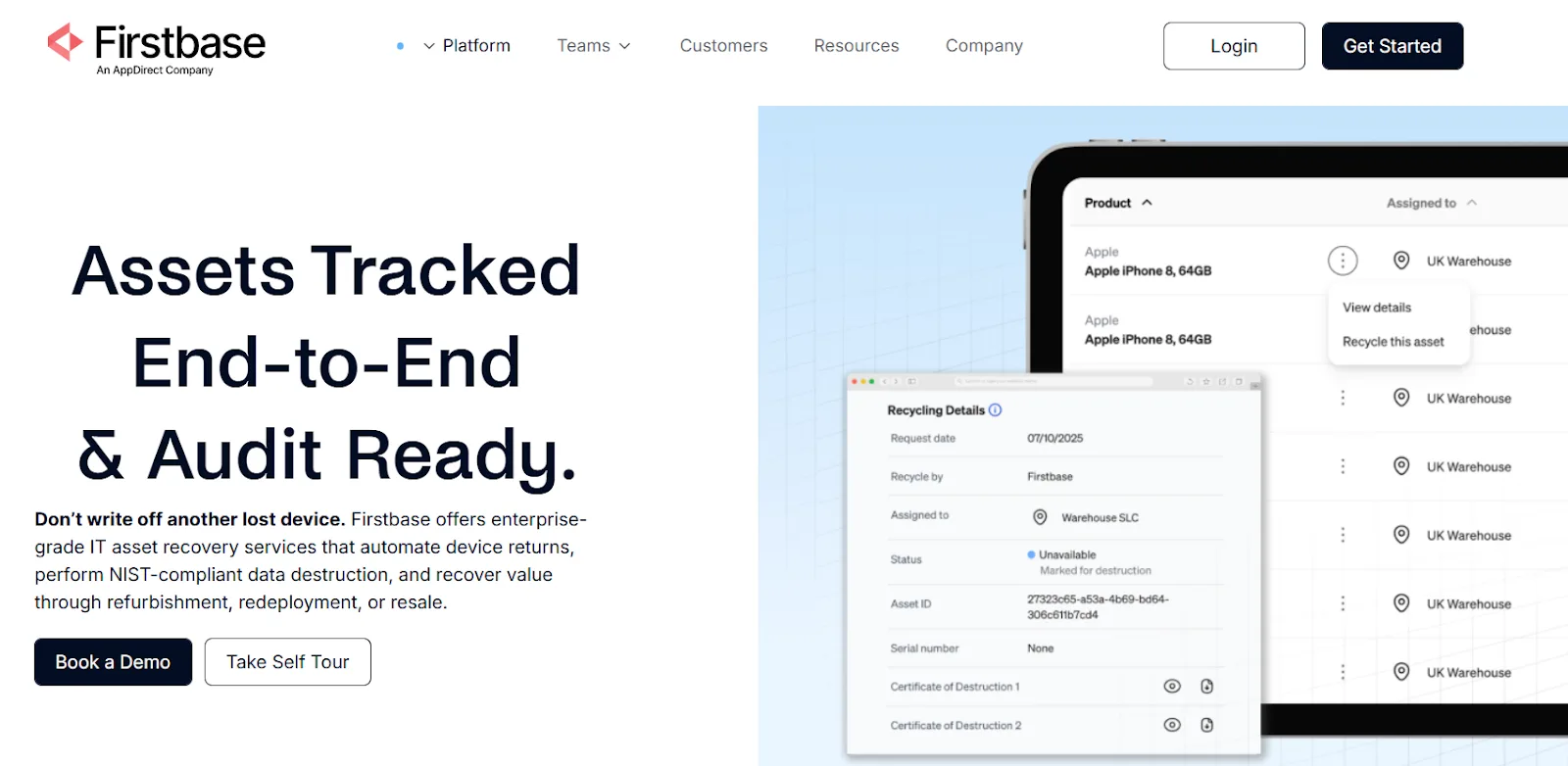
Firstbase treats retrieval as one step in a full IT asset lifecycle, not a standalone return task. The platform covers procurement, deployment, management, retrieval, resale, and retirement in one system for distributed teams with MDM integration.
That gives IT, Finance, and Security leaders a shared operating view, which is a clear step up from point solutions built only for shipping boxes back. Teams can buy through Firstbase, lease on flexible terms, or bring existing fleet devices into the same platform.
Key strengths:
- Zero-touch deployment: Syncs with JAMF, Okta, and Workday to configure devices before they arrive. Teams report about 60% fewer setup tickets in the first 90 days.
- Secure lifecycle control: SOC 2- and NIST 800-88-aligned processes with remote lock-and-wipe, encrypted returns, ITAD, and full asset visibility from deployment through retirement.
- Remarketing through credits: Quarterly resale credits with SKU-level reporting help offset future procurement costs instead of treating retired hardware as a write-off.
- Predictable pricing: Transparent per-seat pricing gives Finance clearer forecasting, with no device markups or surprise logistics fees.
One customer saved $125 per departing employee during offboarding, freed up 700+ hours by avoiding internal logistics, and recouped $175,000+ through better device retrieval and reuse.
Tradeoffs
Some users want deeper built-in audit logging. The platform supports chain-of-custody and compliance records, though more granular audit-log visibility would help.
Ready for the questions you're already asking
1. What happens if an employee refuses to return?
Firstbase runs structured reminder workflows with deadline enforcement and documented escalation steps, retaining a formal audit trail for internal and legal follow-through.
2. How is data protected?
Devices are remotely locked or wiped through your MDM, then processed under NIST 800-88 compliant data erasure with full chain-of-custody documentation and certificates of destruction.
3. Can you support global teams?
Yes. Firstbase operates through in-country warehousing and logistics partners across 150+ countries, handling customs, local shipping, storage, and retrieval.
4. What's the ROI?
Higher retrieval rates reduce replacement purchases, and returned devices flow into refurbishment or resale. That reuse equation lowers net device spend while cutting internal logistics workload by up to 50%.
Hello Retriever
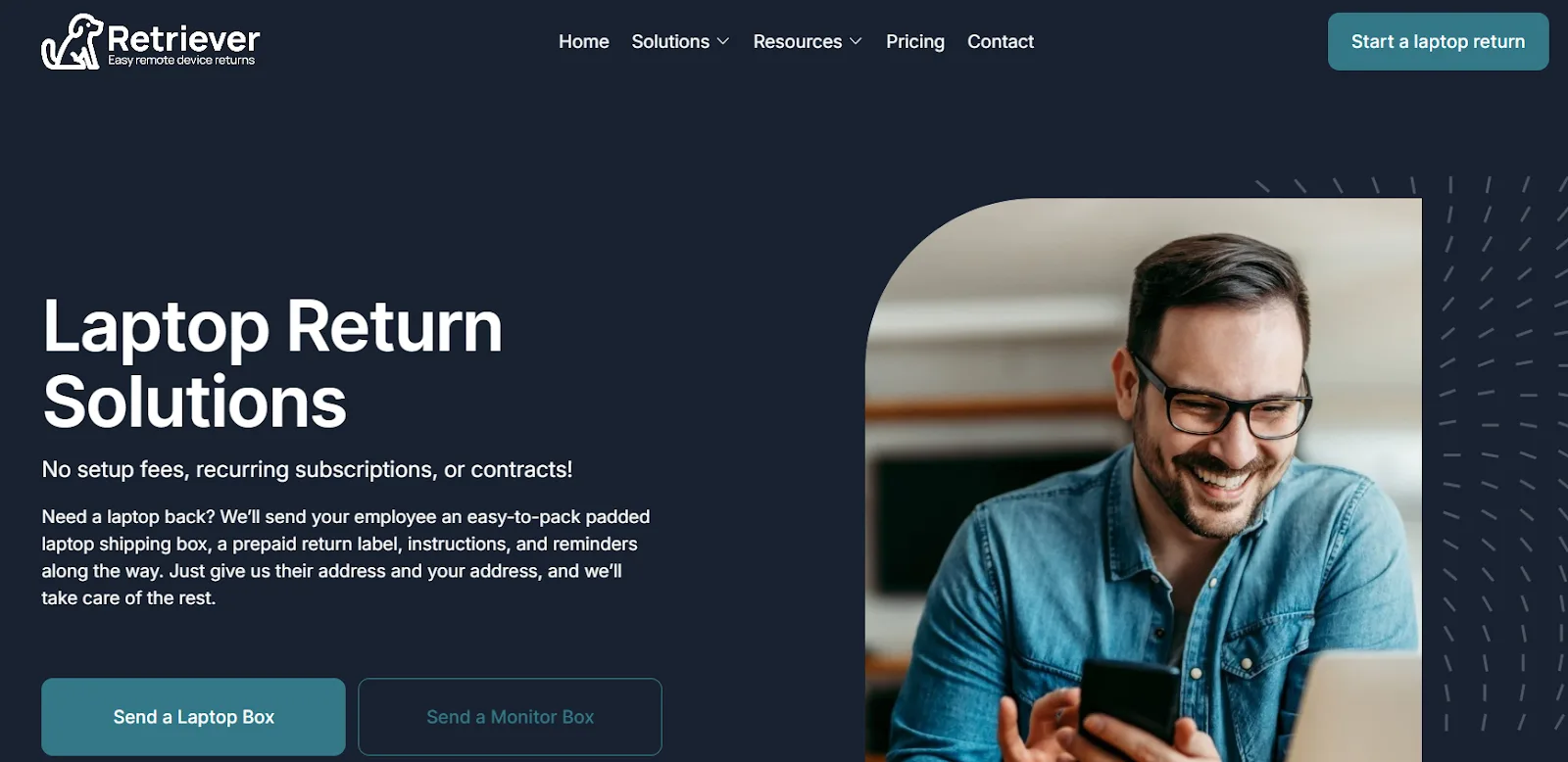
Hello Retriever focuses on getting company laptops back from remote employees with less manual follow-up. The service sends a padded return box, includes a prepaid label, shares instructions, and reminds employees until the device is returned.
By contrast, platforms such as Firstbase extend beyond retrieval into broader lifecycle workflows like storage, redeployment, and device management, which matters more for teams standardizing the full asset journey.
Key strengths:
- Prebuilt return workflow: Submit employee and return addresses, and Hello Retriever handles box shipment, return label, and follow-up.
- Fast shipment setup: Return kits ship within one business day for offboarding spikes or urgent recovery.
- Clear return visibility: Track from box shipment through device delivery with operational visibility.
- Services beyond the box: Warehousing, redeployment, certified data destruction, and disposal support.
Tradeoffs
Billing flexibility looks limited. Some users report having to buy credits upfront rather than paying through a simpler recurring billing model.
ReReady
ReReady focuses on simple laptop return logistics with a cost-driven approach, built to reduce the time and administrative work associated with returns from remote employees.
Compared with broader platforms that connect retrieval to storage, redeployment, or asset control, ReReady stays focused on the handoff and return workflow itself. That narrower scope suits teams that want a simpler return process.
Key strengths:
- Lower operational lift: Positions the workflow as a two-minute task instead of hours coordinating each return manually.
- Managed shipping workflow: Handles boxes, labels, postage, and outbound or return shipments on the customer's behalf.
- Exception handling: Monitors shipping delays, failed delivery attempts, return-to-sender events, and customs issues.
- Flexible order controls: Reminders, signature requirements, pickup scheduling, tracking updates, and webhook-based status visibility.
Tradeoffs
Stays narrow: limited to laptops, constrained geographic coverage, and pickup scheduling adds extra cost on top of the base return price.
Unduit
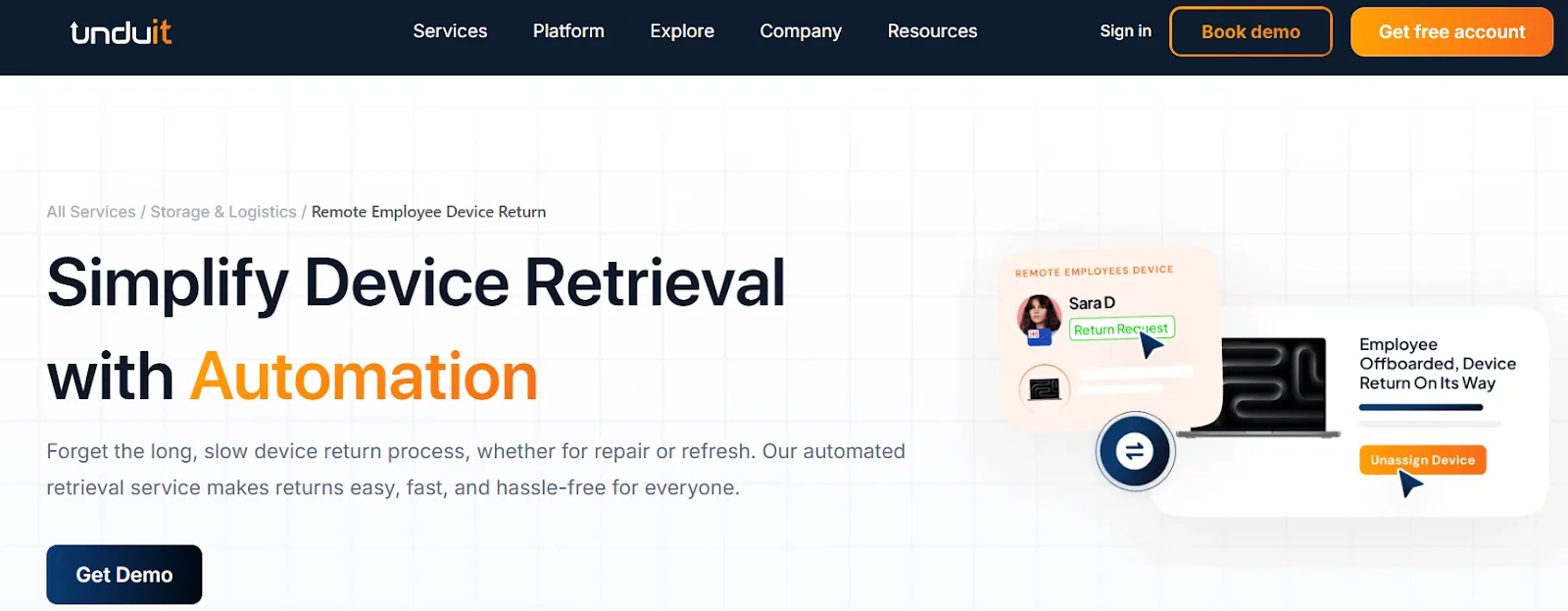
Unduit approaches retrieval as one part of a larger IT asset operations model, connecting recovery with provisioning, storage, refurbishment, disposal, and resale.
For teams comparing options such as Firstbase, the key difference is scope. Unduit leans harder into asset retirement, remarketing, and warehouse-led inventory workflows across the device lifecycle.
Key strengths:
- Asset recovery at scale: Supports remote employee returns and broader global IT asset recovery programs across offices and refresh cycles.
- Post-return value recovery: Links retrieval to buyback, remarketing, refurbishing, and redistribution.
- Retirement and compliance services: Certified data erasure, device disposal, lease return management, and R2 recycling.
- Warehouse-backed inventory support: Secure storage, inventory tracking, packing, shipping, and reallocation.
Tradeoffs
Some users point to heavier setup work and frequent reliance on support for inventory tasks. Resale pricing and reporting are less flexible than some teams need.
Remote Retrieval
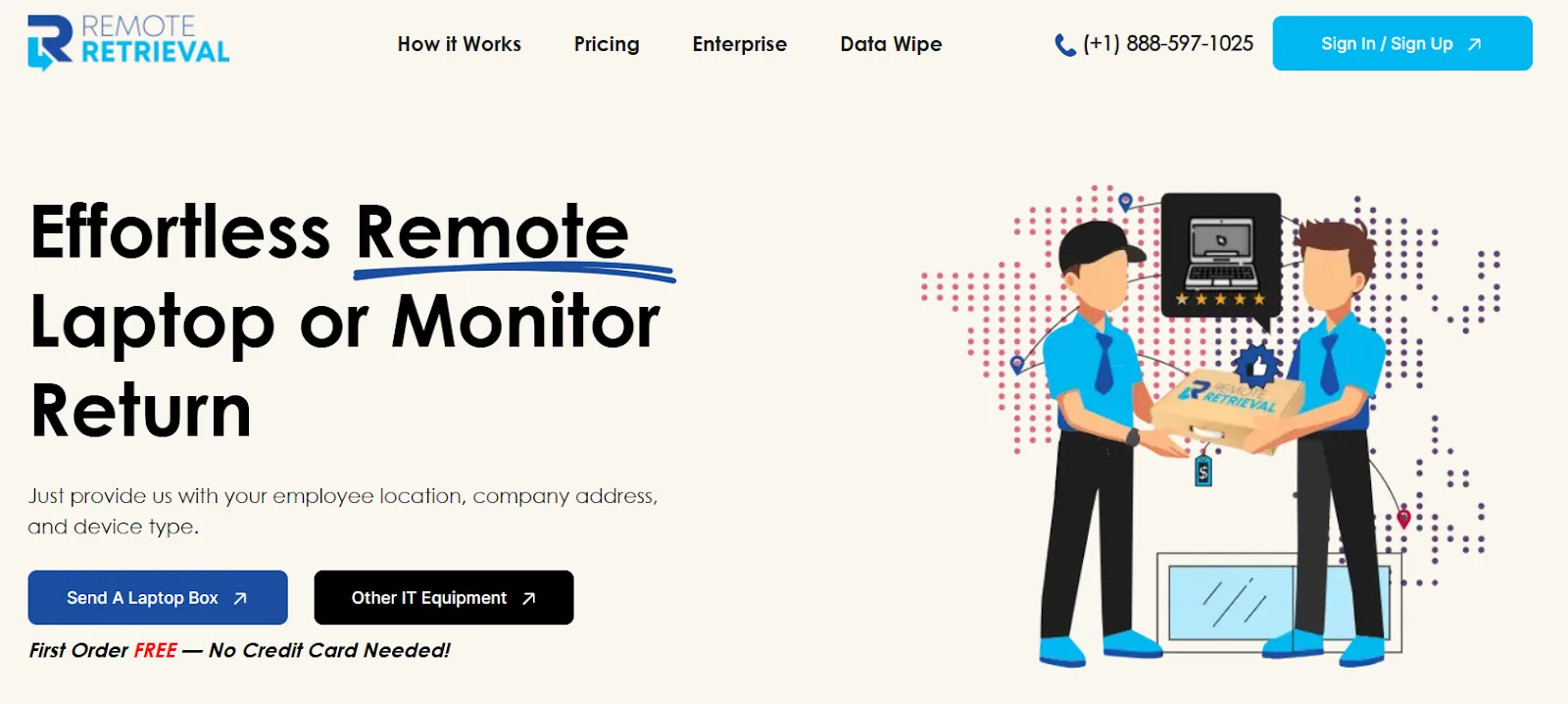
Remote Retrieval is built for straightforward equipment return logistics, with a focus on laptop and monitor recovery from remote employees.
Compared with platforms such as Firstbase or Unduit, Remote Retrieval stays closer to the shipping and collection layer, making it more relevant for teams prioritizing quick returns over downstream asset workflows.
Key strengths:
- Fast kit dispatch: Return boxes ship within 24 hours for offboarding waves or replacement cycles.
- Bulk order support: Enterprise options for centralized coordination across teams, offices, or multi-location rollouts.
- Workflow integrations: API and marketplace integrations for launching bulk retrieval orders from existing systems.
- Multi-team fit: Positioned for IT, HR, admin, and finance teams that need simpler coordination.
Tradeoffs
More limited for global programs. International reach is narrower, and reporting is lighter with email tracking instead of deeper dashboard visibility.
Growrk
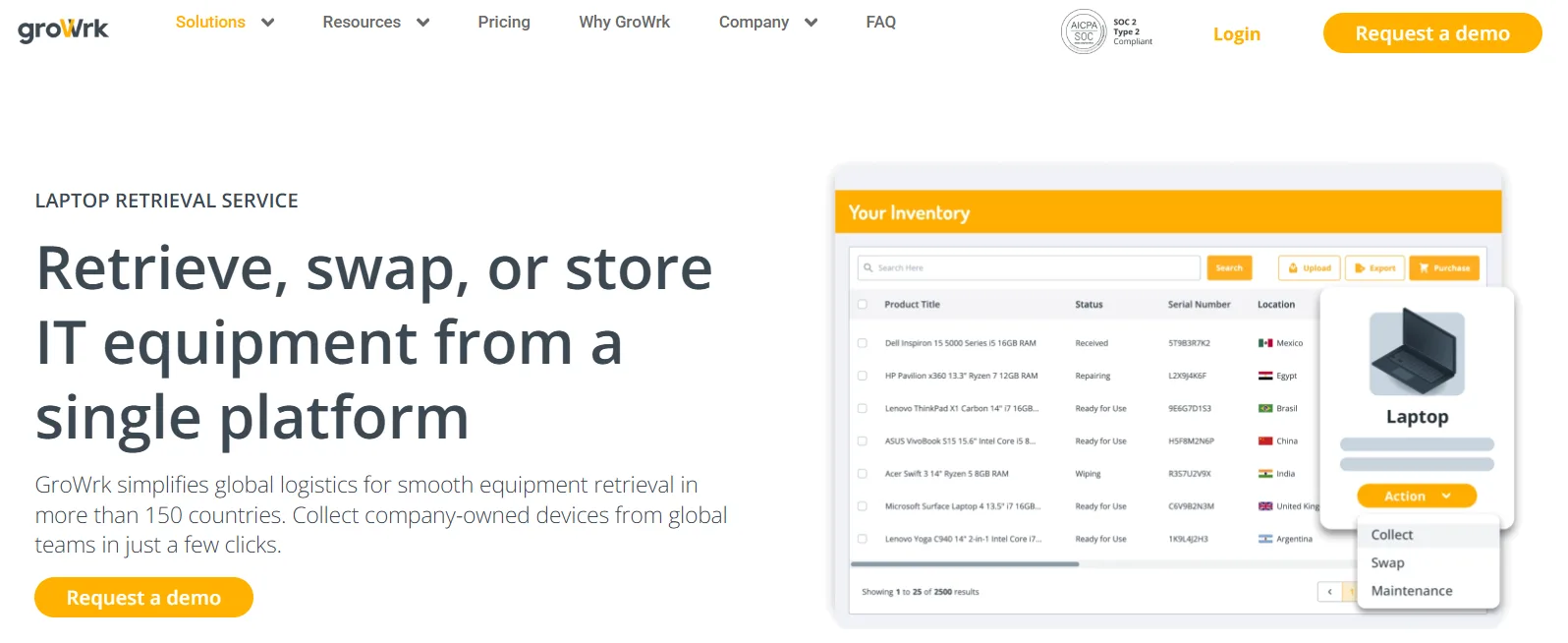
Growrk positions retrieval as part of a wider global device operations model, supporting storage, redeployment, procurement, device servicing, and end-of-life handling alongside collection.
Unlike platforms focused on a single return event, Growrk puts more weight on what happens after recovery, especially when teams need to reuse, reassign, or retire hardware across distributed regions.
Key strengths:
- Global reach: Retrieval, swaps, and storage in 150+ countries for distributed recovery programs.
- Post-return servicing: Cleaning, repairs, reconfiguration, and hard drive wiping before devices are reused.
- End-of-life options: Certified disposal, recycling, donation, and buyback support for retired assets.
- MDM and deployment support: Zero-touch deployment, remote access, SSO, and MacOS/Windows/Linux compatibility.
Tradeoffs
Some users report slow dashboard updates, repeated follow-ups after data entry, and longer shipping timelines. Pricing feels higher than expected.
Iron Mountain
Iron Mountain approaches device retrieval from a security and asset lifecycle angle. The service covers pickups from homes, offices, and distributed sites through a portal or API, with standardized pricing and tracked transport.
The platform puts more emphasis on what follows retrieval, including NIST 800-88 data sanitization, serialized audit reporting, remarketing, and sustainability reporting.
Key strengths:
- Enterprise-grade chain of custody: Secure packaging, tracked transport, and tighter handling controls across retrieval workflows.
- Portal and API access: Launch retrievals with a few clicks rather than managing requests through manual coordination.
- Audit-ready documentation: Serialized sanitization certificates for stronger compliance support.
- Remarketing and circular lifecycle: Reuse, resale channels, and sustainability reporting tied to environmental outcomes.
Tradeoffs
Built for enterprise programs, may feel heavier for simple returns. Pricing is customized, and its 30+ country footprint is narrower than some providers.
What to look for in a laptop retrieval service
Not all laptop retrieval services solve the same problem. Most focus on shipping. But what you actually need is one that reduces loss, protects data, and improves device ROI after return. If you are evaluating vendors, measure them against outcomes that affect IT, Finance, and Security.
1. Retrieval rates you can verify
Many enterprises retrieve only 50 to 60% of laptops. Firstbase reports over 97% retrieval rates, with automated address confirmation and tracked returns that close the loop within 30 days. If the service cannot show the retrieval rate and click-to-return time, you are buying logistics, not control.
2. Unified asset visibility across teams
Inventory gaps drive write-offs and surprise purchases. Gartner noted that 30% of enterprise IT assets were unaccounted for. Firstbase customers achieved 1.8x better asset tracking through centralized lifecycle visibility. A strong platform must track returned, redeployable, and legacy assets in one system.
3. Time and headcount efficiency at scale
It takes about five IT hours per year per remote worker to manage end-user computing logistics, or 5,000 hours per 1,000 employees. Firstbase customers support large fleets with lean teams, including IT procurement specialists overseeing roughly 4,000 laptops.
4. Certified data erasure and chain of custody
You need NIST 800-88 compliant wiping, serialized certificates, and a documented chain of custody. Firstbase performs compliant data erasure and auto-matches certificates of destruction to asset records for audit verification.
5. Financial recovery and redeployment outcomes
Losing 45 laptops per year at $1,500 each costs $67,500 annually. Firstbase connects retrieval to refurbishment, resale credits, and redeployment, reducing new purchase orders and improving budget predictability.
Why Firstbase is the better long-term fit
At this point, the choice comes down to scope. If you are still comparing laptop retrieval services on boxes, labels, and reminders, you are missing the bigger operational question.
The better bet is a platform that helps you recover devices, protect value, and move assets into their next stage without adding manual work across teams.
That is where Firstbase pulls ahead of point solutions. It gives you one system for retrieval, redeployment, compliance, and cost control. Firstbase customers see retrieval rates 1.6 times higher than average, and many cut IT workload by 50%.
Written by
Ahmad Zakaria
Ahmad Zakaria covers IT operations, hardware lifecycle management, and distributed workforce solutions at Firstbase. His content is built from real customer data, operator interviews, and hands-on experience managing devices across 150+ countries.
Get started with
Firstbase today
Remote and hybrid work aren't going anywhere. It's our mission to make it easier to manage the assets your distributed team needs—from onboarding through offboarding and every repair, replacement, and upgrade in between.
Fill out the form and a member from our team will reach out by phone!
Get a Live Demo