Best Equipment Inventory Software
Best Equipment Inventory Software for Global Logistics - 2026
 Chris HerdDecember 9, 2025
Table of contents
- TL;DR: The best equipment inventory software at a glance
- Why Legacy Inventory Tools Fail Remote-First Teams
- How the top equipment inventory management software stacks up (and where they stop short)
- Blueprint for a discovery-to-doorstep workflow
- Simplify procurement-to-retrieval operations with Firstbase
Your IT teams know how many laptops they’ve issued. But can they guarantee that those laptops will show up on time, reach the right country without getting stuck in customs, or make their way back after offboarding?
The “inventory” is visible, but the logistics behind it (procurement, shipping, retrieval, and redeployment) aren’t. That’s the half of asset management that most tools never solve. You cannot expect your equipment inventory software alone to manage all your assets. It cannot account for the entire lifecycle and logistics.
That gap has widened as remote and hybrid work has become permanent. 56% of employees work in a hybrid setup, and seven out of them work permanently from home. So, every one of those laptops, monitors, and peripherals sitting in homes across countries represents real money, compliance exposure, and time that IT can’t afford to waste.
Inventory visibility alone doesn’t solve that. In this guide, we’ll show you the other half of asset management and how platforms like Firstbase solve it across 150+ countries through their warehousing. You’ll also get to compare five other platforms side by side to make an informed decision.
Disclaimer: As the creators of Firstbase, we’re deeply invested in solving global device logistics. That said, this guide aims to provide a fair, research-backed view of leading hardware inventory management software. Our goal is to help you compare options clearly, understand where Firstbase adds the most value, and identify where another tool might suit your setup better.
TL;DR: The best equipment inventory software at a glance
| Platform | USP | Pricing | SLA-backed global logistics | Best for |
|---|---|---|---|---|
| Firstbase | Discovery-to-doorstep device logistics with booking, tracking, and retrieval workflows | Transparent per-seat pricing (no surprise costs) | Yes, 48-hour delivery and pickups | Distributed teams that need customs, shipping, and compliance managed |
| ServiceNow | ITSM-native HAM with deep workflows (stockrooms, staging) | Not transparent | Not guaranteed | Enterprises standardizing ITSM and asset workflows globally |
| Rippling | HR-driven device automation with zero-touch setup and integrated support | Not transparent | Not guaranteed | Fast-growing teams that want device ops triggered by HR workflows |
| Deel IT | All-in-one ITAM + security + 24/7 IT support and remote troubleshooting | Starts at $10/user/month | Not guaranteed | Companies wanting one vendor for procurement, security, and IT helpdesk |
| SolarWinds | Discovery, configuration/patching, and network visibility via agents | Starts at $39/technician/month | Not guaranteed | Infra-heavy environments prioritizing visibility and configuration |
Teams using Firstbase save over 700 IT hours annually, cut retrieval delays by 30+ days, and recoup an average of 1.5× more devices for reuse. Take a self-guided tour to see how predictable, SLA-backed global logistics can simplify your IT operations.
Quick-fire FAQs: What prospects ask next
1. Will customs delay our retrievals?
“One of our laptops has been stuck in French customs for three weeks.”
– Head of IT, UK gaming studio
Firstbase handles duties, customs documentation, and pre-cleared logistics. We back retrievals with 48-hour pickup SLAs in 150+ countries and maintain a 97% on-time rate.
2. Does the pricing balloon as we scale?
“We were spending more on freight and storage than on the devices themselves.”
– HR Lead, SaaS scale-up
Firstbase uses a one-per-seat rate that includes hardware, shipping, wipes, storage, and resale—no surprise fees or extra ops work.
3. Can we prove compliance during audits?
“Our auditors want SOC 2 and 27001 proof with traceable chain-of-custody.”
– Ops Director, AI startup
Every lifecycle event from shipment to certified wipe has a timestamped log and a custody trail. Logs for every lifecycle event are export-ready and aligned with SOC 2, ISO 27001, GDPR, HIPAA, and NIST 800-88.
Why Legacy Inventory Tools Fail Remote-First Teams
Inventory dashboards were built for environments where IT could walk to a storage closet, unbox a laptop, and hand it to a new hire. That model collapsed the moment teams transitioned to remote work.
Today’s challenge is delivering and retrieving devices at scale.
The logistics gap
Even the best inventory management solutions stop at recording and alerting. They don’t arrange shipping, manage bonded storage, or handle regional VAT differences. Only 51% of IT teams report strong collaboration with Finance, which explains why equipment costs so often overrun budgets.
Hardware-related downtime costs employers about $4,000 per employee each year.
Most of that loss is the hours spent chasing shipments, waiting for replacements, and filling ticket queues. Across hundreds of distributed companies, IT teams spend roughly 500 hours per 100 remote employees on manual logistics, like courier coordination and customs paperwork.
The productivity and compliance cost
Remote asset management affects retention, compliance, and total cost per seat. It costs 6-9 months of pay to replace a salaried employee, so every poor onboarding experience is a measurable liability. Add unretrieved hardware, and the problem compounds. Many organizations recover only half of the laptops deployed to remote workers.
For a finance lead, that’s depreciation and replacement costs. For IT, it’s wasted hours. For HR, it’s a day-one experience that quietly undermines culture.
Legacy inventory tools weren’t built to connect those dots. They show you where assets are, but not how to keep them moving through the real world.
How the top equipment inventory management software stacks up (and where they stop short)
Beyond visibility, companies today need a logistics layer that works globally, across tax codes, compliance zones, and return windows. Let’s see if the best equipment inventory tools deliver that.
Firstbase
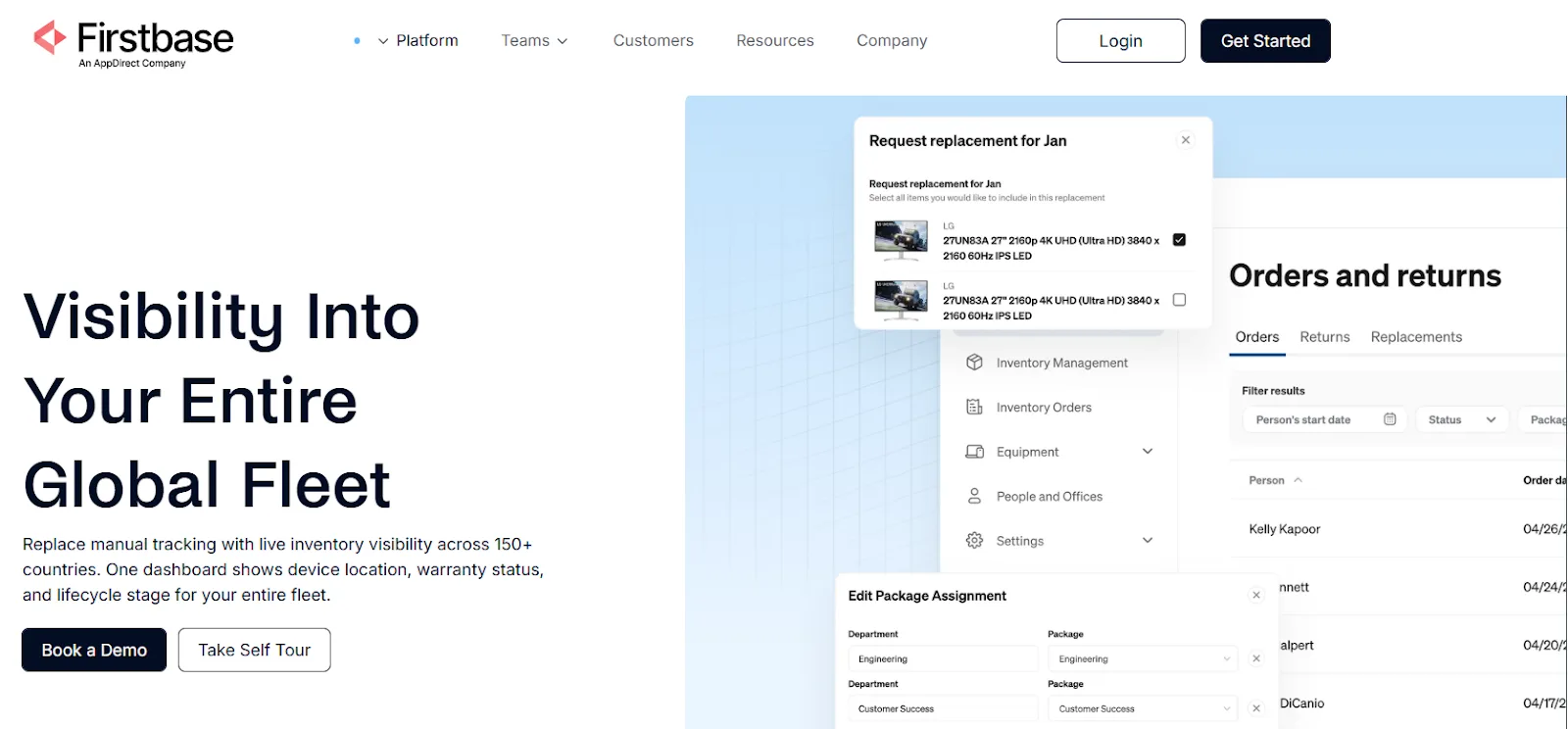
Firstbase was designed for distributed companies worldwide. Instead of acting as another asset tracking dashboard, it connects real-world logistics with IT, HR, and Finance workflows. The platform handles everything from procurement to retrieval.
Its hybrid-work foundation means IT teams no longer need to juggle couriers, customs brokers, or imaging scripts. Devices arrive fully configured, tracked, and insured. Every shipment and return is logged automatically, generating an audit trail for compliance and cost control.
The impact is measurable: customers like Cresta and Earnest Analytics have reported saving over 250 IT hours annually, doubling team coverage, and maintaining retrieval success rates above 97%.
For HR and Finance, this translates into faster onboarding, predictable per-seat spend, and fewer basic tickets.
What works?
- Virtual IT closet: Pre-approved, role-specific device catalog that employees can self-order from, reducing IT fulfillment tickets to zero.
- Global warehousing: Bonded warehouses in 150+ countries enable 48-hour delivery and retrieval, even during customs delays.
- Zero-touch provisioning: Devices arrive ready to use, imaged and secured via Apple and Windows zero-touch workflows.
- Integrated HRIS & MDM sync: Real-time updates between platforms like Okta, JumpCloud, and Rippling cut onboarding from two months to two weeks.
- Automated retrieval and ITAD: Certified NIST 800-88 data wipes and certificates of destruction for every retired asset.
- Per-seat pricing model: Predictable billing that includes shipping, storage, and duty costs, giving Finance total TCO clarity.
- End-to-end compliance: SOC 2 Type II, GDPR, and CCPA compliance with full custody logs.
- Sustainability and reuse: Returned devices are repaired and redeployed through vendor-agnostic resale programs, reducing e-waste.
What doesn’t work?
While Firstbase covers the full logistics chain, users have noted they’d like more granular audit-logging capabilities within the dashboard for deeper compliance tracking. The team continues to expand those controls based on feedback from the enterprise.
ServiceNow
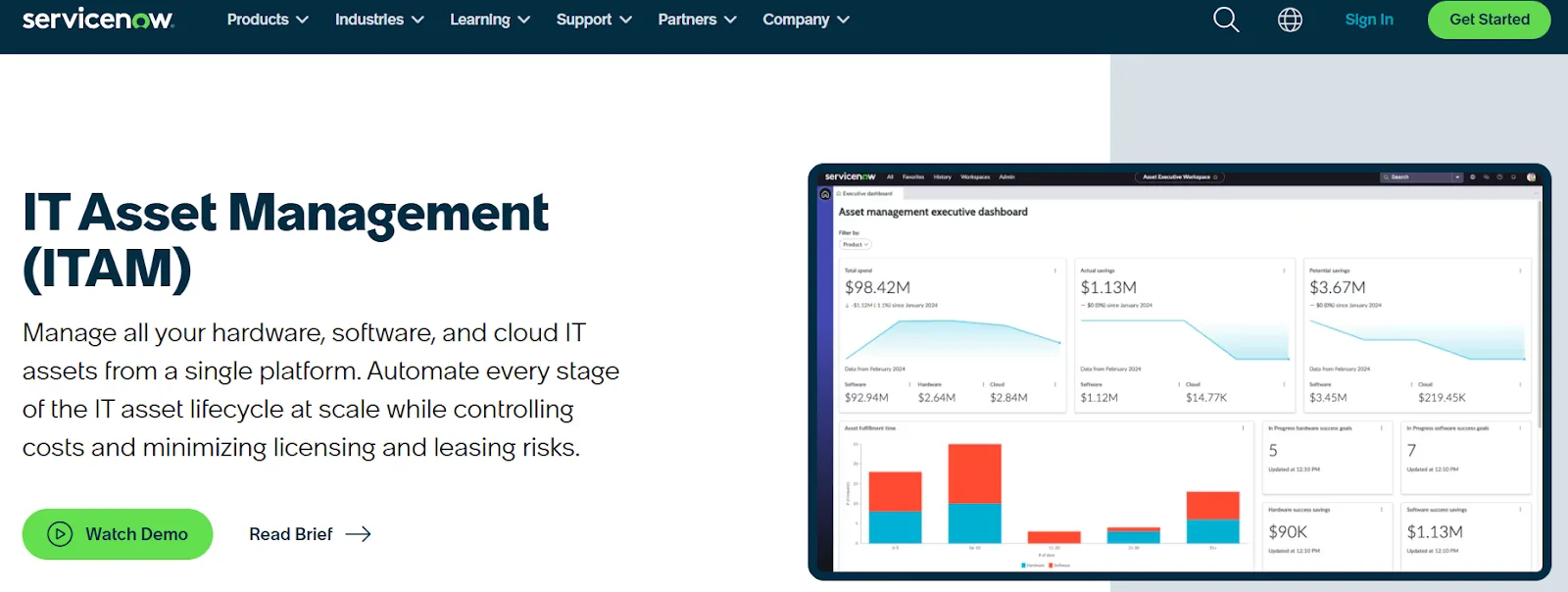
ServiceNow’s Hardware Asset Management (HAM) module extends the Now Platform to automate inventory orchestration, lifecycle tracking, and hardware refresh cycles across distributed locations. It helps large enterprises manage procurement, stock levels, and disposal through a unified, workflow-driven system.
Employees can order assets through a self-service catalog, while IT monitors shipments, stock transfers, and depreciation. The system integrates with ERP and procurement software for financial reconciliation and uses mobile scanning for real-time updates.
However, ServiceNow’s strength lies in data orchestration, not logistics execution. It coordinates who should do what, but doesn’t physically handle how devices get to or from employees, an area where Firstbase bridges the gap.
What works?
- End-to-end lifecycle tracking: Connects procurement, refresh, and disposal workflows through automated tasks. Supports asset aging rules and zero-touch refresh cycles.
- Stockroom and warehouse management: Offers granular location data (aisles, pallets, buildings) with mobile scanning for audits and reconciliations.
- ERP and procurement integrations: Bi-directional integration keeps purchase, depreciation, and service contract data aligned with financial systems.
- Employee self-service catalog: Empowers users to request and track approved assets through a consumer-grade interface. Integrates with shipment APIs for real-time delivery tracking.
What doesn’t work?
ServiceNow’s licensing scales with asset count, making it cost-prohibitive for large hardware fleets. Several users report that core versions lack advanced automation available in Pro tiers, and workflows often require customization or experienced admin oversight.
Rippling
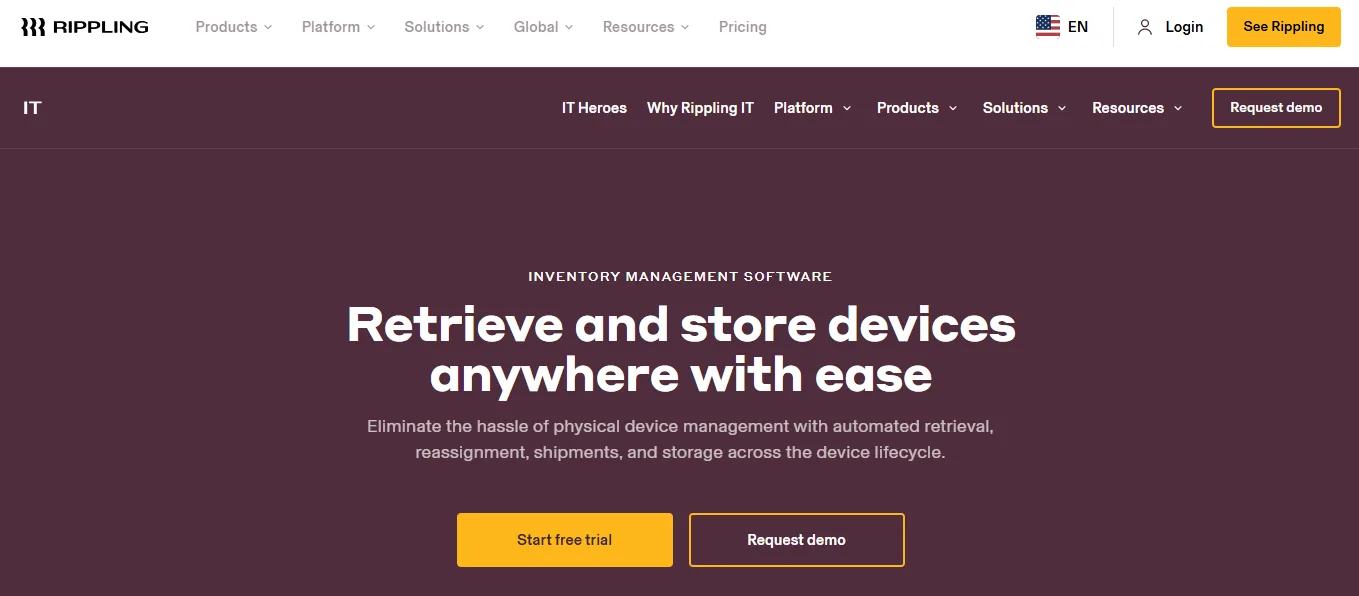
Rippling connects device lifecycle management directly to HR and IT operations. When a new hire is added, the system automatically assigns a pre-configured laptop, ships it, and syncs access controls based on role and location.
When an employee leaves, Rippling ships a return box, tracks the device, wipes it, and stores it securely for reuse. Its global warehouse network helps eliminate the need for local IT closets, while HR integration ensures every action (onboarding, offboarding, reassignment) happens automatically.
Where Firstbase extends this idea is by adding borderless logistics handling customs, bonded storage, and prepaid duties across 150+ countries, which Rippling doesn’t yet offer at scale.
Key features
- Integrated HR-device automation: Syncs hardware assignment and retrieval with HR events, eliminating manual coordination between HR, IT, and procurement.
- Secure offsite warehousing: Returned devices are professionally wiped, tested, and stored for redeployment, minimizing idle assets and on-site storage costs.
- Zero-touch deployment: Ships new or reassigned devices fully configured with apps and security profiles; integrates with SentinelOne for endpoint protection.
- Global visibility dashboard: Offers real-time reporting on device condition, location, and stock levels, with automated alerts for low inventory or aging assets.
Limitations
Rippling’s automation is powerful, but it tends to focus on HR workflows rather than global logistics. It doesn’t manage bonded storage, customs, or per-seat financial modeling like Firstbase.
Some users note the setup complexity for advanced rules and slower support response times during periods of scaling.
Deel IT
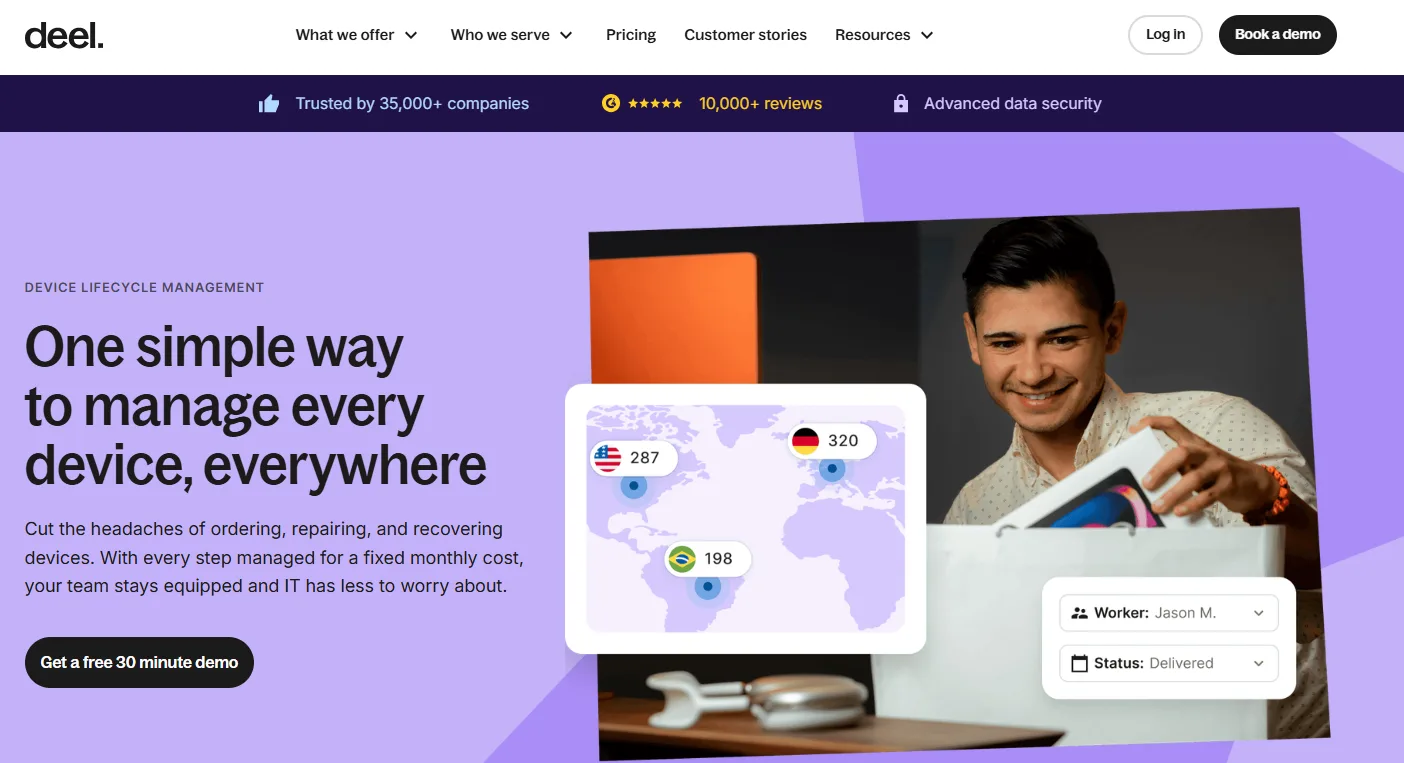
Deel IT combines hardware lifecycle management, device security, and 24/7 global IT support in one system. It automates everything from procurement to disposal: buying, leasing, configuring, tracking, and retrieving laptops with built-in compliance.
Devices can be shipped pre-configured to new hires or retrieved, wiped, and resold when offboarded, all managed through Deel’s centralized dashboard.
The platform excels in breadth, covering procurement, visibility, and security, but operates within Deel’s HR and payroll ecosystem. Compared with Firstbase, Deel IT provides broad coverage and support but less specialization in customs handling, bonded warehousing, or per-seat cost modeling for finance teams.
Key features
- Global device lifecycle automation: Procures, configures, deploys, retrieves, and securely disposes of hardware across 130+ countries.
- Real-time asset visibility: Central dashboard tracks every device’s condition, location, and compliance status, giving IT full oversight over distributed inventories.
- Built-in security and compliance: Remote lock, wipe, and encryption enforcement meet global standards such as GDPR and SOC 2, ensuring secure asset retirement.
- 24/7 IT support and maintenance: Deel provides round-the-clock helpdesk coverage for troubleshooting, repairs, and replacements, reducing internal IT load and downtime.
What doesn’t work?
Some users find Deel’s interface unintuitive and its reporting tools limited in customization or export flexibility. While it manages global scale well, its IT automation is tied to Deel’s HR framework, less modular than Firstbase’s independent, finance- and compliance-driven lifecycle engine.
SolarWinds
SolarWinds offers an IT asset and network inventory suite built primarily for infrastructure-heavy environments. Through its Service Desk, Patch Manager, and Network Configuration Manager (NCM), the platform automates discovery, inventory tracking, and configuration monitoring across servers, PCs, and network devices.
IT teams use it to maintain up-to-date records, detect configuration drift, and plan hardware refreshes with data-driven insights.
SolarWinds excels in visibility across networks and on-prem assets, but isn’t optimized for remote or hybrid logistics.
Unlike Firstbase, it doesn’t handle end-user hardware delivery, customs, or retrieval workflows; its strength remains in data and system-level control, rather than physical asset movement.
What works?
- Automated asset discovery: Scans and catalogs every device, like servers, workstations, VMs, and peripherals, across multi-site networks, maintaining a live asset inventory.
- Configuration change tracking: Monitors and compares hardware and software changes to detect version drift or unapproved modifications across systems.
- Patch and compliance management: Centralizes patching for both Microsoft and third-party applications, with built-in reporting for compliance visibility.
- Integrated ITSM and reporting: Links asset data to incidents and changes through Service Desk, with customizable reports for warranties, contracts, and device health.
What doesn’t work?
Users also report limited automation flexibility, dated mobile support, and slow customer response times. It lacks built-in retrieval, shipping, or warehousing capabilities, making it less suited for distributed or remote-first teams, compared with unified lifecycle platforms like Firstbase.
Freshservice
Freshservice is an ITSM-first platform with enterprise IT asset management built in. It discovers hardware, software, SaaS, cloud resources, and non-IT assets, then ties that inventory to incidents, problems, changes, and contracts for a single source of truth.
A modern CMDB with dependency mapping helps teams assess impact and plan changes. Procurement, renewals, and lifecycle actions (from onboarding to retirement) run inside the same workspace, and the Freddy AI layer surfaces related incidents to speed resolution. This is strong for visibility and governance.
Compared with Firstbase, Freshservice does not execute global device logistics (procurement, shipping, retrieval, customs) itself.
What works?
- Advanced discovery + CMDB: Agent/agentless discovery across on-prem, cloud, SaaS, and non-IT assets, with relationship/dependency mapping for impact analysis.
- Integrated procurement and contracts: Purchase orders, vendor management, and renewals in one flow; one-click inventory replenishment and audit trails.
- Unified lifecycle operations: Track value, warranties, and status from request to retirement; barcode/QR scanning and mobile receipt for non-pingable assets.
- ServiceOps automation and AI: Workflow automator, orchestration center, and Freddy AI suggestions to speed ticket handling and reduce downtime.
What doesn’t work?
Initial setup for advanced workflows can be heavy without a dedicated admin. Some users note gaps in automation flexibility, reporting depth, and mobile capabilities for managers. Support can lag on complex integrations.
Blueprint for a discovery-to-doorstep workflow
Now that we’ve seen how different platforms compare, let’s break down the process step by step, using the Firstbase model: from discovery to delivery, and back again.
Step 1: Auto-discover asset
Firstbase connects to your HR and identity systems to detect changes like new hires, role moves, or exits. When a hire is added, the platform automatically identifies available devices or flags what needs to be ordered. That means IT doesn’t have to check spreadsheets or update ownership manually; every asset always has a known user and location.
Step 2: Rule engine triggers shipment
With the Virtual IT Closet, IT sets role-based rules (for example: “Design team, Germany, MacBook Pro 14”). When HR adds a new hire, those rules automatically trigger an order with the right device and accessories. The catalog includes over 1,500 SKUs across countries, showing live prices and warranty options. Finance teams can set spending limits, so no purchase goes beyond policy.
Step 3: Warehouse kitting and duty pre-pay
Once ordered, devices are prepared in a nearby Firstbase warehouse. The team images, configures, and kits them with accessories. Because Firstbase operates bonded warehouses, it pre-pays customs duties and VAT, thereby removing import delays. IT teams don’t have to manage local vendors or brokers, and employees get their laptops ready to use within 48 hours in most regions.
Step 4: Self-service tracking
As soon as the order ships, both IT and the employee get real-time tracking. Employees can confirm addresses, check delivery updates, or report issues through their dashboard. IT can edit or reroute shipments in one place, with every update logged for audit. This keeps shipments transparent and eliminates back-and-forth tickets.
Step 5: Automated retrieval and certified ITAD
When someone leaves, Firstbase automatically sends a prepaid return kit with a label and clear instructions. Returned devices go to the nearest Firstbase facility, where they’re tested, wiped to NIST 800-88 standards, and re-added to inventory. Companies recover about 97% of devices this way. This reduces loss, improves reuse, and keeps data secure.
Simplify procurement-to-retrieval operations with Firstbase
We just saw how inventory alone doesn’t move devices. The real win is a lifecycle loop: Procure, deploy, support, retrieve, and ITAD.
When you evaluate vendors, check for SLA-backed logistics, bonded warehousing and duties/VAT handling, automated retrieval with certified wipes, audit-ready custody logs, finance-friendly pricing, and clean HRIS/MDM integrations. If any link in that chain is manual, day-one readiness suffers, costs drift, and assets go missing.
Firstbase makes sure your team avoids all of that. In fact, customers report having recouped over $ 175,000 from device reuse, with a new-hire experience holding at 98% CSAT.
Book a quick demo, bring your current process, and compare before-and-after in one call.
Written by
Chris Herd
Chris Herd is the visionary founder and CEO of Firstbase, recently acquired by AppDirect, who pioneered the end-to-end hardware provisioning platform now used by tens of thousands of remote employees. Including employees from Spotify, UI Path, Verint and WeWork. With roots in fintech, Chris experienced firsthand the logistical pains of remote hardware management. His company has since scaled, backed by top-tier investors like Andreessen Horowitz and Kleiner Perkins, before its recent strategic acquisition. As an outspoken champion of remote-first culture, Chris continues to shape how companies equip, empower, and trust their distributed teams.
Get started with
Firstbase today
Remote and hybrid work aren't going anywhere. It's our mission to make it easier to manage the assets your distributed team needs—from onboarding through offboarding and every repair, replacement, and upgrade in between.
Fill out the form and a member from our team will reach out by phone!
Get a Live Demo