From Provision to Retrieval: Best Hardware Inventory Platforms for Remote Teams in 2026
Best Hardware Inventory Platforms for Remote Teams in 2026
 Chris HerdDecember 8, 2025
Table of contents
- TL;DR Comparing the best hardware inventory management tools in 2025
- Why legacy inventory tools fail remote-first teams
- Best hardware inventory tools compared
- The lifecycle logistics blueprint every platform needs
- How to evaluate a hardware inventory provider
- Make device management predictable with Firstbase
Every company tracks hardware, but few can account for where it really is. With 67% employees from the tech industry working from home, mobile devices and laptops end up scattered across homes, hubs, and countries. And each one carries cost, risk, and compliance weight that most hardware inventory management software can’t track, especially when inventory data lives in different tools instead of one system.
As long as companies think tracking means “knowing who owns”, it’s hard to prevent the freight costs, data exposure, and lost resale value that come with unreturned laptops.
In this guide, let’s see why that gap exists, how global retrievals and customs costs drain IT budgets, and what a true lifecycle platform looks like when it automates everything from procurement to recovery.
We’ll also learn how Firstbase’s prepaid duties and retrieval logistics erase the hidden costs most hardware inventory tools never account for.
Disclaimer: We work closely with teams tackling the same hardware and logistics challenges discussed here. While we know this space inside out, this comparison is built to stay objective. Our goal is to help you see what’s out there and their strengths and their limits so that you can evaluate them with full context.
TL;DR Comparing the best hardware inventory management tools in 2025
| Platform | Transparent pricing | USP | Global logistics + SLAs | Best for |
|---|---|---|---|---|
| Firstbase | Yes, transparent per-seat pricing | End-to-end lifecycle logistics with prepaid duties, retrieval, and resale | 48-hour delivery and pickup SLAs worldwide | Distributed or remote-first companies (50–5,000 employees) |
| Freshservice | Starts from $29/ agent/month | ITSM + asset visibility under one roof | No | Mid-size IT teams wanting unified ticketing + asset view |
| Rippling | Not transparent | Employee-linked inventory and automated onboarding | No | SaaS and fintech firms automating HR + IT ops |
| JumpCloud | $15/user/month | Unified directory + device management | No | Mid-market orgs needing security + compliance tools |
| Lansweeper | €219 / month | Deep device discovery + CMDB intelligence | No | Enterprises with complex hybrid or on-prem networks |
Companies using Firstbase save 250+ IT admin hours and avoid doubling global headcount in their first year. Take the Firstbase self-guided tour to see how much time your team can win back.
Will customs delays or surprise duties derail global deliveries?
Short answer: No. Firstbase pre-pays every duty, tax, and import fee before a device ships, so nothing gets stuck waiting for payment or paperwork. Shipments move through regional hubs and clear customs within 48 hours, which prevents packages from sitting “on hold” or being bounced back.
This keeps delivery timelines steady, even for remote teams spread across strict customs regions.
Why legacy inventory tools fail remote-first teams
Most traditional hardware inventory management systems were built for offices, not for workforces spread across countries. They record the basic inventory tracking like serial numbers and who a device was issued to. But do they move hardware through customs, trigger retrievals at termination, or reconcile duties and taxes? Rarely.
With fragmentation, there’s a wide gap. The average company now runs 100+ apps, so asset data, HR status, and tickets stay in different systems and rarely drive a physical action like a pickup or return label.
Then lost or unreturned devices contribute to security breaches. The average breach now costs $4.88M, and endpoint loss/theft continues to feature in incident chains, meaning every unmanaged laptop is an expensive risk, not just lost capex.
When decommissioned equipment is mishandled, regulators notice. In fact, the SEC fined Morgan Stanley $35M after old drives with customer data were resold.
Finally, offboarding. In remote and hybrid teams, retrieval needs to be triggered by HRIS events, coordinated with carriers, and closed with a wipe certificate. Many legacy tools don’t integrate deeply enough to automate that end-to-end loop, which is why equipment lingers off-network.
If your tool can’t move, retrieve, and wipe data across borders and systems, it will fail remote-first operations.
Best hardware inventory tools compared
Let’s look at the top hardware inventory management tools, with their key features, to avoid the above challenges.
Lifecycle-logistics platform: Firstbase
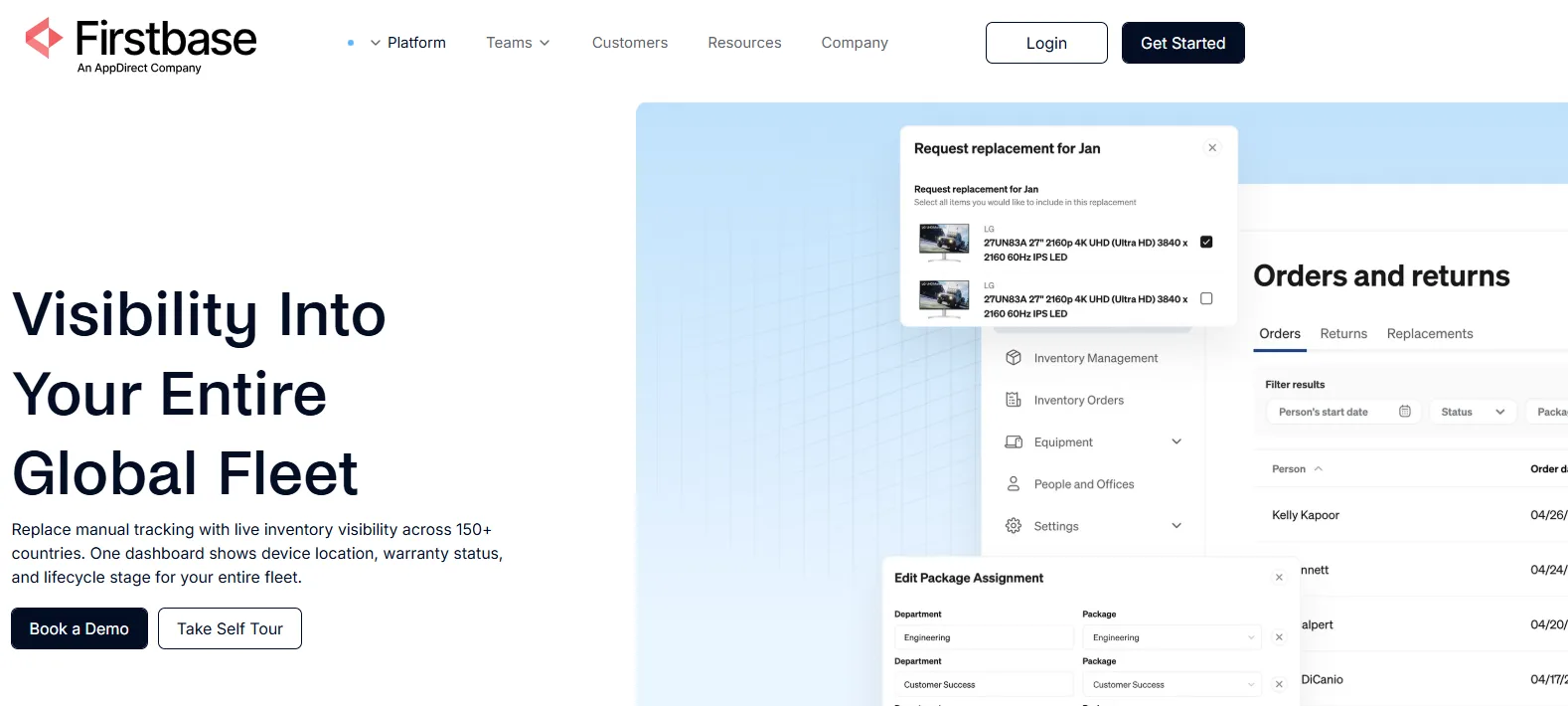
Firstbase gives you a unified platform to manage every stage of hardware operations, be it procurement, deployment, support, retrieval, or certified recycling. Your devices are shipped pre-provisioned from regional hubs within days, already enrolled in MDM, and cleared through customs.
The platform’s automation replaces spreadsheets and manual coordination with a straightforward visibility into asset status, costs, and compliance. Finance teams can plan predictable budgets; HR ensures employees are equipped on day one; and IT gains control without adding headcount.
Beyond tracking, Firstbase enforces data security through verified device destruction and supports circular use through refurbishment and resale credits. It’s an operating backbone for distributed work, allowing teams to scale hardware programs confidently across borders while keeping lifecycle data, logistics, and spend under one system.
Key features
- One-click ship-provisioned workflow: Ships preconfigured, MDM-ready devices worldwide in two days, reducing deployment time by up to 80%.
- Automated lifecycle management: Handles refreshes, retrievals, and inventory thresholds without manual tracking, freeing IT from repetitive updates.
- Unified source of truth: Consolidates all the hardware assets (legacy and new) into a single dashboard with real-time location and condition visibility.
- Budget forecasting: Breaks down asset costs by function and geography for accurate financial planning and predictable spend.
- Self-service marketplace: Lets employees order approved equipment through role-based catalogs with built-in approval flows.
- Zero-touch global deployment: Automates imaging, shipping, and device activation across continents with fallback manual imaging when needed.
- Compliance-ready disposal: Ensures data protection with NIST 800-88-compliant wiping and certified destruction documentation.
- Asset reuse and value recovery: Refurbishes and resells retired devices, generating credits that offset future IT purchases.
Best for
Mid-market and enterprise companies (50–5,000 employees) operating across multiple regions. It’s useful especially for HR, Finance, and IT teams seeking predictable, compliant device management for distributed workforces.
ITSM-Bundled Asset Module: Freshservice
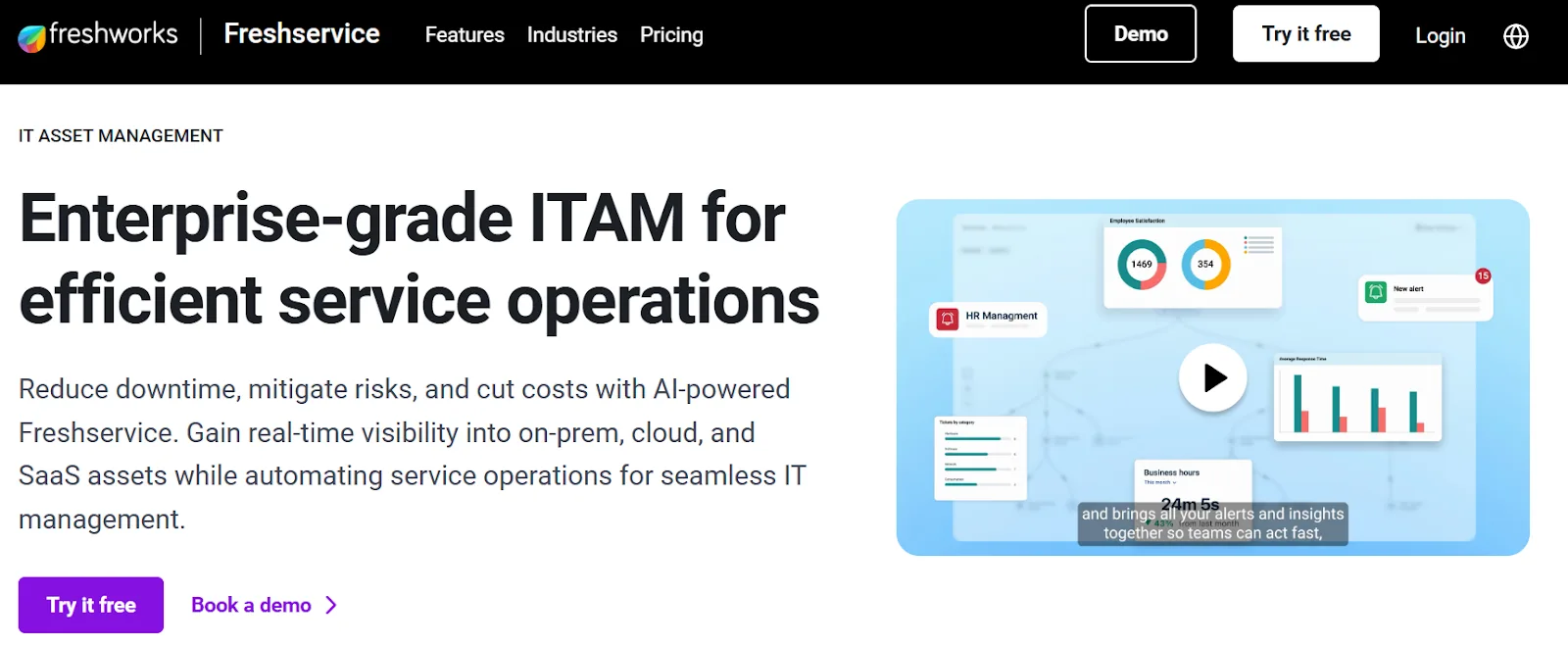
Freshservice gives you both IT service management and asset visibility under one roof, with a clear picture of every hardware, software, and cloud asset in your company. It integrates seamlessly with discovery tools, endpoint solutions, and patch management systems from a marketplace of over 250+ apps.
It is often adopted by teams that already use it for ticketing or mobile device management, and want basic barcode scanning.
The platform connects asset intelligence to service delivery workflows so every ticket, purchase order, and renewal is linked to a live asset record. From procurement to retirement, it helps IT and finance teams track ownership, utilization, and value in real time, all within a single unified dashboard.
Key features
- Centralized hub for all assets: Auto-discover IT, non-IT, SaaS, and virtual assets through native and connected discovery tools.
- Integrated CMDB: Connect assets, incidents, changes, and projects in a single configuration management database
- AI-assisted insights: Help agents prioritize and resolve asset-related tickets faster with Freddy AI through contextual recommendations, prediction, and employee self-service.
- Accurate forecasting: Track depreciation, plan budgets, and monitor asset health for better financial governance.
Best for
Mid-size enterprises with structured ITSM workflows. Serves fast-scaling SaaS, BFSI, and healthcare firms needing tighter alignment between helpdesk operations and IT asset management software.
Workforce suite w/ device add-on: Rippling
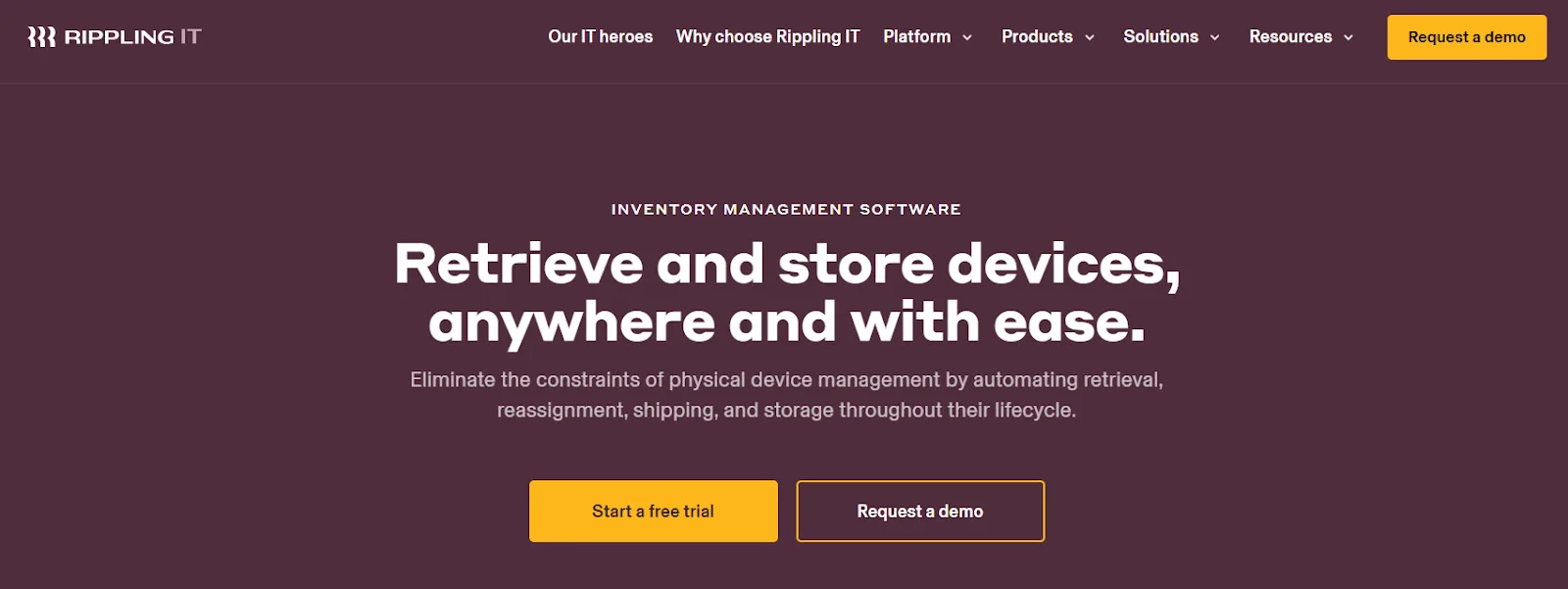
Rippling takes a people-first approach to device management by linking every laptop, monitor, and peripheral directly to an employee profile. Rather than juggling separate HR, IT, and MDM tools, the platform unifies them under one system. Devices are automatically assigned, configured, and shipped when someone joins and retrieved just as easily when they leave.
Its global warehouse network handles storage, wiping, and refurbishment, eliminating the need for on-site IT closets. This integration turns what’s usually a manual, error-prone process into an automated, employee-centric workflow that scales across distributed teams and multiple regions.
Key features
- Zero-touch device onboarding: Ship pre-configured, role-based devices with one click, synced to new-hire workflows.
- Automatic offboarding and retrieval: Send retrieval kits with prepaid shipping, boosting return rates and eliminating FedEx runs.
- Global warehousing and refurbishment: Secure offsite storage where returned devices are wiped, tested, and redeployed.
- Inventory monitoring and reporting: Real-time visibility into device condition, shipment status, and reassignment readiness.
Best for
Fast-growing SaaS and fintech firms managing distributed teams that need automated onboarding, retrieval, and storage without building internal IT logistics.
Directory / MDM Suite: JumpCloud
JumpCloud brings device management and asset visibility together in a single cloud-based directory platform. Instead of relying on separate tools for inventory, patching, and compliance, it gives IT teams full control over every device—from onboarding to decommissioning.
You can view managed and unmanaged devices, accessories, and peripherals all in one dashboard. By syncing asset data with device management, teams can remotely patch, wipe, or monitor hardware at scale. The result is a unified system that keeps inventory accurate, secure, and compliant across macOS, Windows, Linux, iOS, and Android environments.
Key features
- Device management integration: Syncs directly with JumpCloud Device Management to auto-update records and enable remote actions like patching and wiping.
- Maintenance and warranty tracking: Store invoices, schedule repairs, and track warranty timelines within each asset record.
- Compliance and reporting: Export asset data to demonstrate SOC 2, HIPAA, and NIST compliance with detailed audit trails.
- Proactive monitoring and alerts: Detect system risks, unauthorized software, or offline devices through configurable health alerts and central dashboards.
Best for
IT-driven mid-market organizations in regulated sectors that need unified device control, compliance monitoring, and remote management across global endpoints.
Discovery-first CMDB - Lansweeper
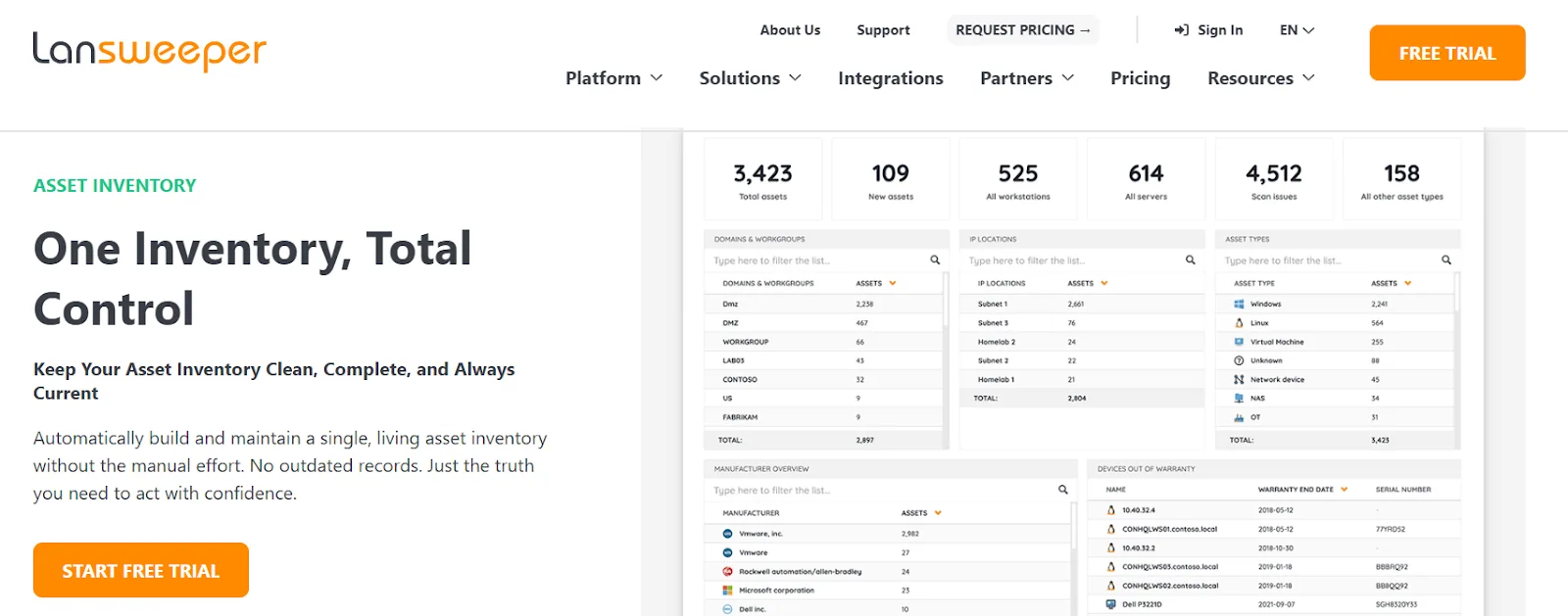
Lansweeper specializes in deep, automated hardware discovery across IT, OT, and cloud environments. This way, it creates a complete, continuously updated asset inventory. Using agent-based and agentless scans, it detects every connected and off-network device, even unmanaged or shadow IT assets.
By bringing together lifecycle tracking, risk visibility, and cost optimization, Lansweeper helps IT and finance teams plan upgrades, reduce waste, and maintain compliance.
Its normalized, relationship-aware data enriches CMDBs, ITSM tools, and BI dashboards. It gives you actionable intelligence from raw inventory that improves incident response, procurement accuracy, and overall operational efficiency across global environments.
Key features
- Data integrity engine: Automatically normalizes, deduplicates, and classifies asset data from multiple sources, keeping the CMDB clean and accurate without manual cleanup.
- Relationship-aware inventory: Maps users, devices, and systems to visualize dependencies, ownership, and lifecycle stages for precise change or incident management.
- Insight dashboards: Creates dynamic reports and BI-ready visuals from hardware data for patch planning, procurement, and sustainability tracking.
- Connected intelligence: Integrates with ServiceNow, HaloITSM, Axonius, and Power BI through APIs to enrich ITSM and automation workflows using complete asset intelligence.
Best for
Large-scale organizations in education, government, or manufacturing sectors. If you’re already managing complex hybrid networks and require precise asset intelligence for compliance, cost control, and sustainability, this platform is for you.
Open-Source / DIY - Snipe IT
Snipe-IT is a web-based IT asset management system built for teams that want full control without vendor lock-in. It offers a clean, centralized dashboard to manage company-owned laptops, accessories, and software licenses.
Admins can easily see who holds which device, track warranty status, and log check-ins or repairs with a single click. Because it’s open source, organizations can self-host or choose cloud deployment, ensuring flexibility and transparency.
With strong API and low-code integration support, Snipe-IT fits easily into existing systems, offering the benefits of enterprise ITAM without the recurring subscription cost.
Key features
- Interactive admin dashboard: Real-time view of assets, accessories, and consumables with full activity tracking.
- License and warranty management: Built-in alerts for expiring licenses and warranties to prevent compliance lapses.
- Integrations and API access: REST API and ready integrations (Jira, Kandji2Snipe, JAMF2Snipe) for custom automation.
- User-centric tracking: Assign assets, capture digital signatures, and track full checkout history from one interface.
Best for
IT-led small to mid-size companies or educational and non-profit organizations needing a transparent, open-source, and self-hostable asset tracking alternative to paid inventory tools.
*To provide a fair and complete view of the landscape, we also reviewed other tools in each category that serve similar use cases. That includes ServiceNow and SolarWinds for ITSM modules, to Deel and Gusto for workforce suites, Okta and Kandji for directory/MDM solutions, Device42 and ManageEngine for discovery-first CMDBs, and GLPI among open-source options. While each has strengths in its niche, the platforms featured above reflect the most relevant choices for distributed and global hardware operations.
The lifecycle logistics blueprint every platform needs
Most of the hardware inventory tools we saw fall into one of the same four buckets: CMDBs, ITSM modules, workforce suites, or open-source trackers. They record what you own, but they don’t handle what happens after a device leaves the warehouse.
None of them manages customs delays, pickup failures, and broken returns altogether. That’s why global teams use Firstbase. The platform comes with software automation with a global logistics backbone to manage the entire hardware lifecycle: procurement, deployment, support, retrieval, and IT asset disposition (ITAD).
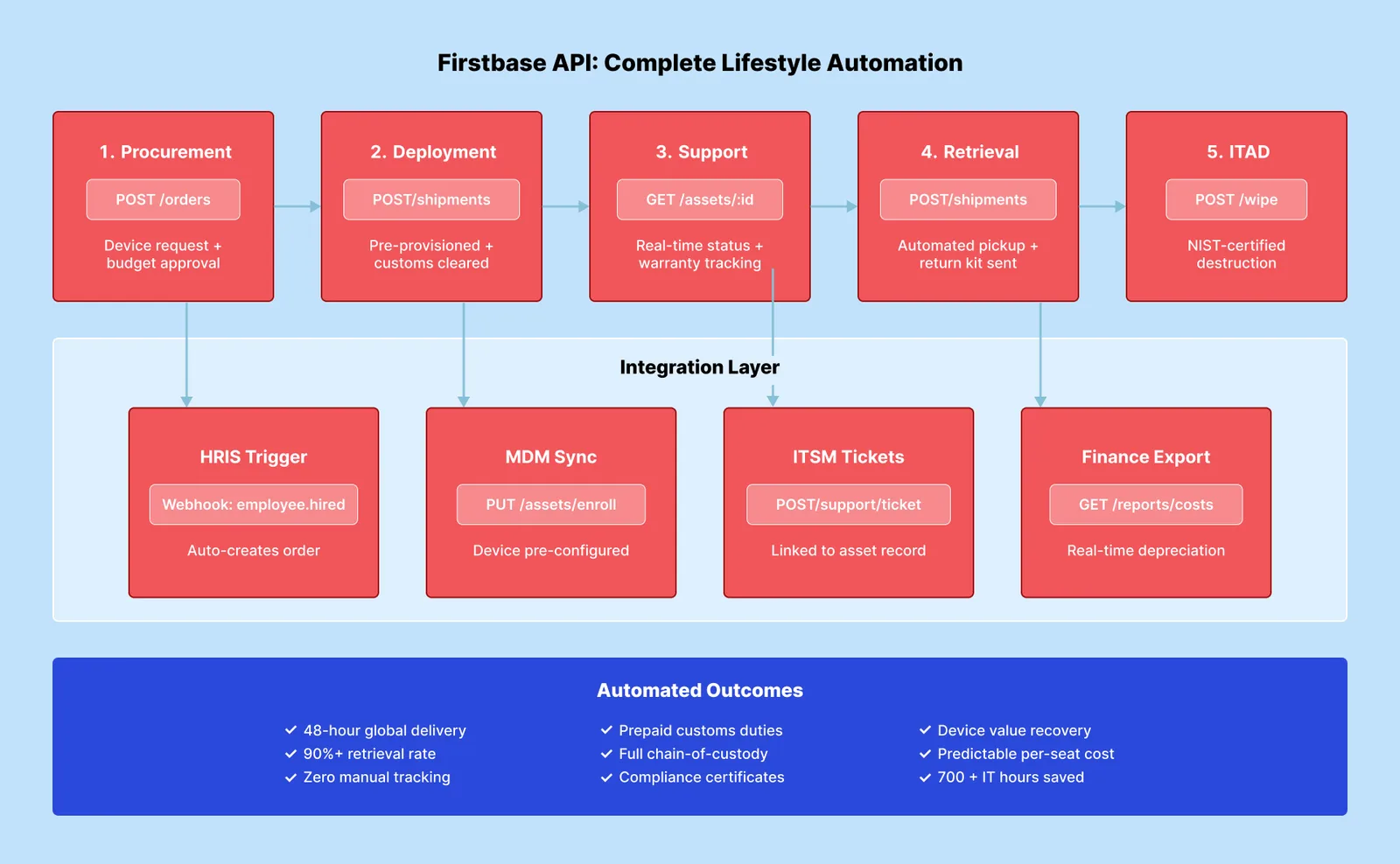
So you’ll not just be tracking what you own but also knowing where it is, who’s using it, and how soon it’ll be back in circulation.
For IT Managers
Your team’s week shouldn’t disappear into shipping tickets and address lookups. With Firstbase, IT finally gets what every support team has been missing: a self-service virtual IT closet. Devices are ordered, shipped, and retrieved automatically through one dashboard.
The result is 1.8 times better asset tracking, 1.6 times faster retrieval rates, and up to 97% of laptops successfully returned within 30 days. Cresta’s IT team, for example, reduced logistics hours by allowing Firstbase to handle retrievals and redeployments.
For Finance Leaders
IT costs shouldn’t surprise you every quarter. Freight spikes, lost assets, and duty fees destroy predictability. Firstbase fixes that with per-seat pricing and global warehouse coverage, so budgets stay steady even as teams expand.
For example, in one M&A scenario, better reuse of returned devices saved over $175,000 in recovered value. Finance teams also gain a real-time view of every device’s location and lifecycle, turning IT into a predictable operating expense.
For HR Ops
Day-one matters. New hires can’t start strong if their laptops are stuck in customs. Firstbase guarantees 48-hour global delivery and pickups through prepaid duties and local warehousing. That means no waiting for tracking numbers or courier follow-ups.
For example, Docebo’s HR team achieved consistent onboarding across 30+ countries, while Verse saved hundreds of hours managing returns and achieved nearly 100% retrieval success.
For security and compliance teams
Security isn’t a post-step in device management; it’s part of the lifecycle itself. Firstbase builds this into every retrieval and ITAD workflow. Every returned device receives a NIST 800-88–compliant wipe with a destruction or erasure certificate attached directly to the asset record.
For audits, teams get SOC 2 Type II, ISO 27001, and GDPR-aligned reporting, plus a full chain-of-custody log showing where an asset moved, who handled it, and when it was destroyed or redeployed. Firstbase has supported multiple audit reviews across IT, Security, and Finance teams without gaps in device records or lifecycle documentation.
How to evaluate a hardware inventory provider
When evaluating hardware inventory platforms, focus less on dashboards and more on what they help you get done. Use this checklist to benchmark your options:
| Evaluation area | Key questions | What to look for |
|---|---|---|
| Lifecycle coverage | Does it manage the full hardware lifecycle (procure, deploy, support, retrieve, and ITAD)? Can it handle cross-border shipping, customs, and returns? Is there a reuse or refurbishment process? |
End-to-end visibility and automation, not just asset tracking. Prepaid duties, global warehouses, and 48-hour delivery SLAs. Certified ITAD with device grading and redeployment options. |
| Automation and visibility | Are inventory refreshes, retrievals, and shipments automated? Does it integrate with HRIS, MDM, and ITSM tools? Can you track every device globally? |
75%+ automation rate, zero spreadsheet management. Connectors across Workday, Jamf, JumpCloud, ServiceNow, etc. Real-time location, user assignment, and audit history. |
| Finance predictability | Are device costs predictable? Can Finance forecast based on real asset data? Are SLAs defined for delivery and retrieval? |
Per-seat pricing with transparent freight and duties. Live depreciation and lifecycle insights. Measurable performance like 90%+ retrievals within 30 days. |
| Employee experience | How quickly can new hires get devices? Is offboarding manual or automated? Does it support remote and hybrid onboarding? |
48-hour global delivery and self-service ordering. Automated return kits and remote lock/wipe. Device delivery and tracking anywhere in the world. |
| Security and compliance | How is data wiped and certified? Are audit trails available for every asset move? Does it meet compliance standards? |
NIST 800-88–compliant destruction and digital certificates. Full chain-of-custody logging. SOC 2, ISO, and GDPR-ready reporting. |
Make device management predictable with Firstbase
Across this guide, we’ve seen why most inventory systems fail once work moves beyond office walls. Tracking serial numbers isn’t enough when most devices live across countries, time zones, and compliance zones.
Firstbase gives your device management a predictable, closed-loop system where every shipment, retrieval, and replacement is automated. Your IT gains time back from manual tracking, Finance eliminates surprise freight costs, and HR ensures new hires are productive from day one.
The platform integrates with Workday, ServiceNow, and Okta, so updates move both ways. That means provisioning, retrievals, and refreshes trigger automatically from the systems you already rely on, and every change returns to them without manual follow-ups or spreadsheet fixes.
Customers have reported saving over 700 IT admin hours, $125 per offboarded employee, and recovering more than $175,000 in device value. Book a quick demo to see how your team can achieve these results with full lifecycle control.
Written by
Chris Herd
Chris Herd is the visionary founder and CEO of Firstbase, recently acquired by AppDirect, who pioneered the end-to-end hardware provisioning platform now used by tens of thousands of remote employees. Including employees from Spotify, UI Path, Verint and WeWork. With roots in fintech, Chris experienced firsthand the logistical pains of remote hardware management. His company has since scaled, backed by top-tier investors like Andreessen Horowitz and Kleiner Perkins, before its recent strategic acquisition. As an outspoken champion of remote-first culture, Chris continues to shape how companies equip, empower, and trust their distributed teams.
Get started with
Firstbase today
Remote and hybrid work aren't going anywhere. It's our mission to make it easier to manage the assets your distributed team needs—from onboarding through offboarding and every repair, replacement, and upgrade in between.
Fill out the form and a member from our team will reach out by phone!
Get a Live Demo