How to Choose IT Procurement Companies for Global Teams
Evaluate global IT procurement companies by lifecycle depth, country coverage, and operational fit for distributed teams.
 Ahmad ZakariaMay 26, 2026
Table of contents
- TL;DR: The Top IT Procurement Service Providers at a Glance
- What Do IT Procurement Companies Actually Do, and Which Type Does Your Team Need?
- The Leading IT Procurement Companies for Distributed Teams (2026)
- Why Procurement Alone Isn't Enough: The Lifecycle Gaps That Cost Distributed Teams Most
- How Do You Complete the Device Lifecycle Stack Beyond Procurement?
- From Procurement to Full Lifecycle: What Distributed Teams Actually Need
Your new hire's laptop is somewhere between a warehouse, a courier hub, and customs. Their start date is days away. HR assumes everything is on track. But your IT team finds out and starts chasing updates.
It's where the IT procurement process starts to break for distributed teams. Buying the device was the easy part. The hard part starts after the order goes through, when shipping, setup, recovery, and end-of-life handling depend on manual follow-ups across too many systems.
Hybrid work is now the dominant model for remote-capable employees, with 52% working in a hybrid setting and 26% working exclusively remotely. The situation demands platforms that span the full lifecycle.
In this guide, we'll show you how to evaluate global IT procurement companies for distributed teams, how we compared them across multiple criteria, where the top platforms lag, and what the fix is.
Disclaimer: We're Firstbase, so we know this category from the inside. That also means we owe you a fair comparison. This list is based on the factors that matter most for distributed teams: lifecycle depth, country coverage, procurement and deployment workflows, retrieval and end-of-life support, compliance, and operational fit for your team size and setup.
TL;DR: The Top IT Procurement Service Providers at a Glance
| Company | Best For | Country Coverage | Lifecycle Depth | Limitations |
|---|---|---|---|---|
| Firstbase | Distributed 500–5,000 employee companies | 150+ | Deep | Occasional shipping delays during urgent onboarding |
| Growrk | SMBs scaling globally | 150+ | Broad | Needs clearer retrieval timelines |
| Workwize | MSPs and distributed businesses | 100+ | Broad | Weaker delivery outside the US |
| Unduit | Mid-market to large enterprises | 100+ | Broad | Integration can take more effort |
| Deel IT | IT tied to HR workflows | 130+ | Broad | Higher cost at scale |
| CDW | Hardware-heavy IT environments | 170+ | Moderate | Delayed fulfillment and price changes |
| SHI International | Enterprises, government sectors | 30+ | Moderate | Slower coordination, higher pricing |
What Do IT Procurement Companies Actually Do, and Which Type Does Your Team Need?
If you run IT for a distributed team, IT procurement involves two types of vendors.
1. Enterprise procurement: These platforms help companies control purchasing — sourcing, supplier management, contract workflows, approvals, invoicing, and spend visibility. SAP Ariba, for example, positions itself as a source-to-pay suite. This category fits procurement and finance teams that need policy and spend control across the business.
2. IT hardware lifecycle partners: These platforms run the physical side of employee equipment — procuring and deploying hardware, tracking and securing assets, and retrieving and disposing of devices. This category fits IT ops, People Ops, and IT leaders managing equipment across countries, onboarding cycles, and offboarding workflows.
If your day-to-day involves getting a laptop to a new hire abroad, recovering equipment after offboarding, or maintaining a clean chain of custody, you need a lifecycle partner. We've used that lens to compare IT procurement solutions.
The Leading IT Procurement Companies for Distributed Teams (2026)
Here are the top seven IT procurement platforms, ranked by what they offer and the limits you must watch out for.
Firstbase
Best for: Fast-growing and fully distributed companies with 500 to 5,000 employees
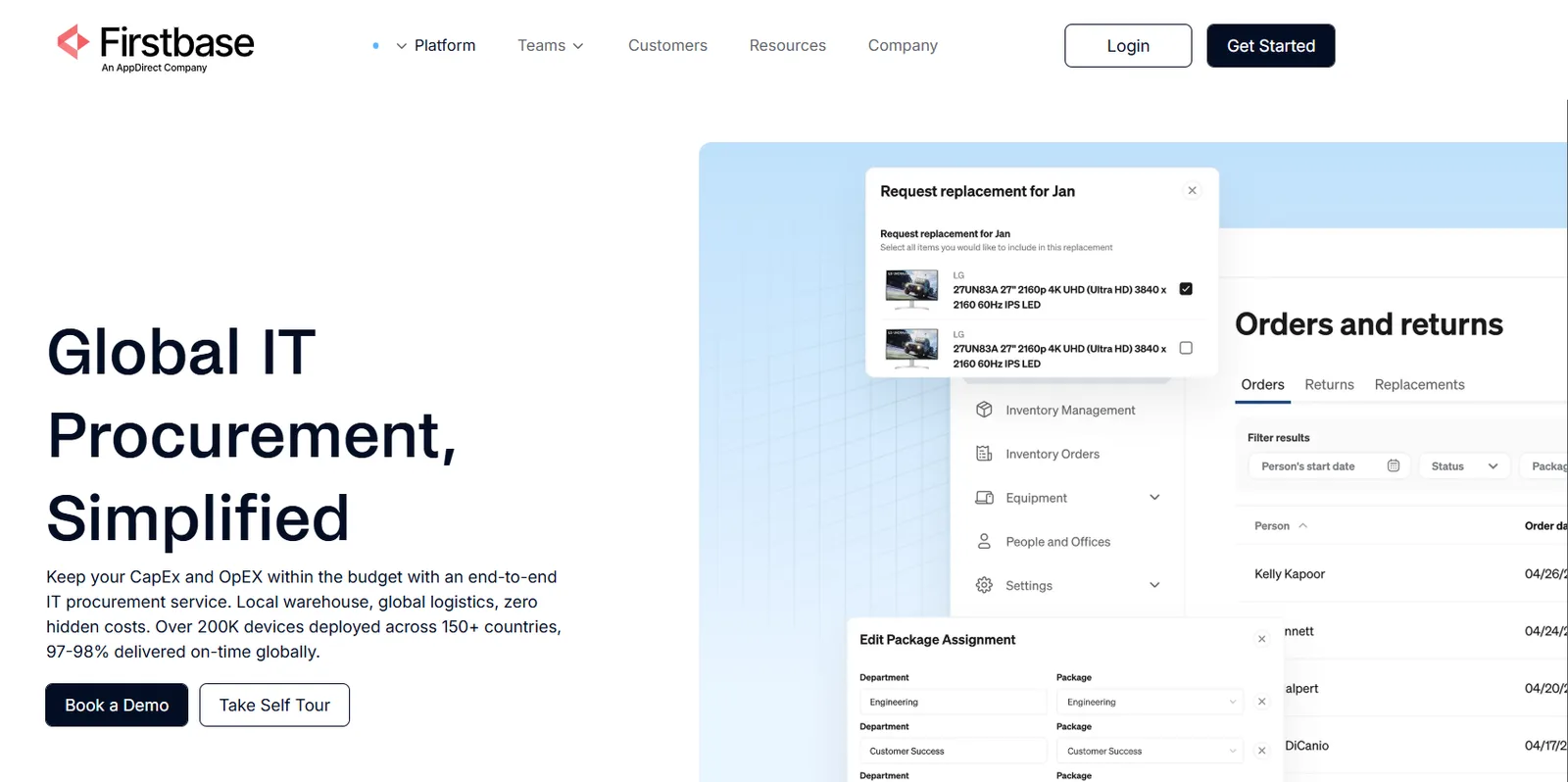
Firstbase is built for distributed teams that need faster hardware operations without IT involvement — global procurement, local warehousing, tax-aware buying, zero-touch deployment, retrieval, and reuse in one system. 200K+ devices deployed across 150+ countries with 97-98% on-time delivery.
- OEM-neutral buying: You can purchase, lease, or supply equipment across major vendors. Your team won't be locked into a single manufacturer.
- Virtual IT Closet: Its role-based hardware catalogs give your employees 100% self-service to request approved gear. Shadow IT purchases go lower, and ordering stays in line with policy.
- Zero-touch deployment: Firstbase syncs with tools like Jamf, Kandji, Okta, and Workday. There's no need for handoffs between HR and IT as provisioning starts with your existing systems.
- Reuse and retrieval built into the model: Returned devices are graded, re-inventoried, repaired when needed, and routed back into service. The platform also supports return kits and scheduled pickups to improve recovery for reuse.
Limitations
Some users say the shipping times have been inconsistent at times during urgent onboarding. A few have also asked for deeper lifecycle reporting. But they also said neither issue was serious enough to break the overall experience.
Growrk
Best for: SMBs and mid-market businesses scaling globally
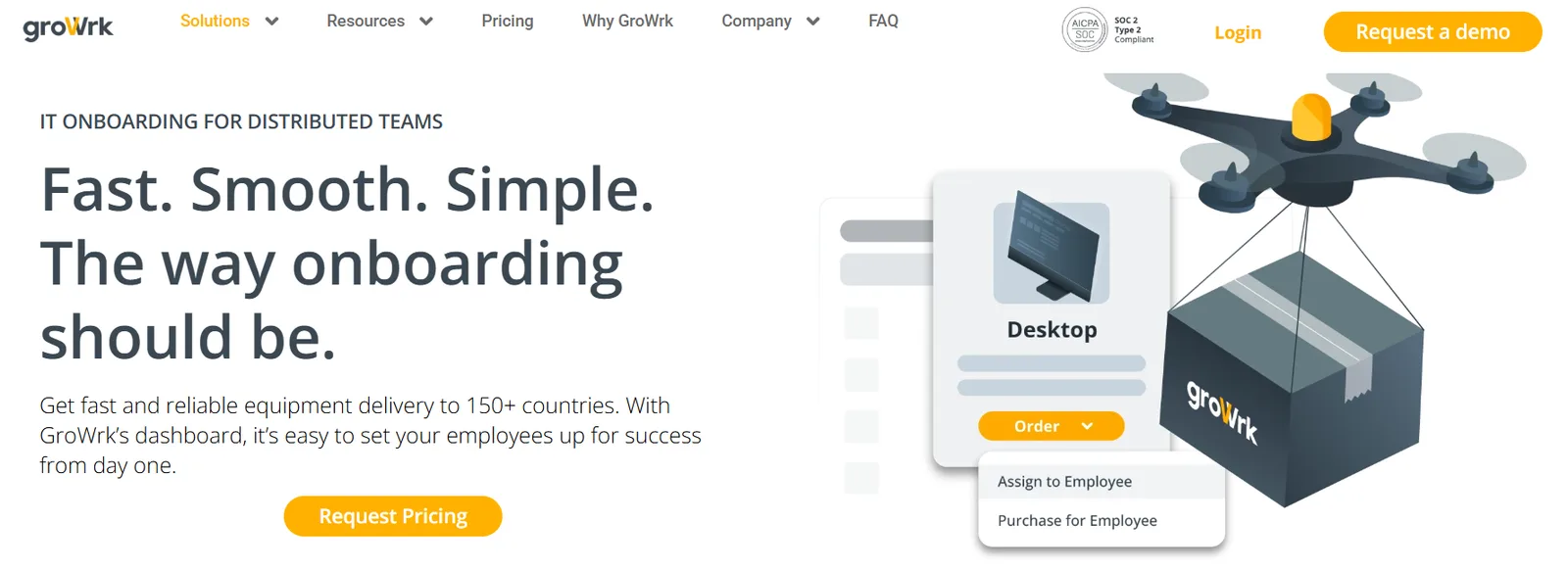
Growrk covers procurement, deployment, retrieval, support, and end-of-life services across 150+ countries. Firstbase differs in offering tighter operational control and a more built-out physical ops layer.
- Employee self-service: You can let hires choose from approved equipment options, then approve the final selection.
- Role-based load-outs: Teams can create pre-selected equipment packages for specific roles and assign them to new hires or current employees.
- Bring-your-own MDM support: GroWrk supports existing device management setups and also offers zero-touch deployment, remote access, and SSO across macOS, Windows, and Linux.
- 40+ integrations: Its integration library helps connect device operations with the rest of your workflow to reduce manual handoffs across onboarding, tracking, and support.
Limitations
Some users want clearer retrieval timelines and more proactive shipment follow-up. Firstbase has a stronger edge here because it automatically confirms addresses and generates shipping labels.
Workwize
Best for: MSPs and fast-growing distributed businesses
Workwize centralizes global procurement and asset control — deployment, retrieval, tracking, compliance, and disposal across 100+ countries.
- Centralized procurement: One platform for global purchasing, vendor management, and procurement activity.
- HRIS integration: Reduces manual admin with visibility into employee-linked device workflows.
- Real-time asset tracking: Monitor asset status, location, and procurement progress live.
- Compliance and disposal: Aligns with GDPR, ISO 27001, and SOC 2 with certified asset disposal.
Limitations
Some reviews point to weak delivery consistency outside the US, limited portal visibility, and slower collections in LATAM and parts of APAC. Firstbase makes a stronger case here, with 97-98% on-time global delivery across 150+ countries.
SEE IT IN ACTION
Take a self-guided tour of Firstbase
See how Firstbase covers global procurement, zero-touch deployment, retrieval, and ITAD — the full lifecycle that procurement-only platforms leave open.
Take the Tour →Unduit
Best for: Mid-market to large enterprises with significant device fleets and ITAM maturity
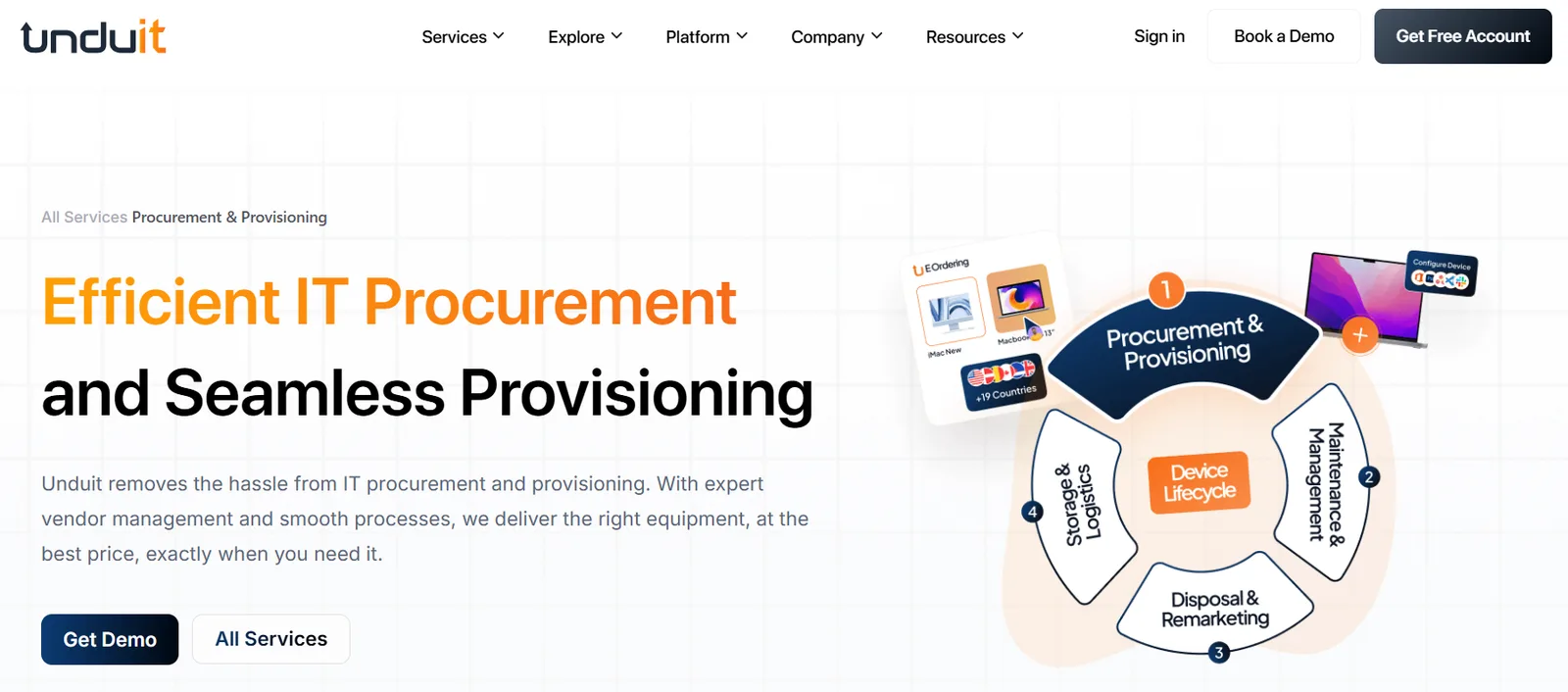
Unduit brings procurement, provisioning, recovery, and redeployment into one place to reduce operational drag across systems.
- Provisioning and configuration: Unduit configures devices to match company requirements before they reach employees, so teams can cut setup time and avoid inconsistent handoffs.
- Employee eOrdering: Its request platform gives employees a direct way to ask for new devices, which helps reduce back-and-forth.
- Leasing and rental options: Unduit offers leasing and rental services alongside purchasing. It gives finance and IT more flexibility for short-term needs, refresh cycles, or budget planning.
- Integrated service and asset control: The platform combines ticketing, workflow automation, SLA tracking, lifecycle insights, and asset-level visibility.
Limitations
Deployment and integration took more effort than expected, especially with legacy ERP and finance systems. If your teams use modern tools like Jamf, Kandji, Okta, and Workday, platforms like Firstbase can eliminate that friction.
Deel IT
Best for: Distributed companies that want IT tied closely to HR workflows
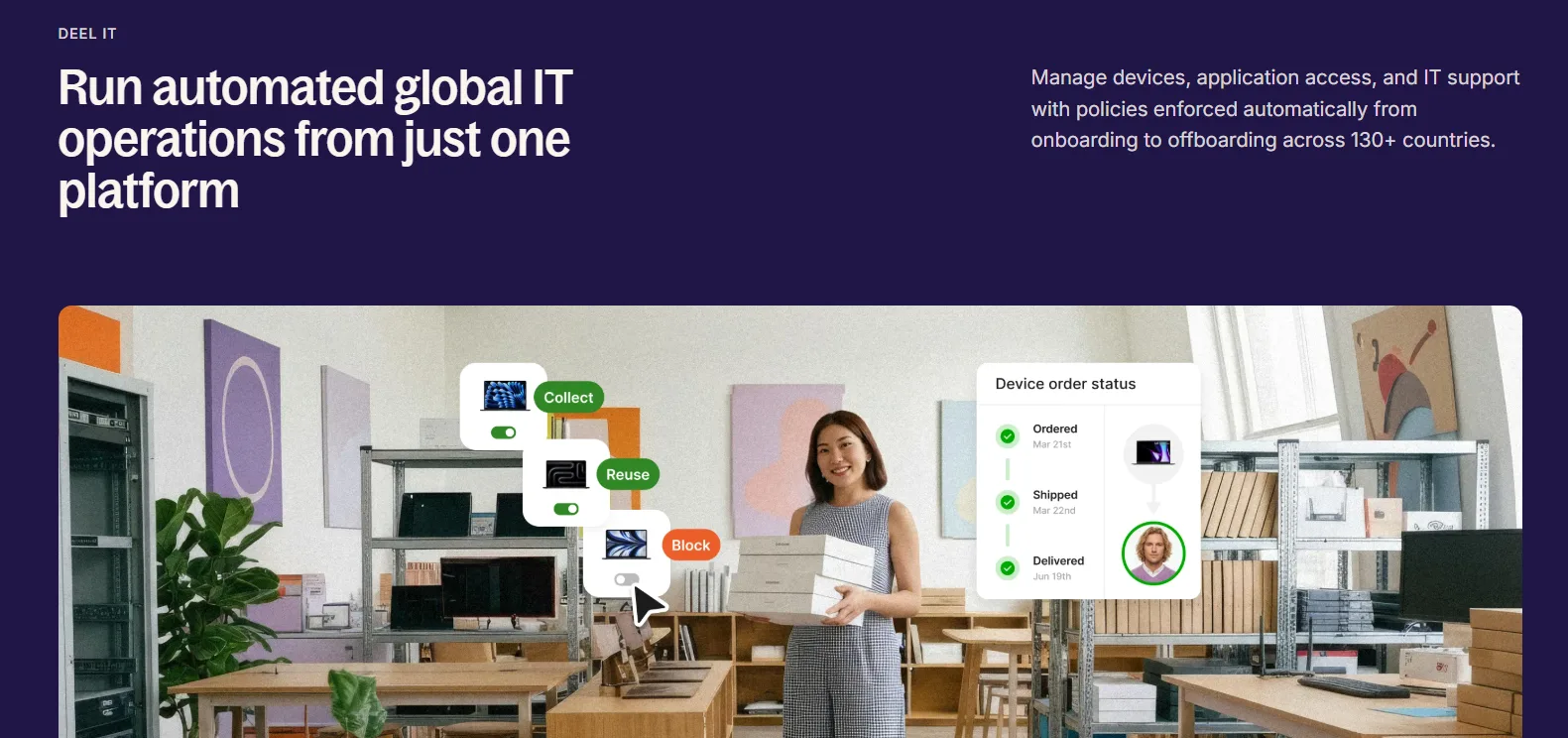
Deel IT ties IT procurement closely to HR workflows — sourcing, delivery, repair, recovery, and support across 130+ countries.
- Flexible acquisition options: Deel IT supports rentals, direct purchases, and BYOD inventory management.
- Policy-based approvals: Teams can set rules in advance so employees only request equipment that fits their role, location, and budget.
- Pre-configured secure delivery: Devices arrive with MDM and role-based setup already handled, which helps new hires get started faster.
- Loaner and repair support: Its support packages include managed repairs and, at higher tiers, temporary replacement devices shipped globally.
Limitations
Some users mention slower compliance reviews, uneven support turnaround, and higher cost at scale. Firstbase does a better job at budget control, with per-seat pricing and reuse-focused retrieval workflows.
CDW
Best for: SMBs to enterprises in hardware-heavy IT environments
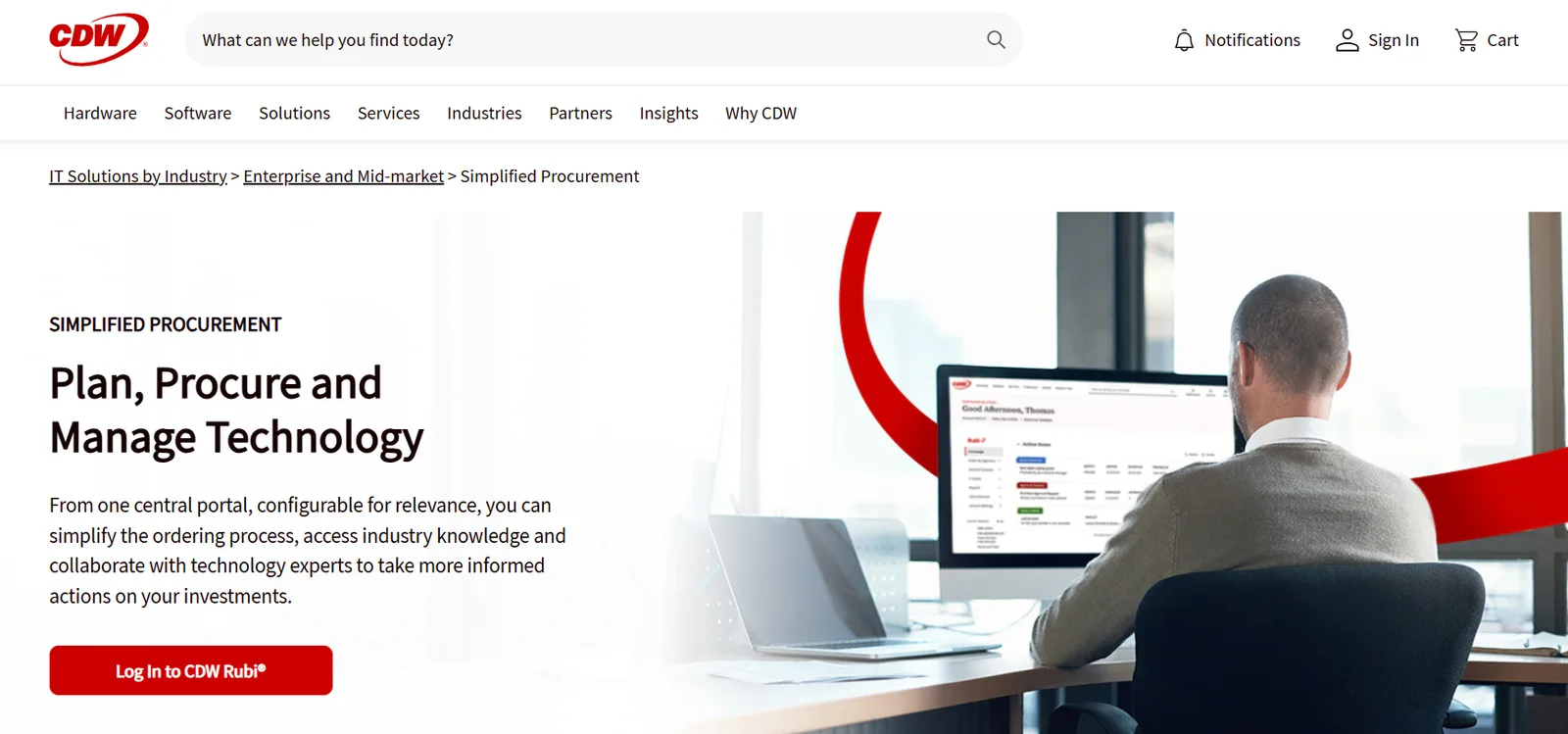
CDW formalizes purchasing through catalogs, approval workflows, and ERP-connected ordering — central portals, self-service, and structured reporting.
- Custom eProcurement integrations: Supports PunchOut, flat file catalogs, and ERP-connected ordering flows.
- Broad data exchange: API, EDI, cXML, CSV, XML, and SFTP for strict procurement infrastructure.
- Pre-approved catalogs: Standardized hardware, software, and services lists to reduce duplicate evaluation.
- Custom reporting: Asset management reporting via JSON and SFTP delivery.
Limitations
Some reviewers report slow follow-up, delayed fulfillment, and unexpected price changes after placing an order. It can be a problem for teams that need tighter predictability once a request is placed.
SHI International
Best for: Mid-market to large enterprises, especially in government sectors
SHI fits when procurement sits inside a larger enterprise buying motion — spanning hardware, software, cloud, ITAM, managed services, and public sector contracts.
- Portal and ERP connectivity: E-commerce tools, catalog management, and ERP integrations for formal purchasing.
- Real-time inventory tracking: Tight integration with SHI warehouses gives buyers stronger visibility.
- Secure decommissioning: Lifecycle and decommissioning services for governed asset retirement.
- Cloud and managed services: Public cloud, FinOps, managed services, and zero-touch provisioning.
Limitations
Some users say SHI can feel slow to navigate because of its size. Others mention higher pricing and limits around preferred vendors, which matters if flexibility and speed are higher priorities.
Why Procurement Alone Isn't Enough: The Lifecycle Gaps That Cost Distributed Teams Most
The platforms above provide strong IT procurement services. But there are expensive gaps some of them overlook.
1. Offboarding and recovery: 71% of teams saw at least one departing employee fail to return company equipment in the past year. Remote employees were 17% more likely to keep it, with average lost equipment value of $1,963 per person. Every missed recovery means a replacement purchase and a budget write-off.
2. Security and data exposure: 59% of unreturned devices contain confidential company data, and only 55% of companies can fully lock former employees out. With the global average data breach costing $4.4 million, weak recovery processes leave data exposure sitting in the field.
3. Disposal, audit, and chain of custody: NIST SP 800-88 Rev.2 requires a formal media sanitization program. A wipe log alone is not enough — if you cannot show how the device was handled and how data was destroyed, your audit trail is weak where regulators expect control.
How Do You Complete the Device Lifecycle Stack Beyond Procurement?
Those gaps show up when procurement ends at the purchase order. You need a physical operations layer between ordering and retirement — a single, controlled system instead of a patchwork of vendors, spreadsheets, and manual follow-ups.
Firstbase helps us provide a great experience for new employees as we scale rapidly. Not only do they make provisioning equipment seamless, but they also insulate us from supply chain issues. Their inventory reporting is particularly unique and powerful for us as a HIPAA-compliant healthcare company. Firstbase enables us to focus our time, attention, and team on our core business.
Malinka Walaliyadde, CEO and Co-Founder at Akasa
Firstbase guarantees the entire lifecycle — procurement, warehousing, provisioning, retrieval, repair, resale, and disposal — tied together with audit trails and custody records.
Firstbase also provides NIST 800-88-compliant wiping and certificates of destruction matched to the original record. For finance, that means recovered budget. For compliance, it means proof.
Does a managed platform make sense if we already have a VAR? Usually, yes. A VAR helps you buy devices but doesn't run retrievals, warehousing, redeployment, and audit-ready custody workflows in one system.
How much effort does migration take? Less than most teams expect. Firstbase centralizes your device data, connects your vendors, and automates the transition without impacting live operations.
From Procurement to Full Lifecycle: What Distributed Teams Actually Need
Once you treat hardware as an operating layer instead of a one-time purchase, the gaps become easier to control and the cost easier to defend. You don't need more vendors — you need fewer failure points.
Firstbase's physical ops layer gives you HRIS-triggered retrieval, a self-service portal, per-seat pricing, NIST-certified disposal, and a 48-hour delivery SLA. Customers report 1.6x higher retrieval rates, and some teams cut lost asset costs by 30%+ in year one.
Written by
Ahmad Zakaria
Ahmad Zakaria covers IT operations, hardware lifecycle management, and distributed workforce solutions at Firstbase. His content is built from real customer data, operator interviews, and hands-on experience managing devices across 150+ countries.
Get started with
Firstbase today
Remote and hybrid work aren't going anywhere. It's our mission to make it easier to manage the assets your distributed team needs—from onboarding through offboarding and every repair, replacement, and upgrade in between.
Fill out the form and a member from our team will reach out by phone!
Get a Live Demo