Best Iru (Kandji) Alternatives in 2026: MDM Comparison + the Layer They All Miss
Five Iru (Kandji) alternatives compared on features, pricing, and limitations — plus the hardware operations layer every MDM misses.
 Ahmad ZakariaJuly 6, 2026
Table of contents
Kandji rebranded to Iru in 2025, but the product does the same thing it always did: enroll Apple devices, push security policies, and patch macOS. It does those things well.
But the problem is what it doesn't do.
Your mobile device management service providers can tell you a device hasn't checked in for 30 days. It can't retrieve it. It can enroll a MacBook in five minutes. But can it get that MacBook to your new hire in Berlin before their start date? No. It can flag a laptop as non-compliant, but won't wipe, rebox, and ship it to the next person who needs it.
That's why companies like New Relic and Docebo pair their MDM with an IT logistics platform like Firstbase to handle the physical side of the device lifecycle.
If you're an IT manager or head of IT at a distributed company, typically 500+ employees, hiring across multiple countries, running a lean IT team evaluating Iru alternatives, this guide compares the top ones and the gap every MDM comparison ignores: what happens before enrollment and after a remote wipe.
Disclaimer: We built Firstbase to solve the hardware operations gap that MDM tools don't cover. We're included in this comparison, and we're upfront about that. Every other tool on this list is evaluated on publicly available data, verified user reviews, and published product documentation. Where a platform falls short, we've said so. Where it's strong, we've said that too.
TL;DR: Iru (Kandji) Alternatives at a Glance
| Platform | Best for | Hardware Ops? | Rating | Key limitation |
|---|---|---|---|---|
| Firstbase | Physical device lifecycle (procurement, shipping, retrieval, disposal) | Yes | 4.8 | Reporting customization is limited |
| Jamf Pro | Deep Apple-only fleet management | No | 4.7 | Add-on pricing stacks up fast |
| Mosyle | Budget-conscious Apple environments | No | 4.6 | Thin documentation; The client agent can lose the MDM connection |
| Addigy | Real-time device monitoring and live support | No | 4.5 | Apple-only; no Windows or Linux |
| JumpCloud | Mixed-OS fleets with identity-first security | No | 4.5 | Weaker patching than dedicated Apple MDMs |
| NinjaOne | Cross-OS endpoint and asset management | No | 4.7 | Remote desktop and reporting gaps |
Customers report getting 10-15 hours per week back after switching to Firstbase. Take a self-guided product tour to see how it works with your current stack.
PRODUCT TOUR
See How Firstbase Works
Take a self-guided tour to see how Firstbase handles device procurement, shipping, retrieval, and redeployment alongside your MDM.
Take the TourThe Best Iru (Kandji) Alternatives
Now that we've established what MDM software does (and where it stops), let's look at the tools worth considering.
Jamf Pro
Best for
Deep Apple-only fleet management with 20+ years of macOS expertise.
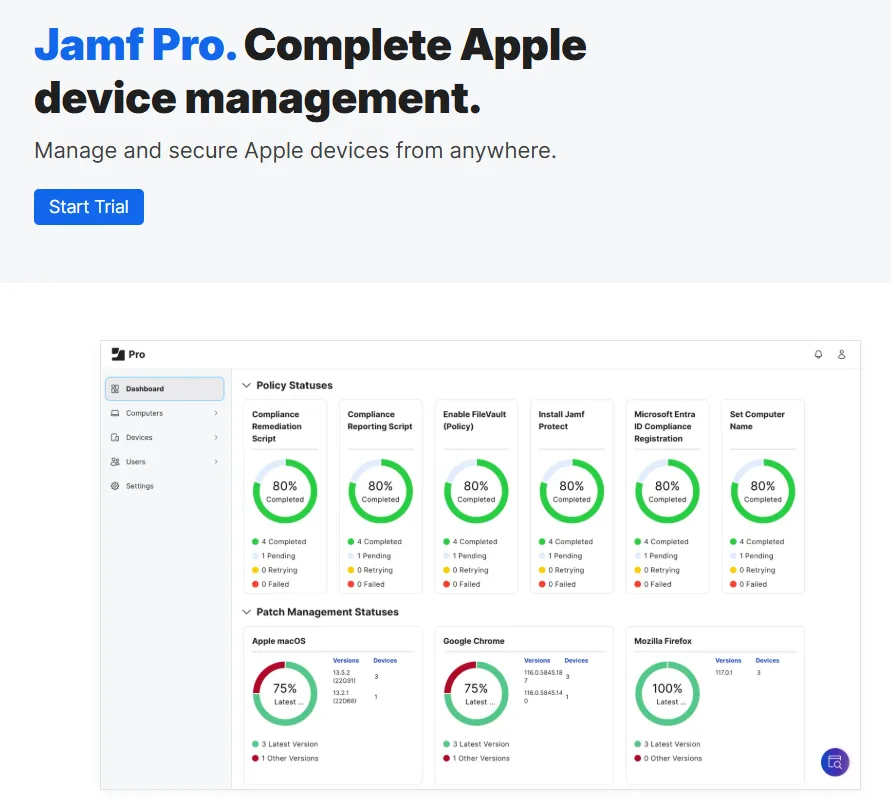
Jamf is the longest-running Apple device management platform on the market, with over 20 years of history. It covers zero-touch deployment through Apple Business Manager, configuration profiles, patching, app management, and security across Mac, iPhone, iPad, Apple TV, and Apple Watch.
Its Blueprints feature (built on Apple's Declarative Device Management) bundles settings, app installs, and restrictions into reusable templates, while Smart Groups dynamically segment devices and users.
If your fleet is overwhelmingly Apple, Jamf is probably the deepest MDM option available. But it stops at the software layer. Jamf can enroll and lock a MacBook remotely; it can't ship one to Berlin or retrieve it when someone leaves.
What stands out
- OS launch readiness: Jamf typically has same-day compatibility when Apple ships a new macOS or iOS version, which matters if you're managing hundreds of devices through an upgrade cycle.
- Integration depth: Native connections to Microsoft Entra, Sentinel, and Security Copilot, plus Google Workspace, Okta, and a marketplace with hundreds of third-party connectors.
- End-user self-service: Self Service+ lets employees handle their own app updates, software updates, and basic device maintenance without filing a ticket.
- Compliance automation: Security baselines from CIS and other industry frameworks can be auto-applied across your fleet through built-in benchmarks.
What to watch for
Limitation
Jamf Pro is the base layer, but security features, threat prevention, and identity tools are separate products with separate price tags. For smaller teams, that total cost gets hard to justify against competitors bundling more into a single SKU.
Customer Rating:4.7/5
Mosyle
Best for
Budget-conscious Apple environments that need unified management at a lower price point.
Mosyle started in K-12 (it was the first Apple MDM built specifically for schools back in 2016) and has since expanded into business and MSP markets, with over 24,000 organizations using its platform. Its uniform price bundling comes at a price point that undercuts most competitors, because of their direct-sales model with no channel middlemen.
For Apple-only environments where budget is a real constraint, Mosyle is worth a serious look. But like every MDM on this list, its visibility ends at the software layer. It can push policies and patches to a device; it has no opinion on how that device got to the destination in the first place.
What stands out
- Unified platform pricing: Apple management, endpoint security, identity (Mosyle Auth 2), encrypted DNS filtering, and patch management ship as a single platform.
- Patch management depth: Mosyle handles OS updates and third-party app patching for virtually any compatible application, with automated enforcement policies.
- Built-in Mac identity management: Mosyle Auth 2 handles local account creation from your IdP, Mac login with a single work credential, and optional device-level 2FA.
- Zero Trust for Mac: An AI-based automated Zero Trust engine that evaluates device posture continuously, which is unusual to see bundled natively into an MDM rather than sold as an add-on.
What to watch for
Limitation
Feature coverage in their docs often lacks screenshots, diagrams, or in-depth explanations, and the DNS filtering documentation has been called confusing by users for most real-world use cases. There's also a known issue with the Mosyle client losing connection to managed devices, which means policies and updates stop pushing until someone manually intervenes.
Customer rating:4.6/5
Addigy
Best for
IT teams that need real-time device monitoring and live remote support for Apple fleets.
Where most MDMs poll devices on a schedule and show you status data that's minutes or hours old, Addigy maintains live health metrics, instant remote screen share, direct terminal access from the browser, and alerts that fire the moment something drifts out of compliance.
It's built for Apple and covers Mac, iPhone, and iPad with zero-touch deployment, policy enforcement, patching, and endpoint hardening (the security suite is powered by SentinelOne).
Like the others on this list, though, Addigy's scope is the device after it's been unboxed. It doesn't touch procurement, shipping, storage, or retrieval.
What stands out
- Always-on device visibility: Persistent monitoring rather than scheduled polling, so compliance status, CPU metrics, and device health are genuinely live rather than stale snapshots.
- Real-time remote support: Screen share and SSH access run directly in the browser with no additional software, which cuts resolution time for IT when an employee's device has a problem.
- Amplify as an MDM add-on: If you're locked into Jamf or another platform and can't migrate, Amplify layers real-time compliance and live troubleshooting on top without replacing anything.
- Executive dashboards: Customizable reporting per organization or department, with audit-ready exports that don't require IT to manually compile data from spreadsheets.
What to watch for
Limitation
Addigy is Apple-only. If you have any Android, ChromeOS, or Windows devices in your fleet, you'll need a second MDM to cover them. macOS patching can also be inconsistent; some devices update smoothly while others stall or skip the expected workflow, and there's no clear pattern to why.
Customer rating:4.5/5
JumpCloud
Best for
Mixed-OS fleets with identity-first security and automated user lifecycle management.
JumpCloud is an identity-first platform that also includes device management, and that distinction matters. While Jamf, Mosyle, and Addigy start with the device and layer security on top, JumpCloud starts with the user identity and ties everything (device policies, access management, MFA, SSO) back to a single set of credentials.
It also handles automated onboarding and offboarding at the identity layer: provision a user in Google Workspace or your HRIS, and device enrollment, app access, and policy enforcement cascade automatically. Revoke that identity, and access dies everywhere at once.
The tradeoff is that JumpCloud's device management isn't as deep as a purpose-built Apple MDM. It won't match Jamf's macOS granularity or Mosyle's patching automation.
What stands out
- True cross-OS management: Mac, Windows, Linux, iOS, ChromeOS, and Android devices managed under one platform with consistent policy management, so you're not running two or three separate tools for a mixed fleet.
- Identity-anchored security: JumpCloud Go ties every session to a verified device with hardware-bound passwordless authentication, which prevents credential theft and session hijacking at a level most MDM solutions don't touch.
- Compliance breadth: Built-in controls and audit-ready reporting for SOC 2, HIPAA, GDPR, and the EU AI Act, with full event logging across every user, device, and access decision.
- Shadow AI governance: JumpCloud can detect unsanctioned AI tools, bind them to managed identities, and enforce policy in real time, which is a problem most MDMs aren't even attempting to solve yet.
What to watch for
Limitation
Device management depth is the compromise. JumpCloud's patching capabilities are weaker than dedicated Apple MDMs, and remote monitoring features are limited compared to something like Addigy's always-on approach.
Customer rating:4.5/5
NinjaOne
Best for
Cross-OS endpoint and asset management with unified patching and shadow IT detection.
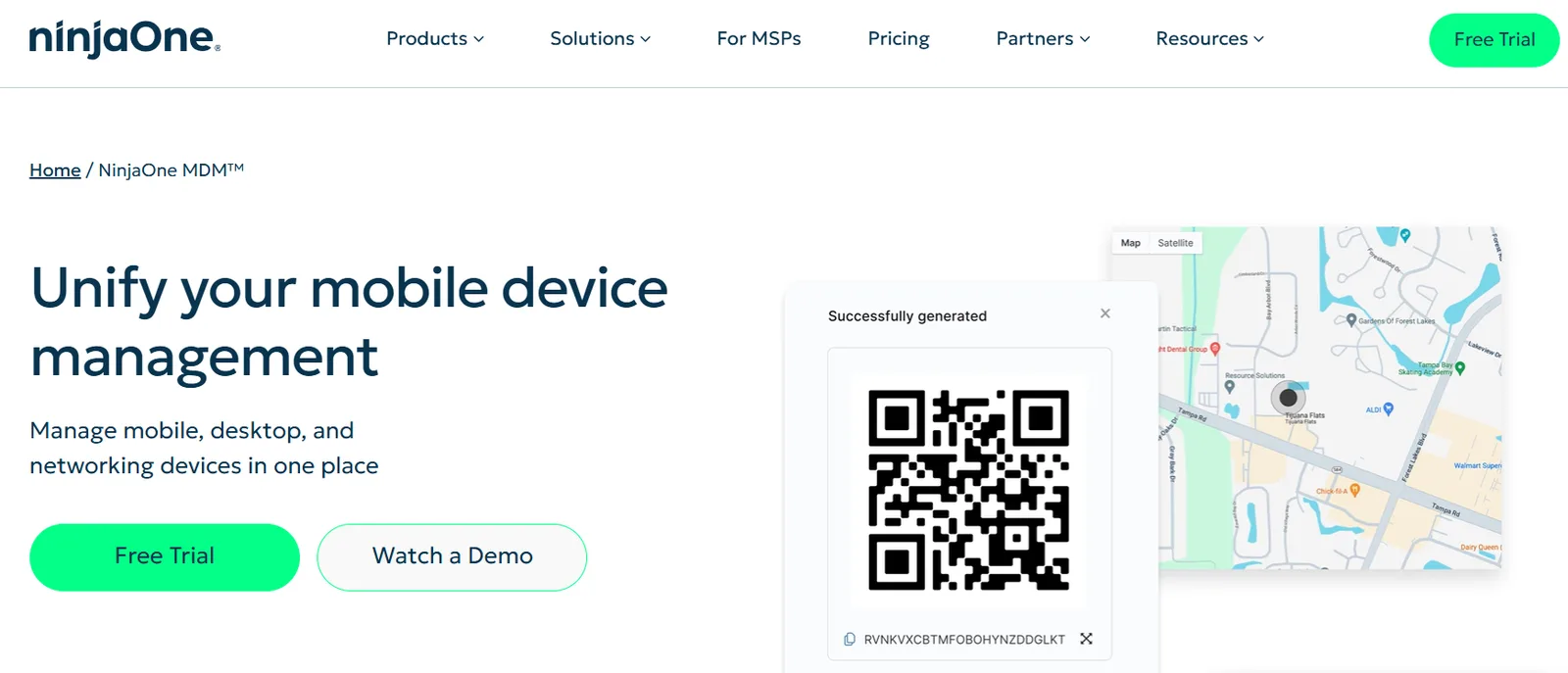
NinjaOne is a unified endpoint management solution that covers Windows, macOS, Linux, Android, iOS, and network devices from a single pane. Where Jamf and Mosyle offer deep Apple management, NinjaOne goes wide across everything an IT team touches. It bundles patch management, remote access, a service desk, SaaS, and endpoint protection.
There's also a full IT asset management module that tracks hardware lifecycle, warranties, and software licensing. NinjaOne can tell you exactly which devices are approaching end-of-warranty and which software licenses are going unused. But it can't ship a replacement laptop to your new hire or retrieve one from a departing employee across the border.
What stands out
- Unified endpoint and asset management: Hardware lifecycle tracking, warranty monitoring, software license management, and device management all live in one console.
- AI-driven patch management: Patch Intelligence scores updates based on community feedback and known issues before you deploy them.
- Shadow IT detection: NinjaOne's network discovery surfaces unmanaged devices (IoT sensors, desk phones, legacy systems) that most MDMs don't see.
- Ease of use: The platform is consistently praised for fast time-to-proficiency, and NinjaOne includes unlimited training and support at no extra charge.
What to watch for
Limitation
Reporting is limited. If you're coming from a more mature RMM tool, you'll also miss features like pre-connection device screenshots, chat-before-connect functionality, and network tunneling through a remote node.
Customer rating:4.7/5
What Every Iru (Kandji) Alternative Has in Common
Every tool above does the same job well. Enrollment, policies, patching, and remote wipe.
The differences are real (Apple depth vs. cross-OS breadth, pricing models, compliance requirements), but they're within the same layer: software control over devices already in someone's hands.
None of them touch what happens before enrollment or after the remote wipe. And that's where the money actually bleeds.
The cost of the missing layer
- Unreturned devices: Industry estimates suggest many enterprises recover only 50% of laptops from remote workers. At an average cost of $1,500 per device, a company with 1,000 employees and 15% annual churn loses roughly $67,500 in hardware alone each year. Monitors and peripherals are almost never collected at all.
- IT hours burned on logistics: Managing device procurement, shipping, and retrieval consumes approximately 500 IT hours per year for every 100 remote employees. That's 2.5 full-time positions' worth of salary spent on boxing laptops and driving to FedEx.
- Security exposure from lost hardware:46% of organizations experienced a data breach directly tied to an unsecured or unrecovered device. Morgan Stanley paid a $35 million fine for misplacing hard drives and servers.
- Unpredictable device spend: When devices don't come back, Finance approves replacement purchases on short notice. IT teams end up buying two or three laptops per employee over a few years because retrieval processes simply don't exist.
Your MDM handles the software. Your HRIS triggers the hire. Your ITSM logs the ticket. But nobody in that stack is buying the laptop, shipping it across borders, getting it back when someone leaves, wiping it, and putting it back into inventory.
That's the operational layer none of these tools were built to solve.
How does Firstbase close the hardware layer gap?
Firstbase isn't an MDM. It's the physical infrastructure and logistics layer that sits underneath your MDM and makes it actually work at scale.
Where MDM software handles enrollment and policy enforcement, Firstbase handles everything that involves a physical device moving through space: procurement from 150+ global resellers and distribution partners, imaging, shipping, tracking, repair, retrieval, and certified disposal. It pairs with any MDM vendor (Jamf, Microsoft Intune, JumpCloud, the lot) and feeds asset data into a single dashboard so IT has visibility into lifecycle stages that MDMs simply don't cover.
It also integrates with HRIS platforms like Workday and BambooHR so that a new hire added to your HR system automatically triggers a device order; a termination automatically kicks off retrieval.
Here's what that looks like in practice:
Departing employees confirm their address in the platform, receive a return kit at home, and schedule a pickup without leaving their house. The full retrieval cycle from offboarding trigger to wiped device back in inventory takes under 30 days. The time previously spent coordinating with VARs, packing boxes, printing shipping labels, and chasing unresponsive ex-employees gets eliminated. Employees self-serve approved accessories without filing a request.
There's value to be gleaned from automating processes from both a headcount and operational overhead perspective, and also the value you're squeezing out of the assets that you're spending thousands of dollars on. Now, we're able to maximize that in having a centralized, full lifecycle management program in place with a platform like Firstbase.
Thomas Olsen
Firstbase is also one of roughly 200 Apple Authorized Resellers in the U.S., which means guaranteed Apple Business Manager enrollment, priority procurement, and direct Apple service backing.
Every device action is tracked in the Firstbase platform with full chain-of-custody documentation, serial number histories, and certificates of destruction. That audit trail satisfies SOC 2, HIPAA, and NIST 800-88 requirements without IT having to compile anything manually.
Does Firstbase replace my MDM, or does it work alongside it?
Firstbase works alongside your MDM. Keep using Jamf, Kandji, Intune, Mosyle, JumpCloud, or your current tool for enrollment, policies, app management, and remote wipe.
It handles the part MDM does not cover: procuring devices, storing inventory, shipping laptops to employees, managing returns, certified wiping, and redeploying hardware.
So your MDM controls the device once it is active. Firstbase manages how that device gets to the employee, is returned, and is reused.
How to Choose the Right Kandji Alternative for Your Situation
Before you commit to a platform, run through these questions. Your answers will tell you whether you need a different MDM, a hardware operations partner, or both.
Is your device fleet 90%+ Apple, or do you manage a mix of macOS, Windows, Linux, and mobile?
Do you need deep macOS configuration (custom scripts, extension attributes, granular policies), or are pre-built automations enough?
How many devices are you managing today, and how fast is that number growing?
How many people on your IT team are spending time on shipping, retrieval, and break/fix coordination instead of strategic work?
Can your current team handle a 2x headcount increase without adding IT staff?
Is someone on your team storing laptops in a closet, a spare room, or their own home?
Do you have employees in more than one country?
Do you know the customs, VAT, and import regulations for every country you operate in?
How long does it take to get a configured device to your furthest hire? If it's more than two weeks, that's a logistics problem, not an MDM problem.
What percentage of devices do you actually get back when employees leave?
Do departing employees have to leave their house to return equipment?
How long does a returned device sit before it's wiped, repaired, and ready for the next person?
Can Finance forecast device spend for the next three quarters, or does every purchase feel like a surprise?
Are you buying new laptops because you can't get the old ones back fast enough?
Do you know the per-employee cost of your full device lifecycle, from procurement through disposal?
Here's a quick guide to choose:
- If your answers point mostly to MDM concerns (enrollment, patching, compliance, security policies), you need a better MDM. Pick from the list above based on fleet composition and budget.
- If your answers point to logistics concerns (shipping timelines, retrieval rates, device spend, international complexity), your MDM is probably fine. You need a hardware operations platform like Firstbase underneath it.
- If both sets of answers made you uncomfortable, you need to solve both layers.
Is Your MDM Actually Your Whole Device Strategy?
Every alternative on this list solves the same problem Iru solves: securing and managing devices after they're powered on. Not every MDM handles what happens before the device reaches your employee or after it leaves their hands.
Firstbase operates in that gap as a single procurement source, global shipping engine, and retrieval system that feeds directly into the MDM stack you already run. It turns device operations from a reactive scramble into a line item that Finance can actually predict.
Companies using Firstbase have cut per-employee offboarding costs by $125 while maintaining retrieval turnaround times under 30 days. Book a demo to see how it works with your current MDM.
Written by
Ahmad Zakaria
Ahmad Zakaria covers IT operations, hardware lifecycle management, and distributed workforce solutions at Firstbase. His content is built from real customer data, operator interviews, and hands-on experience managing devices across 150+ countries.
Get started with
Firstbase today
Remote and hybrid work aren't going anywhere. It's our mission to make it easier to manage the assets your distributed team needs—from onboarding through offboarding and every repair, replacement, and upgrade in between.
Fill out the form and a member from our team will reach out by phone!
Get a Live Demo