Best Hardware Asset Management Software That Covers Procurement Through Retirement
When your company manages hardware in a single building, it’s easy for IT to tag and track it in a system. But if you're the IT Manager or Systems Engineer holding together a fleet spread across a dozen countries with…
 Ahmad ZakariaOctober 8, 2026
Table of contents
- TL;DR The Best Hardware Asset Management Solutions
- What IT Asset Management Software Actually Needs to Do
- Two Categories of HAM Software (and Why the Difference Matters)
- Tracking-First HAM Tools Worth Evaluating
- Operations-First HAM: What It Looks Like When the Platform Moves the Device
- FAQs
- Which IT Hardware Asset Management Approach Fits Your Team?
- Is Your HAM Software Tracking Devices, or Managing Them?
When your company manages hardware in a single building, it’s easy for IT to tag and track it in a system. But if you're the IT Manager or Systems Engineer holding together a fleet spread across a dozen countries with three people on the team, that's not the part keeping you up at night. The hours go to getting the device to the employee and retrieving it during offboarding.
The tracking software still works. What falls apart is everything downstream of the record, because no HAM tool was built to get a laptop to São Paulo, chase it down when someone quits, or produce a Certificate of Destruction once a device is retired.
Let’s call it what it is: an operations problem. Most buying guides skip past it, ranking tools on dashboards and MDM sync instead of asking what happens the week after a device ships.
This guide will cover tools that track well, and where a platform like Firstbase takes over the physical side, getting devices there, offboarding them, and closing the loop.
TL;DR The Best Hardware Asset Management Solutions
| Platform | Type | Rating | Strength | Limitation | Physical Execution |
|---|---|---|---|---|---|
| Freshservice | Tracking-first | 4.6 | ITSM-integrated discovery | Slow load times, cost scales with agents | None |
| ServiceNow | Tracking-first | 4.3 | Deep CMDB, enterprise scale | Complex setup, high cost | None |
| Rippling IT | Tracking-first (claims ops) | 4.7 | Identity-triggered provisioning | Slow warehouse turnaround | Claimed, unverified at scale |
| InvGate | Tracking-first | 4.7 | Multi-source discovery | No vulnerability or deployment module | None |
| EZO AssetSonar | Tracking-first | 4.5 | Unified asset-to-ticket context | Manual, unfilterable reporting | None |
| Firstbase | Operations-first | 4.8 | Executes procurement through retirement | Not a CMDB or ticketing replacement | Native |
Prefer to explore first? Take the self-guided tour to see how teams recover about 500 IT hours a year once procurement, deployment, and retrieval stop living in a spreadsheet.
What IT Asset Management Software Actually Needs to Do
Most HAM evaluations run through the same checklist.
- Minimal manual oversight: The system should update itself when a device moves and shouldn’t wait for someone to log in and change a field. Real-time syncing from MDM check-ins or HRIS status changes is more efficient than a dashboard that only reflects what got typed in last.
- MDM integration: Your HAM tool needs to integrate directly with MDM platforms like Jamf, Intune, or Kandji. Without that sync, you're maintaining two records for the same device, and they'll eventually disagree.
- A UI non-IT staff can use: HR, facilities, and office managers touch retrievals and cleanouts more often than IT does. The platform needs a permissions layer that lets them log a return or flag a device without full admin credentials.
- Pricing that scales without impacting growth: Per-asset licensing looks fine at 200 devices. At 2,000, it's a budget line finance starts asking about every quarter.
- Physical execution: This is the requirement no HAM tool meets, because it isn't a feature you can code. It's what happens to a device physically, and no software moves a laptop on its own.
Two Categories of HAM Software (and Why the Difference Matters)
That way, every HAM platform on the market falls into one of two categories.
| Criteria | Tracking-First HAM | Operations-First HAM |
|---|---|---|
| What it answers | Where is this device supposed to be, per the last recorded update? | Where is this device right now, and what does it need to reach its next state? |
| Core data model | A CMDB record tied to a serial number, updated by manual entry or agent check-in | A live status tied to a physical event: shipped, in transit, delivered, flagged for return, retired |
| Procurement | Logs the PO and adds the asset once it arrives | Places the order, manages the vendor relationship, and enrolls the device pre-shipment |
| Offboarding/retrieval | Flags the device "pending return" and waits | Sends the return kit, tracks the shipment, escalates if it stalls |
| End of life | Marks the asset "retired" in the record | Coordinates the wipe, generates the Certificate of Destruction, handles resale or disposal |
| Where it breaks | The record is only as accurate as the last manual update | Depends on actually being able to move a device: carriers, warehouses, customs, local compliance |
Tracking-first tools are built around the CMDB: asset discovery, inventory, license reconciliation. Operations-first tools are built around the device's physical movement: procurement, shipping, retrieval, disposal.
Tracking-First HAM Tools Worth Evaluating
If asset tracking is genuinely your problem, one of these five platforms will solve it well. Here's how each one holds up:
Freshservice
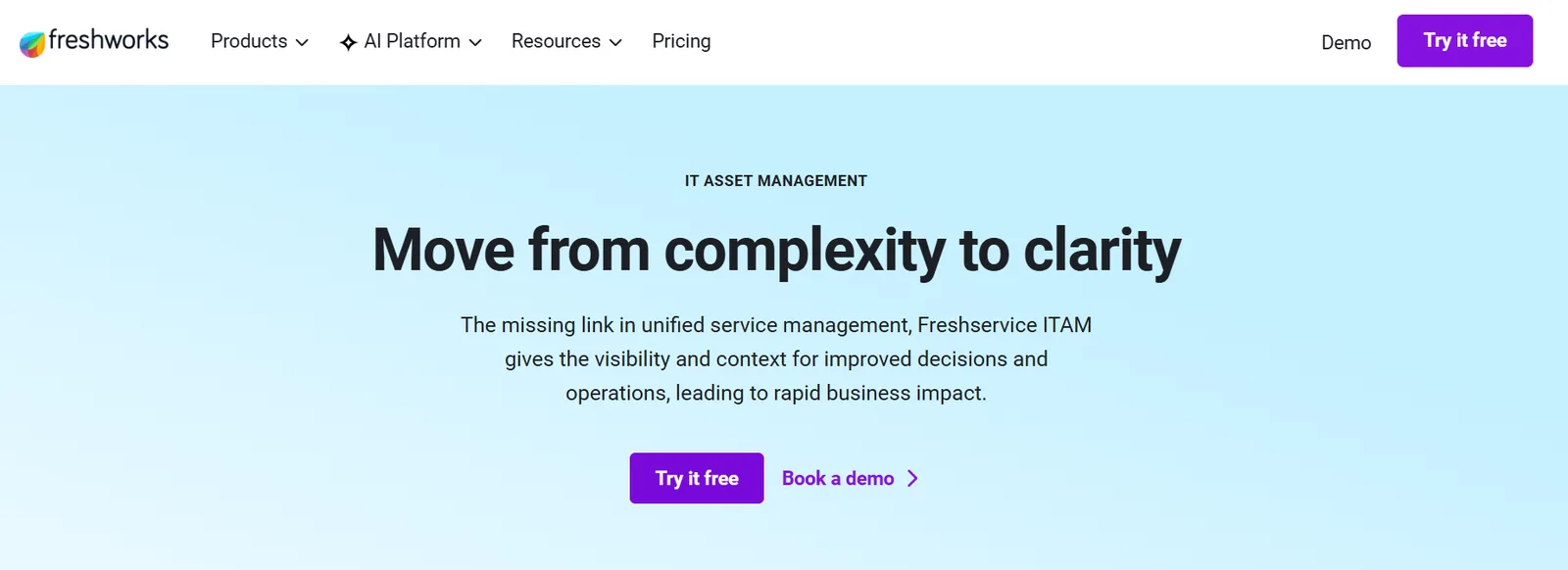
Freshservice bundles ITAM into a broader ITSM, ITOM, and ESM platform built around Freddy AI. Asset data isn't standalone here; it feeds directly into ticket routing and incident summarization.
Best for
That's a different bet than a dedicated HAM tool, because Freshservice treats your asset problem and your service desk problem as the same.
What it's good at
- Automated discovery: scans on-prem, cloud, and hybrid environments to keep inventory current without manual entry.
- Software license tracking: maintains a license profile across the fleet for cost control and compliance.
- Dependency mapping: shows how apps, services, and infrastructure connect, useful when tracing an incident.
- Data center infrastructure management: tracks data center assets, power, and space for capacity planning.
- IP address management: manages IPs and network dependencies to avoid conflicts during expansion.
Where it falls short
Users flag slow page and module load times. The cost climbs fast, since more agents and more AI features both add to the bill. And the Jamf connector is additive-only. That means it adds new devices but never removes those that leave Jamf, so someone has to manually clean stale records from the CMDB.
How automation works: Freddy AI serves as the automation layer, though not asset-specific. It drafts tickets, summarizes incidents, and suggests routing on intake, then flags recurring issues and SLA risk before they escalate. Every AI action remains visible to admins.
ServiceNow
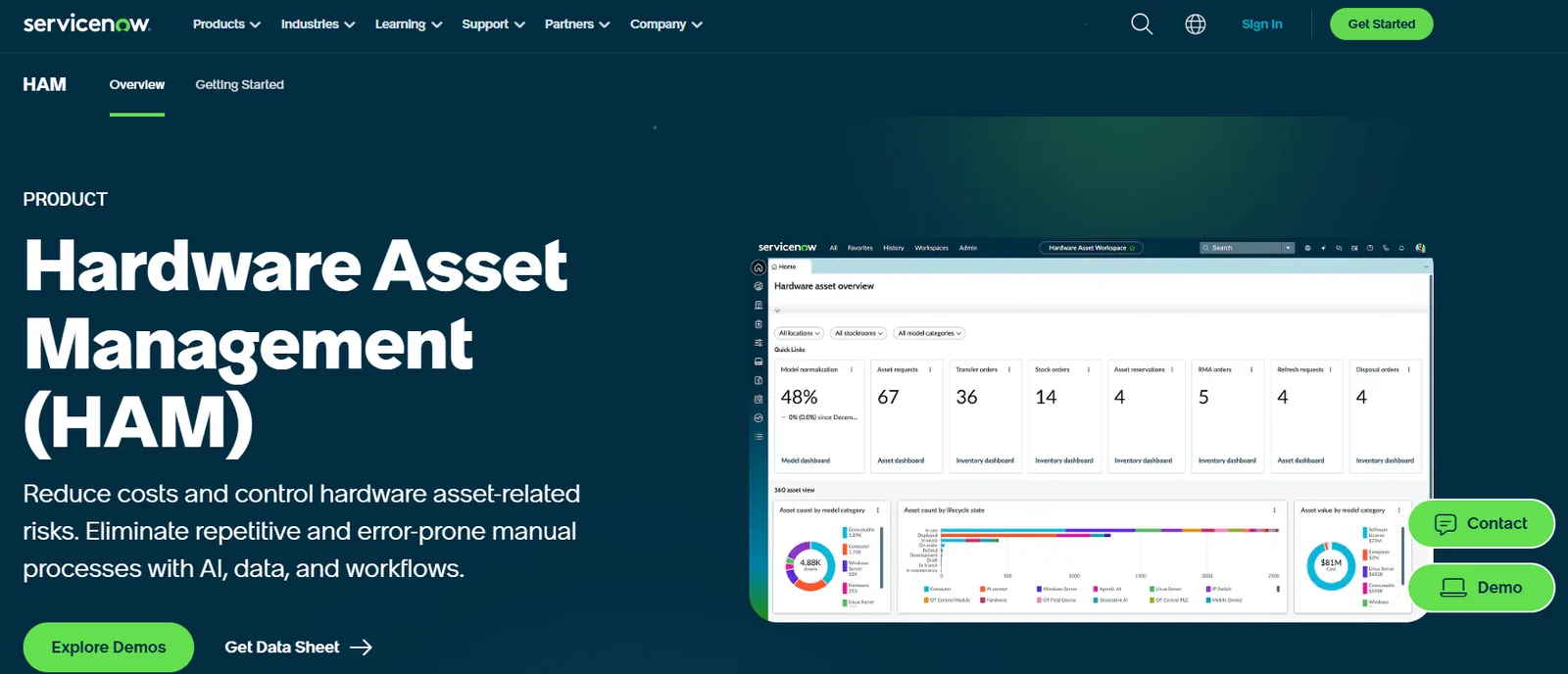
ServiceNow runs hardware asset management process through its CMDB, the same configuration record that other ServiceNow modules, from IT Service Management to request management, already write to. That's the real difference from Freshservice, where asset data sits inside a ticketing system instead.
Best for
Here, the asset record is the platform's backbone; everything else builds on top of it. It's why enterprises with complex, multi-system environments pick ServiceNow over lighter tools, and why a 300-person IT team often finds it more than they need.
What it's good at
- Real-time asset visibility: tracks location and condition across the fleet so status reflects what's actually happening, not what was last entered.
- Stockroom inventory management: keeps warehouse inventory accurate across multiple stockrooms through automated workflows.
- Data center infrastructure tracking: manages racks, power, and space for capacity planning, useful if your estate includes servers, not just laptops.
- Audit readiness: keeps asset and license records complete enough to respond to a compliance audit without a scramble.
- Deep third-party integration: connects existing software investments directly to the CMDB rather than operating as a standalone silo.
Where it falls short
Setup complexity (Discovery and Service Mapping need skilled resources and multiple configuration passes), a hard dependency on clean CMDB data, and cost are all what users point to. Pro and Enterprise-tier pricing is a real barrier for mid-sized teams, and the advanced configuration UI still lags behind the newer Next Experience workspace.
How automation works: ServiceNow's Autonomous Workforce AI specialists go further than Freshservice's ticket-routing bots. They self-assign work based on skill and authorization, then escalate to a person once a task exceeds their scope. None of that touches anything physical, though: procurement, deployment, and disposal get automated as CMDB tasks and approvals.
Rippling IT
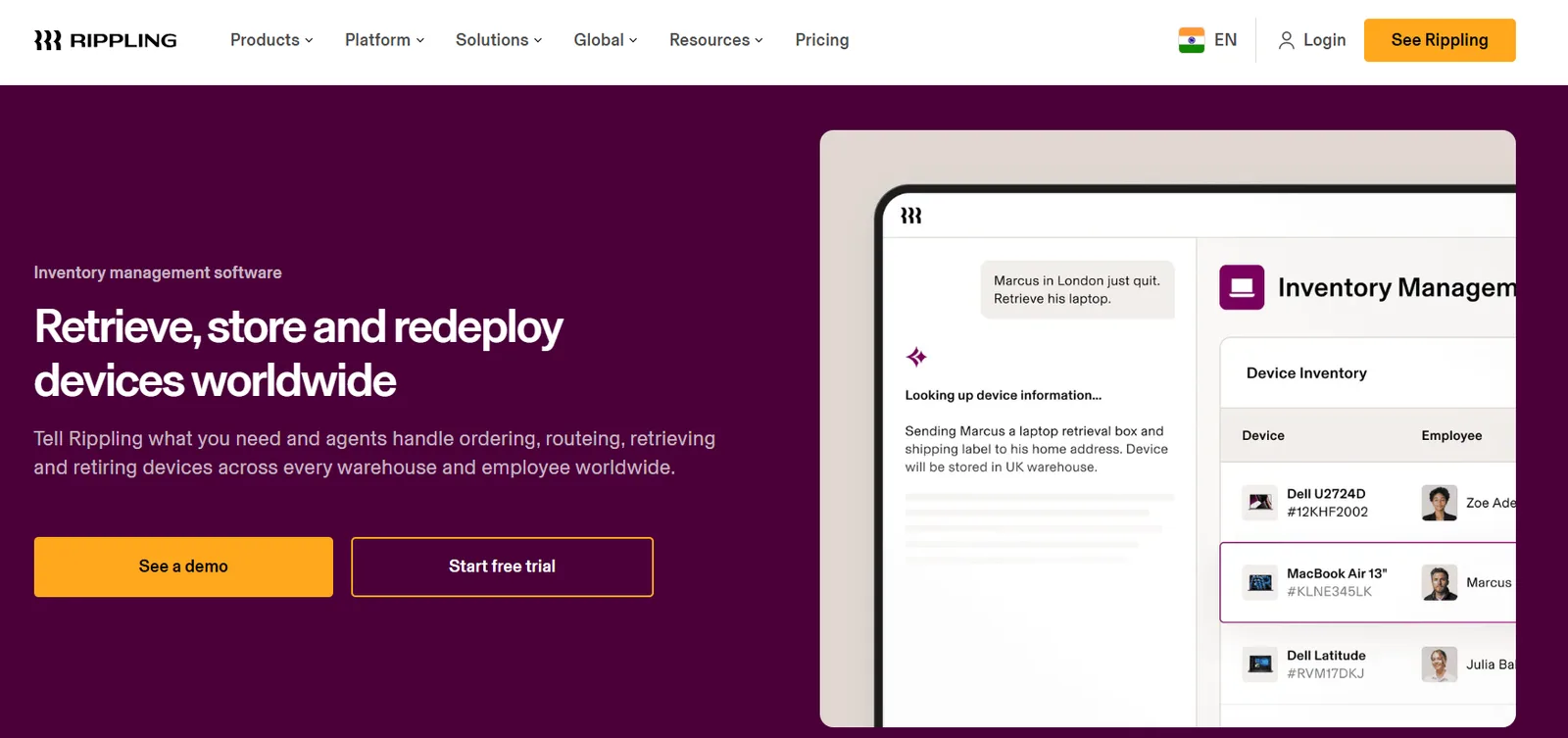
Rippling IT is part of Rippling's broader HR, IT, and finance platform, and its pitch goes beyond those of Freshservice or ServiceNow. It doesn't stop at the CMDB record: it claims to handle shipping, retrieval, warehousing, and buyback directly.
Best for
That makes Rippling the only tool on this list that is built as an extension of an HR platform rather than as a dedicated logistics operations tool.
What it's good at
- Identity-triggered provisioning: an HR status change (new hire, role change, termination) automatically triggers device and app access changes; no separate trigger needed.
- Zero-touch deployment: ships devices pre-configured with the right apps and security controls straight to a new hire.
- Device Buyback: shows the real-time resale value for unassigned or archived devices and issues a credit for sellback.
- Bulk unenrollment: disconnects devices from Apple Business Manager or Microsoft Entra in bulk instead of one at a time.
- Global reassignment: redeploys existing inventory to a new employee rather than issuing a new purchase.
Where it falls short
Multiple users cite a steep configuration lift to get advanced automation working; understanding how policies, permissions, and workflows interact takes new admins real time to learn. One user flags that warehouse provisioning turnaround for new devices takes longer than desired. MDM commands are also reported as slow to reach end devices.
How automation works: This is where Rippling genuinely differs from Freshservice and ServiceNow. Both of those automate the ticket or the CMDB record; Rippling claims to automate the physical action itself, generating a shipping label and dispatching a box the instant offboarding fires in the system. But the turnaround complaint above suggests that execution doesn't always match the pitch.
InvGate
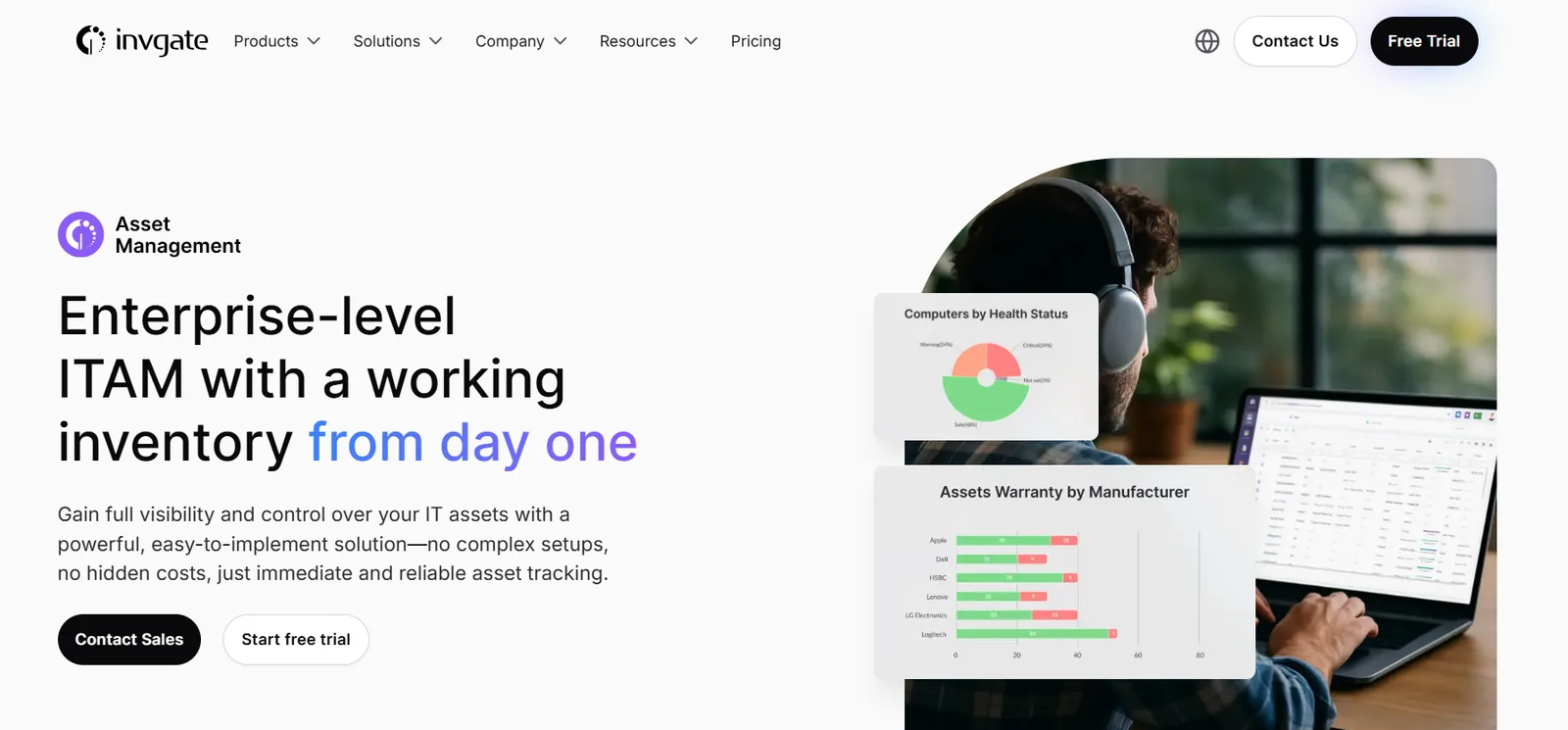
InvGate builds its hardware inventory from three sources: an agent that stays with a device off-network, network scanning for switches and printers your MDM won't catch, and manual import for stockroom gear.
Ideal for
It tracks hardware and software on a single platform, so licenses live in the same system as devices. InvGate serves teams managing 1,500 to 10,000 devices with two to five IT staff members.
What it's good at
- Warranty and depreciation automation: warranty data is pulled directly from Dell and Lenovo, depreciation is calculated on a set schedule, and contracts automatically link to the asset record.
- License reconciliation: licenses are automatically assigned and unassigned as devices change hands or new purchases are made.
- Linked audit trails: every asset ties directly to its support tickets, so changes and compliance history get logged as they happen.
- Smart Tags: auto-identifies assets based on defined properties and flags unauthorized moves or changes without manual review.
- Regulated-industry deployment: audit-ready records and flexible deployment for government, aerospace, defense, and financial services with data residency requirements.
Where it falls short
Users note two specific gaps: no vulnerability control module, and no remote software deployment module. It can flag a device failing a health check, but pushing the fix requires a separate tool. One reviewer also described the help desk configuration as tangled, with nested functions that risk breaking something already in use during setup.
How automation works: InvGate's automation is triggered by asset state. A license changing hands or a device failing a health check fires the workflow directly, and Auto Healing resolves some issues before they ever generate a ticket. InvGate can identify a vulnerability or an outdated endpoint, but it can't remediate either on its own.
EZO AssetSonar
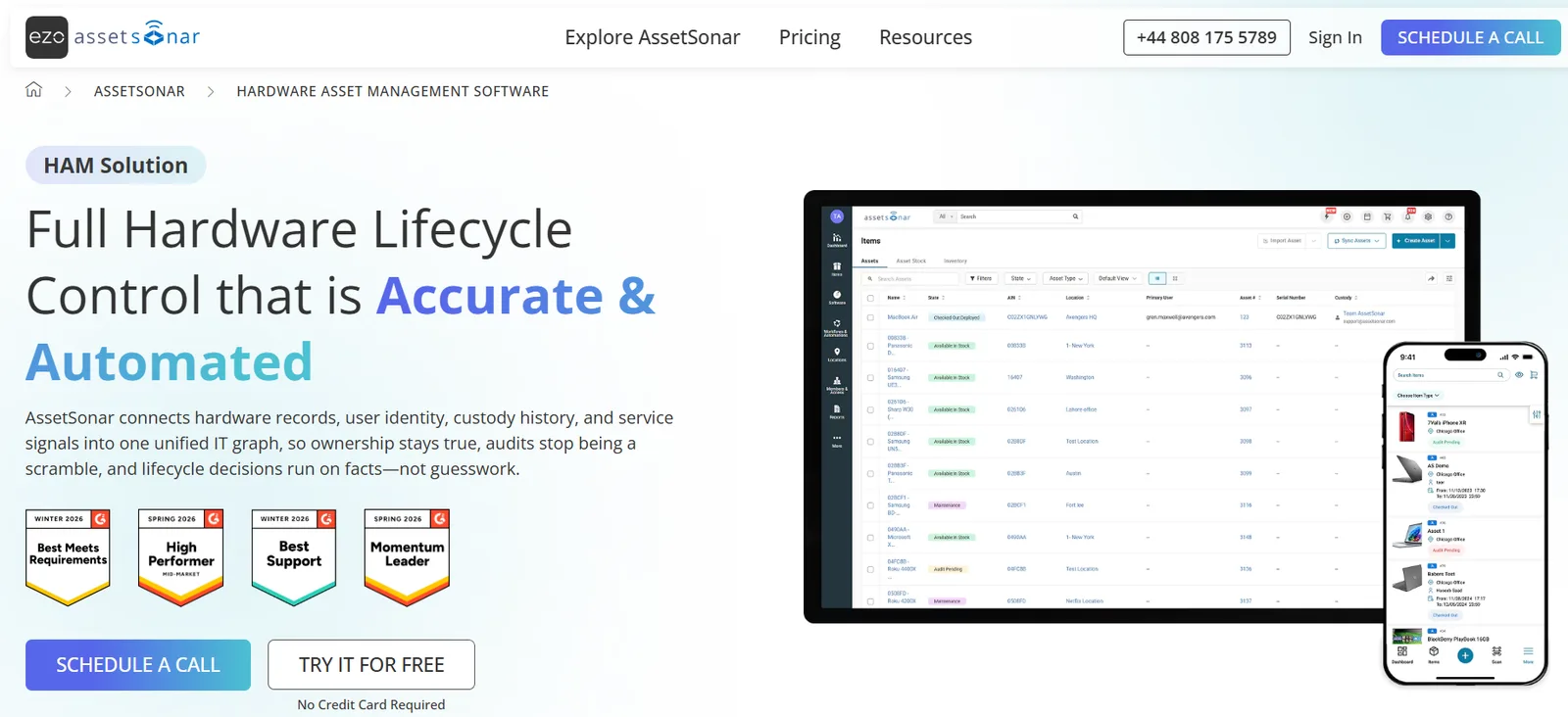
AssetSonar organizes everything around what it calls the IT Graph: every asset linked to its owner, custody history, tickets, and licenses in one structure, so investigating a device doesn't mean checking the CMDB, then the help desk, then a spreadsheet. They promise fewer clicks per investigation and no stale records. Zoe, their AI copilot, ships included rather than priced as a separate add-on tier.
Not ideal for
Pricing runs high for smaller teams that don't need the full feature set.
What it's good at
- Offboarding checklists built from an HR trigger: the moment an exit is recorded, AssetSonar surfaces every device, license, and access item the employee touched in one ticket, and closes with a timestamped record of what got recovered.
- Procurement tracking on the asset record: vendor info, purchase cost, and PO linkage live with the asset itself, so forecasting and audit prep don't require pulling data from a separate purchasing system.
- Onboarding handoffs through its own agent or MDM: device assignment and checkout happen automatically based on provisioning rules, with custody recorded from day one.
- Usage monitoring to catch ghost assets early: tracks device activity, location, and assigned user in real time, flagging unauthorized use before it turns into an audit finding.
- Retirement flagging by condition, not just age: devices get flagged for decommissioning based on usage and condition, and every retirement event stays logged for compliance history.
Where it falls short
New users need real training time before the interface stops feeling complex, and the mobile app lags the desktop version in functionality. The sharpest complaint is reporting: pulling a report means exporting every item ever logged in the system, then filtering it manually in Excel, with no built-in filter by date or department.
How automation works: Automation here runs on a wider event surface than the rest of this list: asset changes, SaaS events, HR updates, and monitoring alerts can all fire a workflow. Onboarding and offboarding run as full sequences instead of a manual checklist. None of it ships a box or confirms a device landed back at a warehouse, the same ceiling every tool here runs into.
Operations-First HAM: What It Looks Like When the Platform Moves the Device
Let’s now see what changes at each stage when Firstbase, an operation-first platform, executes the physical work instead of just recording it.
Procurement and provisioning
The order fires the moment someone shows up in the HRIS. As an Apple Authorized Reseller, Firstbase enrolls devices directly in a client's Apple Business Manager account, which integrates with the client's MDM. So the laptop arrives already tied to corporate policy and doesn’t wait for someone to image it manually.
The zero-touch deployment means the device remains in a pending, pre-configured state before it ever leaves the warehouse. Companies like New Relic run this at scale with a single procurement specialist managing roughly 4,000 laptops globally.
Retrieval
Offboarding triggers the return automatically instead of waiting for someone to remember. For example, at New Relic, connecting Firstbase to their Workday HRIS means employment status changes feed directly into Firstbase, and the return process kicks off every 24 hours without a manual step.
That's what kept their retrieval rate high (97%) through a recent headcount reduction, a real stress test of the process.
Retirement (ITAD)
A device flagged for end of life receives a NIST 800-88-certified wipe and a Certificate of Destruction within the same platform, with no separate vendor or second shipment.
Office Pickup extends this to bulk cleanouts: one ITAD request covers multiple items, tracked or untracked, with Firstbase-managed carrier pickup in the US or self-coordinated pickup elsewhere. There's no fee for resale.
Integration
None of this requires replacing your tracking tool. Firstbase API covers orders, returns, replacements, restocking, inventory levels, shipment notices, and offboarding and reactivation, with SCIM support for identity-driven deprovisioning. That means when HR records a termination date, Firstbase can cut the employee's device access that same day, instead of leaving it open for weeks until someone checks the offboarding list by hand.
That's the layer that lets the stages above run on triggers from systems Firstbase doesn't own, such as an HRIS event, a termination date, or a stock-level threshold.
FAQs
No. Firstbase connects via its API and webhooks to cover orders, returns, replacements, restocking, accurate inventory levels, shipment notices, and offboarding and reactivation, so your existing tool stays exactly where it is as the system of record. Nothing gets rebuilt; Firstbase just runs the physical side underneath it.
The opposite happens. A single-purpose ITAD vendor only sees a device the moment it's retired. Firstbase has the full history from procurement onward, which is why it can offer real-time resale estimates and an in-platform Certificate of Destruction instead of a static quote and a CoD that shows up in someone's inbox after the fact.
Our new hires log into Firstbase, create an account, and choose from a few different hardware packages. The equipment shows up, it's automatically associated with the user, and we easily monitor the devices through Firstbase's dashboard.
Chad Brustin, Director of Information Security, Finfare
Which IT Hardware Asset Management Approach Fits Your Team?
This framework should make it easy for you to decide on a platform.
Operates out of one or two offices, so retrieval and deployment rarely leave the building Already has a solid MDM in place and mainly needs the record to stay accurate Needs deep CMDB context tied directly to tickets, incidents, and service history Has enough IT headcount to own coordination work in-house
Has devices spread across multiple countries or time zones Regularly loses days chasing devices down after offboarding Runs IT lean, with a team that hasn't scaled at the same rate as the fleet Wants procurement, shipping, retrieval, and disposal handled without stitching together separate vendors
The honest split is whether your highest cost is bad data or bad logistics. It’s usually obvious once you count the hours your team spends chasing devices versus updating records.
Is Your HAM Software Tracking Devices, or Managing Them?
We've drawn a clear line between tracking and operations and walked through what actually happens on each side.
So, here's the short version: a tracking record tells you where a device should be. It doesn't get it there, and it definitely doesn't get it back. That's one most HAM tools were never built for.
Firstbase runs that job as the operations layer beneath whatever tracking tool you already rely on, handling the physical side of a device's life rather than just its paperwork. Customers running device management through the platform report 1.8x higher asset-tracking accuracy and faster hardware recovery.
If your team is still absorbing that cost manually, book a demo to see what it looks like once the platform handles it instead.
Written by
Ahmad Zakaria
Ahmad Zakaria covers IT operations, hardware lifecycle management, and distributed workforce solutions at Firstbase. His content is built from real customer data, operator interviews, and hands-on experience managing devices across 150+ countries.
Get started with
Firstbase today
Remote and hybrid work aren't going anywhere. It's our mission to make it easier to manage the assets your distributed team needs—from onboarding through offboarding and every repair, replacement, and upgrade in between.
Fill out the form and a member from our team will reach out by phone!
Get a Live Demo