Best GLPI Alternatives for Remote-First IT Operations in 2026
Honest comparison of Snipe-IT, ManageEngine, Freshservice, and TOPdesk — plus the operational gap they all share.
 Ahmad ZakariaJuly 6, 2026
Table of contents
GLPI is open-source, self-hosted, and flexible enough that thousands of IT teams choose it on purpose. But if you're reading this, you probably already know the other side: GLPI's configuration complexity scales faster than your team does. Upgrades break plugins, attachments vanish between versions, and an admin overhead that quietly eats up hours every week.
Those are real problems, and they're the top reasons IT managers and Ops leads start searching for alternatives.
Here's what most "GLPI alternatives" guides won't tell you, though. Every GLPI alternative fixes how you track assets in a database. But none of them solves the physical problem that actually burns your time, like getting a laptop to a new hire in São Paulo by Monday, or retrieving one from an ex-employee in Berlin who stopped responding to emails.
That's a different category of problem entirely (and one that tools like Firstbase exist to address). In this guide, we'll compare the best GLPI alternatives honestly, then show you the gap they all share.
TL;DR Top GLPI Alternatives 2026 at a Glance
| Platform | Highlights | Best for | Not for | Limitations | Rating |
|---|---|---|---|---|---|
| Snipe-IT | Open-source, 99.99% uptime SLA, REST API, Jamf/Kandji integrations | Small to mid-size teams wanting open-source asset tracking | Teams needing ITSM or ticketing | Performance lags at scale; notification gaps | 4.6 |
| ManageEngine ServiceDesk Plus | AI ticket triage, 14 ITIL practices, multi-instance model, GenAI integrations | Large orgs needing ITIL workflows across departments | Teams escaping complexity; steep learning curve | Dated UI, slow cloud plans, custom field limits | 4.2 |
| Freshservice | Cloud-native, auto-discovery, Freddy AI, dependency mapping | Lean IT teams that want a fast setup | Budget-conscious teams; best features gated by tier | Expensive, restrictive forms, AI agent misfires | 4.6 |
| TOPdesk | Pre-configured workflows, self-service portal, and preventative maintenance | Service teams wanting a guided setup without coding | Teams needing complex automated notifications | Click-heavy ticketing, unreliable email triggers | 4.1 |
| Firstbase | 90%+ retrieval rate, 150+ countries, HRIS automation, device redeployment | IT managers at 500-person distributed companies who want one vendor, one invoice, zero logistics overhead | Teams with fewer than 50 devices with no plans to scale | Complements ITAM tools, doesn't replace them | 4.8 |
Want to see how the platform works? Take a self-guided product tour.
PRODUCT TOUR
See How Firstbase Works
Take a self-guided tour to see how Firstbase automates device procurement, deployment, retrieval, and redeployment across 150+ countries.
Take the TourBest GLPI Alternatives Compared (2026)
With that context in mind, let's look at the tools worth considering. We've kept this honest; no tool is perfect, and the right pick depends on your team size, hosting preferences, and how much configuration you're willing to tolerate.
Snipe-IT
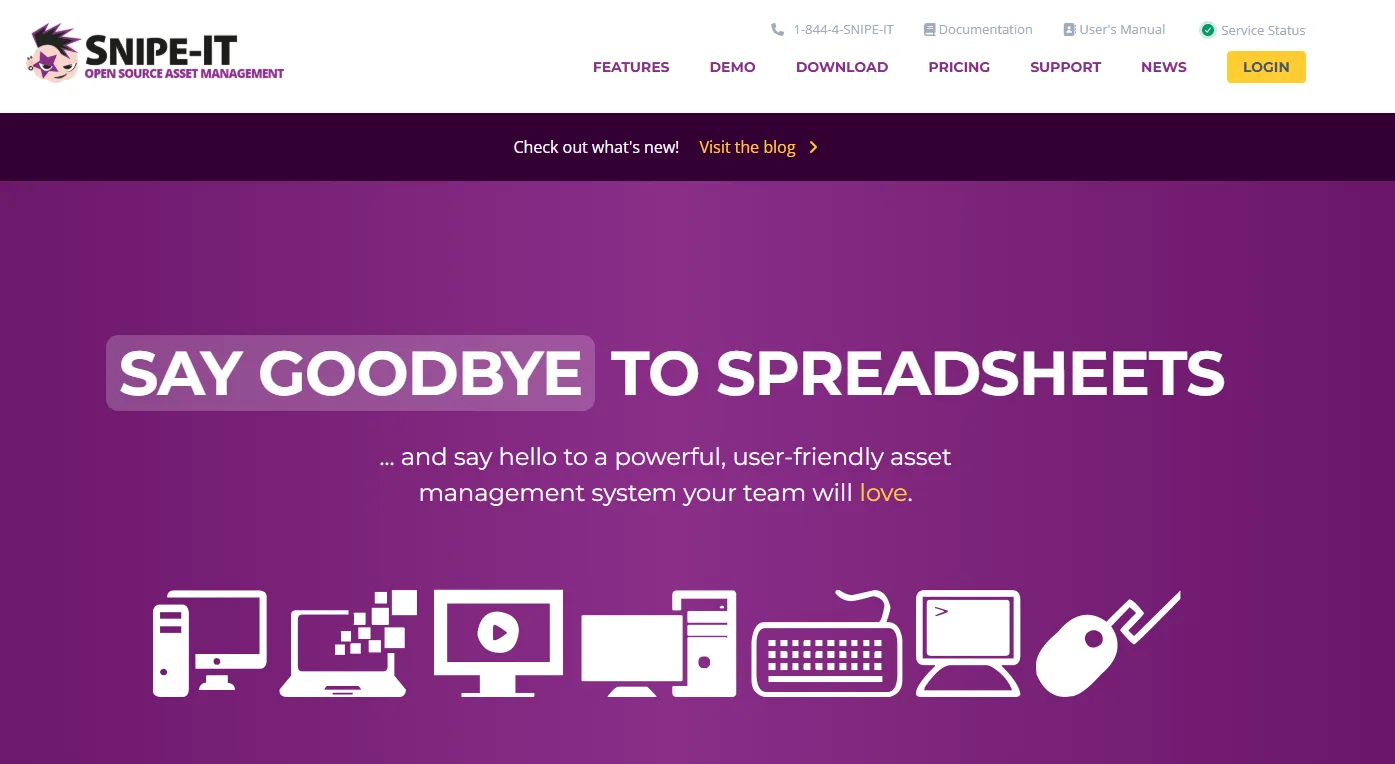
Who it's for: Small to mid-size IT teams that want GLPI's open-source philosophy without the configuration overhead. If you're comfortable self-hosting (or want a managed cloud option) and your primary need is asset tracking with a cleaner interface, Snipe-IT is a strong fit.
Snipe-IT is open-source IT asset management software built specifically for tracking physical assets, licenses, and accessories. If you left GLPI partly because of vendor lock-in anxiety, Snipe-IT speaks directly to that concern: you can self-host it, let them host it, or fork the entire codebase. Your data stays exportable no matter what.
Key features
- Open-source with full code visibility on GitHub, so you can audit security and standards yourself rather than taking a vendor's word for it
- Cloud-hosted option with a 99.99% SLA uptime guarantee and global data centers
- Asset check-in/check-out tracking with full history, barcode scanning, QR code labels, and digital signature acceptance
- REST API for building custom automations, plus LDAP sync, SAML login, SCIM provisioning, and integrations with Jamf and Kandji
- License management with expiration alerts and built-in email notifications for both admins and end users
Limitation
Performance can lag under heavy use, which slows down day-to-day operations. Users have also reported gaps in notifications, particularly around duplicate asset assignments and license expiration alerts. And like every tool on this list, Snipe-IT tracks your assets. It doesn't ship, retrieve, or repair them.
ManageEngine ServiceDesk Plus
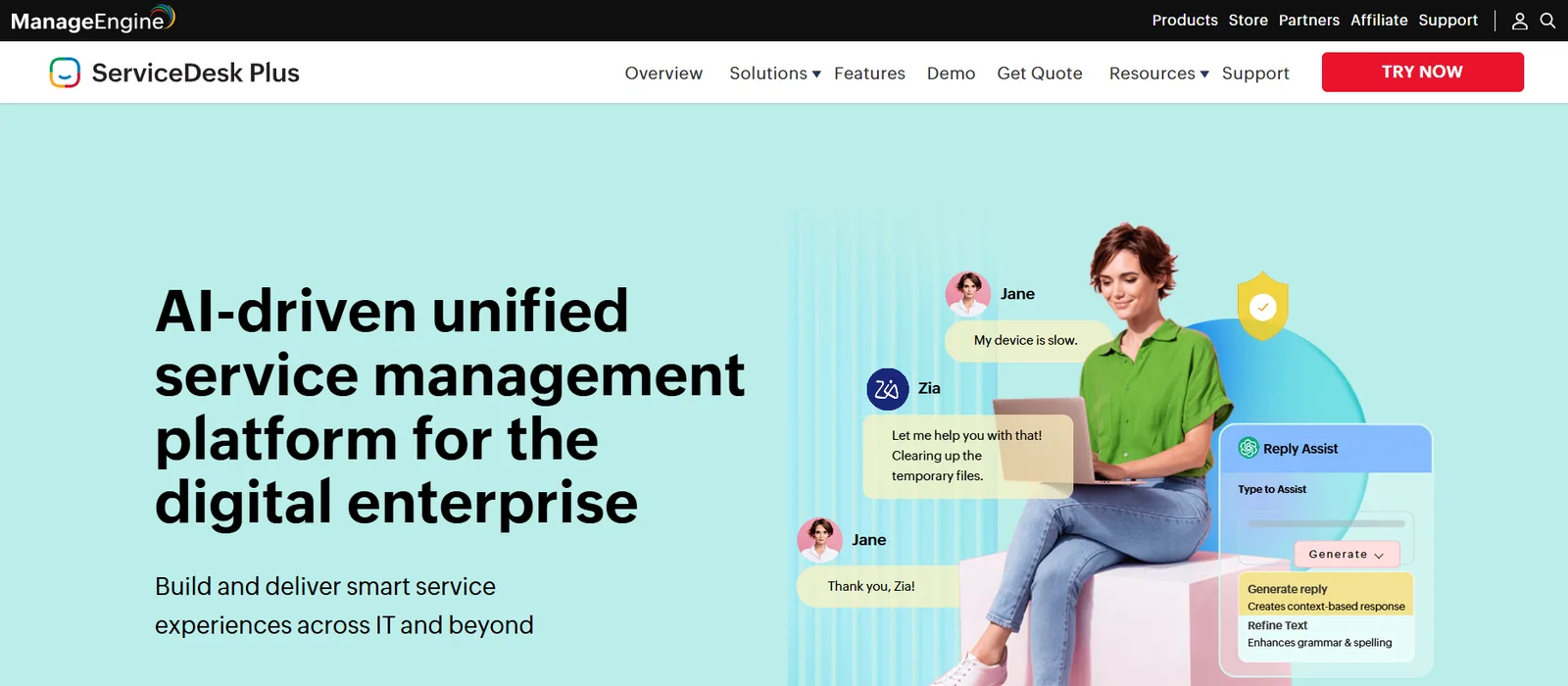
Who it's for: Mid-size to large IT teams that want ITIL-aligned workflows and a broad feature set under one vendor. It works best if you're already in the ManageEngine ecosystem and need enterprise service management beyond just IT.
ManageEngine ServiceDesk Plus is a unified service management platform that bundles ITSM, IT asset management, and a CMDB into one product. It's been around for 20 years and includes 14 ITIL-certified practices and 10 PinkVERIFY-certified practices, which tells you a lot about its position in the market.
If you're coming from GLPI and want something with more structure out of the box, ServiceDesk Plus offers that, both on-premises and in the cloud, with the option to migrate between the two.
Key features
- AI-powered ticket triage, routing, and sentiment analysis through a built-in ML prediction engine, with no additional cost across all editions
- Virtual support agent (Zia) that handles end-user requests through text and voice conversations
- GenAI integrations with ChatGPT and Microsoft Copilot for knowledge discovery, script generation, and request summarization
- A multi-instance model that lets you run separate service desk instances with data and process segregation across departments like HR, facilities, and finance
- Low-code customization for building custom modules, forms, configurations, and reports
Limitation
The UI feels dated and heavy, especially in larger environments. Cloud-hosted plans can run noticeably slow. Initial setup and workflow customization are time-consuming, and advanced features need extra configuration and training. Integration gaps are a real issue too; some users have had to keep legacy ticketing systems running alongside ServiceDesk Plus because the connectors couldn't fully replace existing workflows.
Freshservice
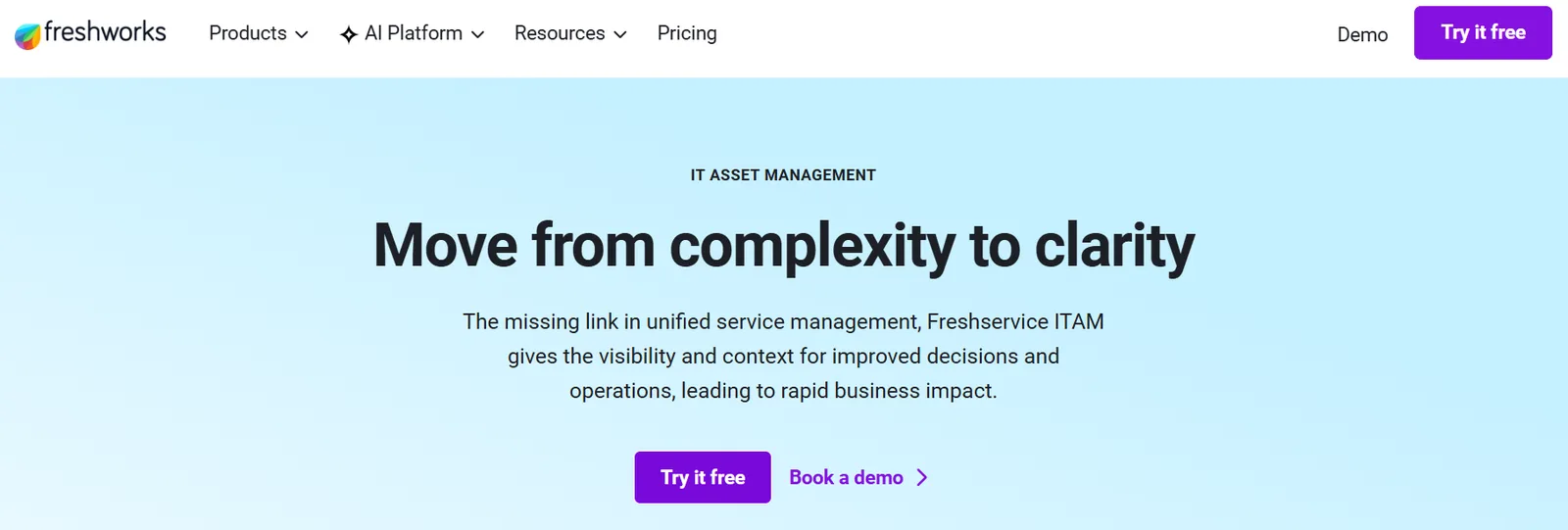
Who it's for: Lean IT teams at mid-size companies who need a polished ITSM platform without a long implementation timeline. If your biggest complaint about GLPI was the time sink of maintaining it, Freshservice is the opposite end of that spectrum. Just be prepared for the price tag that comes with it.
Freshservice is Freshworks' cloud-native ITSM platform and is probably the most approachable option on this list for teams that want to get up and running quickly. While GLPI demands upfront configuration time, Freshservice leans the other way with an intuitive design and built-in AI. It bundles ITSM, ITAM, and IT operations management together, with enterprise service management extensions for HR, facilities, and finance teams.
Key features
- Automated discovery across on-prem, cloud, and hybrid environments to maintain an audit-ready asset inventory without manual entry
- Software license management that tracks usage, flags waste, and helps you right-size spend across your stack
- Dependency mapping that visualizes how apps, services, and infrastructure connect, so you can plan changes without guessing what might break
- Freddy AI Copilot that surfaces related past incidents linked to similar assets, generates post-incident reports, and drafts audit-ready summaries
- Freddy AI Agent that handles software access requests end-to-end; employees describe what they need, and the request gets raised and fulfilled automatically
Limitation
Subscription costs run high, and the features that make Freshservice worth it are often locked behind upper-tier plans. Customization can feel restrictive; forms don't support table fields in service requests, and adapting the portal to specific business needs takes more workaround than you'd expect. The AI agent also has accuracy issues, sometimes misinterpreting requests and submitting tickets that don't match the user's request. There's no built-in remote access capability either.
TOPdesk
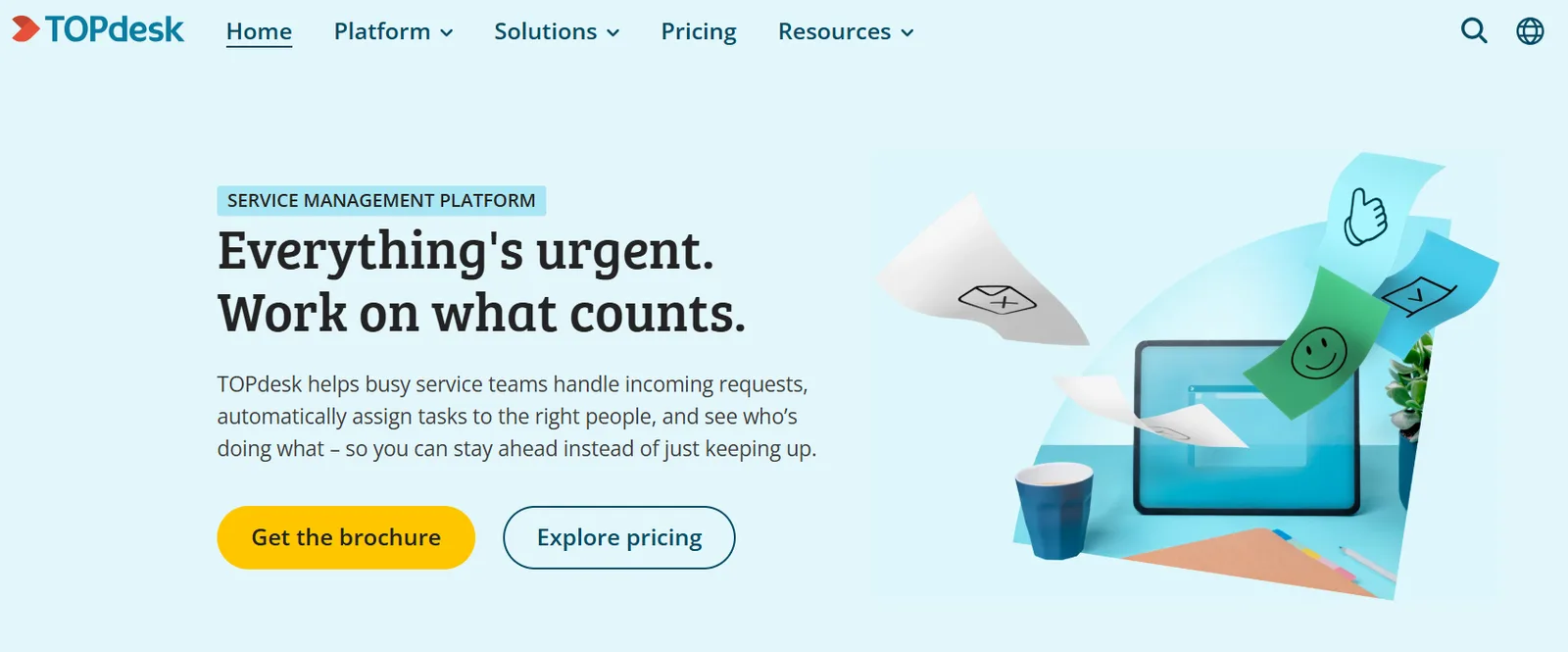
Who it's for: Mid-size service teams (IT, facilities, HR) that want a guided setup and a platform they can maintain internally without technical staff. TOPdesk works well if you value a quick implementation backed by vendor support.
TOPdesk is a service management platform with over 30 years of ITSM experience. It positions itself as a standard tool that's flexible enough to personalize.
Where GLPI demands significant configuration to get workflows running the way you need them, TOPdesk gives you a pre-configured starting point and lets you tweak from there, without coding or consultant dependencies.
It covers ITSM, facility management, and enterprise service management on a single platform.
Key features
- Automatic ticket categorization, prioritization, and agent assignment so incoming requests get routed without manual sorting
- Knowledge management that captures resolved ticket solutions and makes them reusable, so agents aren't solving the same problems twice
- Asset management with a graphical overview of location, ownership, repair status, and network connections across all asset types
- Self-service portal that combines a knowledge base, service catalog, and request tracker, giving end users 24/7 access to FAQs, orders, and ticket status
- Planned preventative maintenance scheduling with graphical overviews for recording activities and scheduling asset replacements
Limitation
Users find their ticketing system click-heavy; sending a single message takes more steps than it should. Workflow-based email alerts are difficult to configure and time-consuming to get right, with triggers that don't always work as expected. Some users have reported weeks of delays getting alert workflows to function properly. There's no option to send acknowledgments to external stakeholders outside your organization, and automatic email allocation isn't available either.
What Every GLPI Alternative Has in Common
Every tool above does something GLPI does, but with a cleaner UI or less configuration overhead.
But none of them ships a laptop to a new hire in Bucharest. Nor do any of them retrieve one from an ex-employee in another country. They cannot handle the customs paperwork when you need to move 30 devices into places like India, where every state has different shipping requirements.
That's the blind spot. Every GLPI alternative manages your asset records. None of them manages your actual assets. And the cost of that gap is:
- 500 IT staff hours per year for every 100 remote employees just to handle device logistics: procurement, shipping, address confirmations, "where is my laptop" email chains.
- $100 per remote employee per year in shipping costs alone, because distributed workforces turn every delivery into a per-employee line item instead of a bulk office shipment. For a 1,000-person company, that's $100K annually.
- $250K in hidden headcount costs per 1,000 employees, because 5,000 annual logistics hours is equivalent to 2.5 full-time IT positions at $100K average salary.
- $67.5K in lost laptops per year at a 1,000-person company, even assuming an above-average 70% retrieval rate. And that's just laptops; according to Gartner, monitors and peripherals are almost never collected.
This is the gap that device lifecycle platforms like Firstbase fill. Not by replacing your ITAM tool, but by handling the physical work your ITAM software was never designed to do.
How Firstbase Works Alongside Your ITAM Tool
Firstbase isn't a GLPI alternative. It doesn't compete with any of the tools above. It's the operations layer that handles all the physical work that ITAM software assumes someone else is doing.
For example, your ITAM tool tracks Device #2847 as "assigned to Francis, Berlin office." Firstbase is what actually got it to Francis' apartment before their start date, and what gets it back when they leave.
How it connects to your existing stack
Firstbase integrates with HRIS platforms so that employee lifecycle events automatically trigger device actions. When HR updates an employment status, Firstbase kicks off the corresponding workflow within 24 hours. A new hire added to Workday gets an email prompting them to select their equipment. An employee marked as terminated triggers a retrieval, with boxes, labels, and pickup coordination sent directly to their home address.
Companies like New Relic ran this exact setup. Their team integrated Firstbase with Workday, and the return process now initiates automatically every night; no IT intervention required.
What Firstbase handles that your ITAM tool doesn't
- Procurement and deployment: Pre-configured, MDM-enrolled devices shipped from regional hubs. Customers have gone from storing 100 laptops in an IT closet to deploying globally across India, Romania, and Germany, growing from 160 to 300 employees in under a year.
- Retrievals: Departing employees confirm their address in the platform, receive a retrieval kit at home, and leave it for carrier pickup. Firstbase consistently hits 90%+ retrieval rates, with a turnaround of less than 30 days from offboarding to wiped-and-ready inventory. The industry average for retrieval rates sits between 30% and 50%.
- Refurbishment and redeployment: Retrieved devices get cleaned, wiped, graded, and returned to deployable inventory. Customers report recouping $175,000+ in asset value through device reuse after partnering with Firstbase during an M&A restructure.
- Global logistics in 150+ countries: Customs, duties, VAT, carrier coordination, and region-specific shipping regulations are handled by Firstbase's operations team.
Today we're at almost 300 people, and we still have only three IT team members. We're a very lean team trying to be as efficient as possible. Removing the task of boxing up computers and driving to FedEx has allowed us to tackle larger projects and strategic initiatives, which has been a game-changer for our IT department.
Jared Allenbrand
Pick the ITAM tool that fits your team. Then pair it with the operations layer that makes your asset data mean something in the physical world.
How to Choose the Right GLPI Alternative for Your Situation
The right pick depends on what's actually causing friction for your team. Are you fighting GLPI's configuration overhead, or the physical logistics that no ITAM tool handles? Maybe both.
This framework helps you match your situation to the right tool.
| If your primary pain is... | Consider | Why |
|---|---|---|
| GLPI's maintenance overhead, but you want to stay open-source | Snipe-IT | Self-host or cloud-hosted with 99.99% uptime SLA, full code visibility on GitHub, and no vendor lock-in |
| Lack of ITIL structure and cross-department service management | ManageEngine ServiceDesk Plus | 14 ITIL-certified practices, multi-instance model for HR/facilities/finance |
| Slow setup and too much admin time before the tool is usable | Freshservice | Cloud-native, built-in AI, fastest time-to-value on this list |
| No guided implementation, and your team isn't technical enough to self-configure | TOPdesk | 30+ years of best practices baked into a pre-configured starting point |
| The software is fine; your real problem is physically getting devices to employees and back | Firstbase (alongside any ITAM tool above) | Handles procurement, global shipping, retrievals, and redeployment in 150+ countries |
Is Your GLPI Alternative Solving the Right Problem?
We've compared four GLPI alternatives on feature depth and where each one falls short. Pick whichever fits your tracking needs. But if your team is spending hours every week on physical device logistics, the ITAM tool isn't the whole answer.
Firstbase works alongside whichever platform you choose and handles what none of them do: procuring and shipping pre-configured devices globally, retrieving them when employees leave, and returning refurbished hardware to your deployable inventory. Your HRIS triggers the workflow; Firstbase executes the physical outcome without any FedEx runs, customs paperwork, or chasing ex-employees over email.
Customers have automated 75% of their equipment lifecycle management, retrieved 1.5x more laptops for reuse, and cut IT tickets by 50% within three months of going live.
Book a demo to see how it works with your stack.
Written by
Ahmad Zakaria
Ahmad Zakaria covers IT operations, hardware lifecycle management, and distributed workforce solutions at Firstbase. His content is built from real customer data, operator interviews, and hands-on experience managing devices across 150+ countries.
Get started with
Firstbase today
Remote and hybrid work aren't going anywhere. It's our mission to make it easier to manage the assets your distributed team needs—from onboarding through offboarding and every repair, replacement, and upgrade in between.
Fill out the form and a member from our team will reach out by phone!
Get a Live Demo