Asset Panda Alternatives for ITAM, Device Retrieval, and ITAD
Compare Asset Panda alternatives built for distributed IT teams managing devices across borders.
 Ahmad ZakariaMay 26, 2026
Table of contents
Asset Panda works best when the main job is keeping a clean asset register. It gives IT teams a structured way to log devices, scan barcodes, and run audits. Many IT teams start there, only to face challenges as the fleet grows and the stack gets more complex.
We found user reviews pointing to three recurring complaints:
- Costs rise once the asset count increases.
- Manual data entry feels slow and tedious.
- Integrations fall short for common stacks, including Jamf and Google Workspace, which block workflow automation.
Those issues matter, yet a bigger issue lies underneath. Asset tracking does not handle cross-border delivery, customs and tax surprises, break-fix swaps, or reliable retrieval at offboarding. These failures will soon make your inventory problem an operations and cost problem.
So this blog covers Asset Panda alternatives for distributed companies with roughly 50 to 15,000 employees hiring and offboarding across multiple countries. That includes procurement, in-country fulfillment, delivery, support, swaps, and retrieval.
That is the lens for this comparison. We will cover tools that improve tracking, plus platforms like Firstbase that handle the full device lifecycle across borders for remote teams. In fact, it's the only option in this comparison built to cover both sides in one system, the digital record and the physical movement of hardware, from procurement and global shipping to retrieval and end-of-life handling, all tied to the same asset record.
Keep reading to find the best fit for your team.
TL;DR: The top Asset Panda alternatives at a glance
| Platform | Best for | Pros | Cons | Lifecycle scope |
|---|---|---|---|---|
| Firstbase | Distributed teams with 50–15,000 employees across many countries | Covers procurement to retrieval across 150+ countries, 48-hour delivery, per-seat pricing, and audit trail | Reporting needs improvement | Full lifecycle layer, physical plus records, procurement, deploy, support, retrieve, end-of-life |
| Snipe-IT | Teams wanting low lock-in ITAM | Self-host, hosted, 99.99% uptime SLA, API, Jamf, and Jira integrations | Alerts can be missed, and UI feels dated | Digital record and tracking; no physical logistics layer |
| NinjaOne | IT teams needing endpoint control at scale | Patching across Windows, macOS, Linux, 6,000+ apps, 100+ monitoring templates | Ticketing and reporting limits | Digital endpoint lifecycle, monitoring, maintenance, enforcement; no procurement or logistics |
| ManageEngine AssetExplorer | Multi-site ITAM with discovery plus CMDB context | Agent and agentless discovery, barcode, QR, license compliance | Complex setup, customization load, and add-ons add cost | Digital lifecycle workflows from procurement to retirement; no global hardware movement layer |
| SolarWinds Web Help Desk | Ticketing and SLA management | Email-to-ticket automation, routing rules, asset-ticket mapping, WMI discovery for Windows assets | No change management, dated features, and weak mobile experience | Ticketing and asset history inside your environment; no cross-border delivery or retrieval ops |
| Ivanti Neurons | Enterprise teams unifying ITSM, endpoint, and exposure visibility | Unified ITSM, endpoint, and security, multi-source discovery, vulnerability context | Learning curve, modules can feel disjointed, customization takes time | Digital lifecycle, discovery and workflows from procurement through disposal; no physical logistics layer |
Teams using Firstbase save 700+ hours by avoiding internal coordination for logistics, decommissioning, and redeployments. And they see 75% time savings across the equipment lifecycle, which frees IT to reclaim thousands of hours each year. Take a self-guided tour to see what that looks like in practice.
The hidden costs of manual device logistics
An ITAM tool like Asset Panda helps you track ownership and status. But it does not run the work that makes a remote fleet function. After you assign a device, someone still has to procure it, ship it, clear customs, handle break-fix, and retrieve it at offboarding.
Teams often manage those steps through email threads, local couriers, and spreadsheets. The effort looks manageable until you hire across countries. Then the costs show up across IT, Finance, and HR.
| Team | Impact | Cost or risk signal |
|---|---|---|
| IT | Every delay or break-fix turns into tickets, follow-ups, and escalations. | $22 average cost per help desk ticket |
| Finance | Missing retrievals become write-offs, and unclear custody raises security exposure. | $49,246 average value of a lost laptop |
| HR Ops | Day 1 readiness suffers when devices and tools arrive late | Tech disruptions tied to nearly $4M annual productivity loss at 2,000 employees |
With Firstbase we can onboard with quicker notice and in a very seamless fashion, globally. We're able to click a few buttons and ensure our machines are returned, inventoried, and reused with ease. We have saved days of time each month for our IT team. The impact for international shipping and device management alone has been a lifesaver.
Allie Winkelman, Director of Learning and Development, Thrive Global
Tracking vs managing: what's the difference
Tracking answers where the asset is, who holds the asset, and what status belongs on the record. On the other hand, managing answers how a team gets the right device to the right person, with predictable lead times, predictable landed cost, and a plan for support and retrieval.
Remote teams fail in the second part more often than the first. That is why this blog separates tools into two groups. Some alternatives improve tracking, discovery, and internal workflows.
Others add a lifecycle operations layer, procurement, fulfillment, swaps, retrieval, and end-of-life, so your asset data shows what's happening in the real world. Firstbase fits in this second group.
How we've curated the list
You'll see each platform ranked based on what matters for remote-first teams.
- First, how well does it reduce manual work inside IT, like discovery, tracking, reporting, and support workflows?
- Second, how does it handle the physical device lifecycle for remote teams, procurement, delivery coordination, swaps, retrieval, and end-of-life?
- Third, where does it fit best, given your team size, workflow, and the environment in which the tool makes sense?
- Lastly, why is it a credible Asset Panda alternative for that use case, whether through stronger discovery, endpoint control, service desk workflow, or a full-lifecycle layer?
Top 2026 Asset Panda alternatives
We used the same evaluation criteria across every option in this roundup. Here's the list of the best Asset Panda alternatives.
1. Firstbase
Ideal for: Distributed teams with 50–15,000 employees across many countries
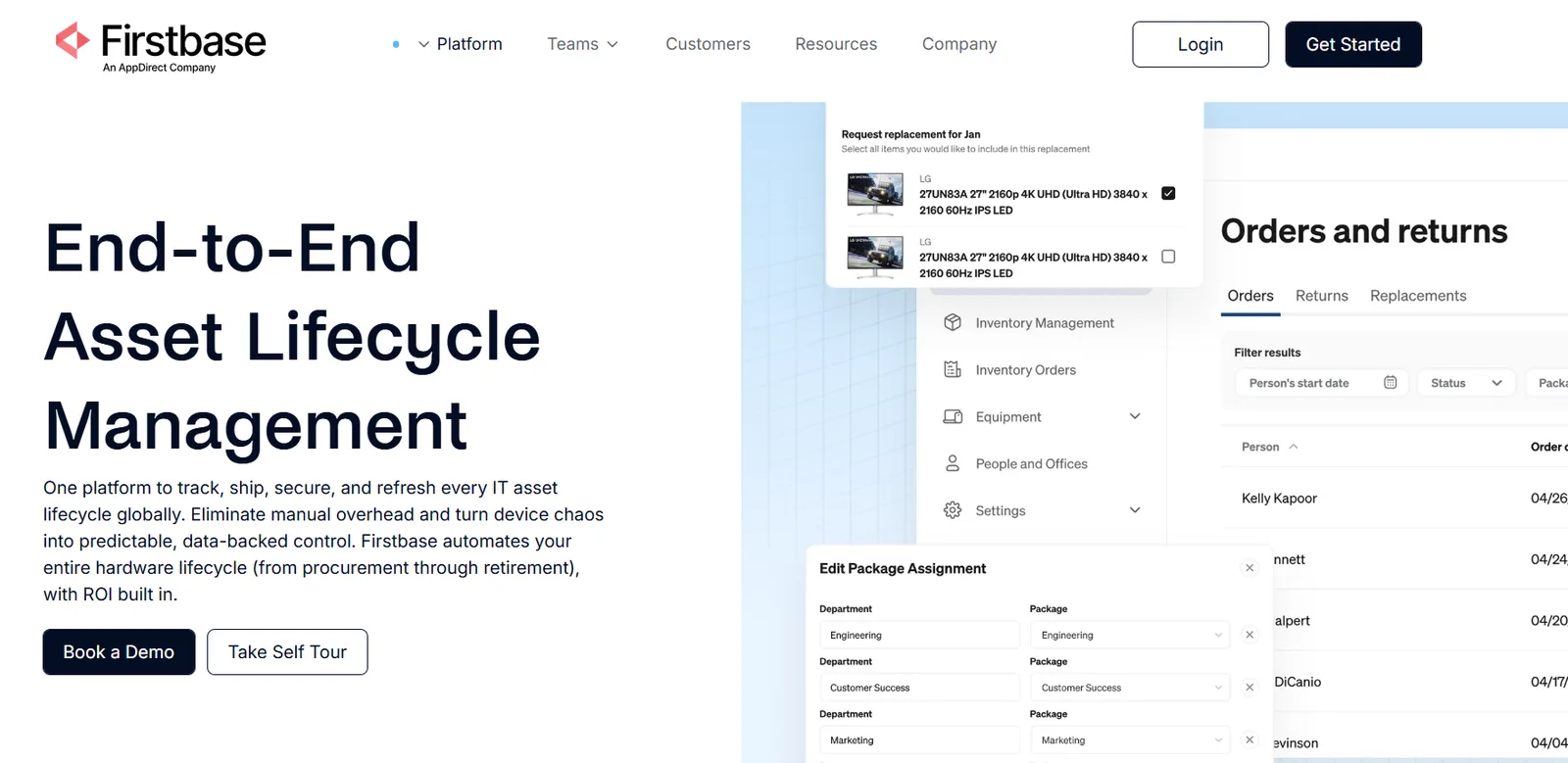
Firstbase handles the full equipment lifecycle from procurement and deployment to management and retrieval across 150+ countries. It supports both growing teams of 50 and global teams of 15,000. You can procure, deploy, manage, and retrieve laptops, monitors, keyboards, and other gear in one place. The platform shows every device in one view across regions like India, the UK, and the US. The system automatically logs assignments, transfers, and lifecycle events, so your teams don't have to rely on spreadsheets and manual updates.
What Firstbase offers
- Virtual IT closet with 100% self-serve requests: Employees can pick from a catalog, and approvals route through the right owners. So, HR, IT, and Finance avoid endless back-and-forth.
- SLA-backed delivery windows by region: Firstbase uses global warehouses and region-specific SLAs, with delivery or pickup in as little as 48 hours for most major markets.
- Predictable per-seat pricing tied to the full lifecycle: Finance can forecast spend as headcount shifts, without last-minute freight charges and one-off orders.
- Compliance-grade audit trail: Every lifecycle event is logged with exportable records to support SOC 2, HIPAA, GDPR, and CCPA requirements without manual reconciliation.
Limitations
The platform's reporting has room for improvement, according to user feedback. Support issues can still occur, though escalation can be hands-on.
Lifecycle scope
Asset Panda's focus is on tracking but not logistics. It helps you record and locate assets. Yet, it does not handle global delivery, retrieval, resale, ITAD, or customs coordination. Firstbase closes the loop with SLA-backed logistics, global retrieval, ITAD, and resale. So your teams can manage procurement through end-of-life in one system rather than manually coordinating with vendors.
How Firstbase works with your current ITAM: Firstbase does not replace your ITAM system of record. It handles the physical lifecycle layer your ITAM does not run, including procurement, shipping, swaps, retrieval, and end-of-life operations. Your existing ITAM continues to store asset records, ownership, and reporting, while Firstbase executes the work that keeps devices moving across the lifecycle.
Best fit for
Distributed organizations that want to remove shipping chores from IT, HR, and Finance, and run global equipment ops with fewer manual steps.
Strength & Trade-offs
Strong full-lifecycle coverage across 150+ countries with SLA-backed logistics and per-seat pricing. Reporting and support responsiveness have room to improve based on user feedback.
2. Snipe-IT
Ideal for: Teams wanting low lock-in ITAM with self-host or hosted options
Snipe-IT is built for IT asset management and helps teams track which laptop each team member has, purchase dates, software licenses, and accessories. Unlike Asset Panda, you can run Snipe-IT on your own servers, use its hosted cloud plan, or use the source code to customize the product for your needs. Data export is built in, so you keep control of your records. Snipe-IT highlights 13+ years in the market. On its hosted cloud plan, it lists a 99.99% uptime SLA, a low-latency global network, and region selection so data stays in the region you choose.
What Snipe-IT offers
- Asset management: Track assignments, locations, status, one-click check-in, asset histories, and model-based grouping.
- License management: Track licenses, support multi-pack licenses, and send email alerts for upcoming expirations.
- Integrations and API: Connect with Jira, Jamf, and Kandji, and a REST API for custom workflows.
- Security and access: bcrypt password hashing, two-factor authentication, HTTPS-only cookies. It also supports for 55+ languages with a mobile-friendly interface.
Limitations
Some users report missed alerts for dual asset holders and license expirations, which reduces trust in reminders. The interface can feel dated, with fewer built-in features compared to newer tools.
Lifecycle scope
Snipe-IT focuses on the digital record. It doesn't cover what Firstbase does—hardware sourcing, bonded warehousing, zero-touch deployment, shipping, and end-of-life handling.
Best fit for
IT teams that want a flexible, low lock-in asset tracker with self-host or hosted options, strong basics, and API access.
Strength & Trade-offs
Flexible deployment options (self-host, cloud, open source) with strong basics and 13+ years track record. Alert reliability and dated UI are noted trade-offs.
3. NinjaOne
Ideal for: IT teams needing endpoint control at scale
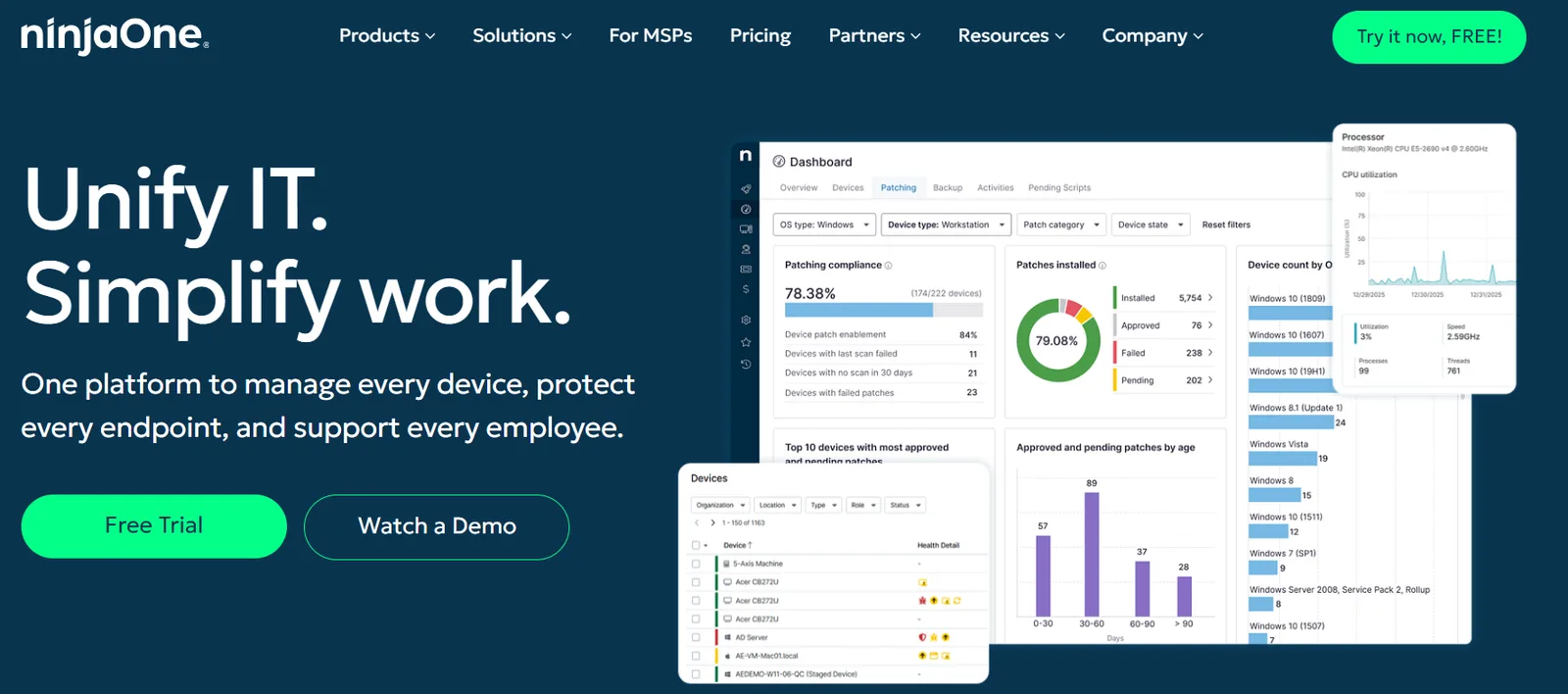
NinjaOne positions itself as one platform to manage every device, protect every endpoint, and support every employee. It centralizes endpoint visibility, device management, and user support for distributed environments, with real-time insight into device health, configurations, and compliance status. It also focuses on reducing manual work by automating patching, deployments, configurations, and compliance enforcement. Compared with Asset Panda, NinjaOne goes beyond tracking and audits by adding day-to-day endpoint control and remote troubleshooting.
What NinjaOne offers
- Multi-platform patching: Automates patching across Windows, macOS, Linux, and 6,000+ applications using policies and prioritization.
- Real-time device insight: Tracks hardware, software, warranty status, and performance data for faster decisions.
- Monitoring and alerts: Unified endpoint visibility with custom alerts, and 100+ monitoring templates.
- Remote actions: Supports security and troubleshooting actions like lock or wipe, passcode resets, device restrictions, and remote screen view on mobile devices.
Limitations
Ticketing and ITIL expectations can fall short, with limited reporting unless you add external tools. Some users also report slow or frustrating remote access experiences.
Lifecycle scope
NinjaOne runs what happens on the device after it is in an employee's hands: monitoring, patching, policy enforcement, and remote support. It does not run the physical side of distributed fleets, like getting hardware to employees in different countries, coordinating swaps and returns, or handling end-of-life processing as Firstbase does.
Best fit for
IT teams managing large, mixed OS fleets that need patching, monitoring, automation, and remote support in one console.
Strength & Trade-offs
Excellent multi-OS patching and endpoint monitoring with 6,000+ app support. Ticketing limits and occasional remote access issues are trade-offs.
4. ManageEngine AssetExplorer
Ideal for: Multi-site ITAM with discovery plus CMDB context
ManageEngine AssetExplorer is for teams that want asset data pulled from the network, then governed through structured ITAM processes. It supports quick deployment for multi-site environments. Then, it adds automated hardware and software discovery, inventory management, purchase and vendor tracking, and a CMDB to map configuration items and dependencies. As an alternative to Asset Panda, which highlights flexible tracking and 20+ native integrations, AssetExplorer places more emphasis on discovery and CMDB context to reduce manual entry and improve multi-site accuracy.
What ManageEngine AssetExplorer offers
- Discovery and inventorying: Agent-based and agentless discovery plus automated scans, barcode, QR, and RFID support.
- Software and license controls: Handles reconciliation, usage monitoring, unauthorized software tracking, and license compliance.
- Workflow and automation: No-code and low-code automations for lifecycle workflows, notifications, and user assignment options, like login-history-based assignment.
- CMDB plus commercial tracking: CMDB views, purchase orders, vendor tracking, and contract management with expiry alerts.
Limitations
Early setup can feel overwhelming, with many features to configure, and add-ons can cost extra. Customer service quality is also a repeated complaint in some feedback.
Lifecycle scope
AssetExplorer only manages the asset lifecycle through digital workflows and reporting. But Firstbase adds HR-triggered retrieval workflows with courier pickups, logistics, and customs handling, and end-of-life processing with NIST 800-88 wipes and certificates tied to the asset record.
Best fit for
IT teams that are looking for discovery-led inventory, license compliance, CMDB visibility, and purchase controls across multiple sites.
Strength & Trade-offs
Comprehensive discovery (agent + agentless) with CMDB and license compliance. Complex setup and add-on costs are the main trade-offs.
5. SolarWinds Web Help Desk
Ideal for: Ticketing and SLA management
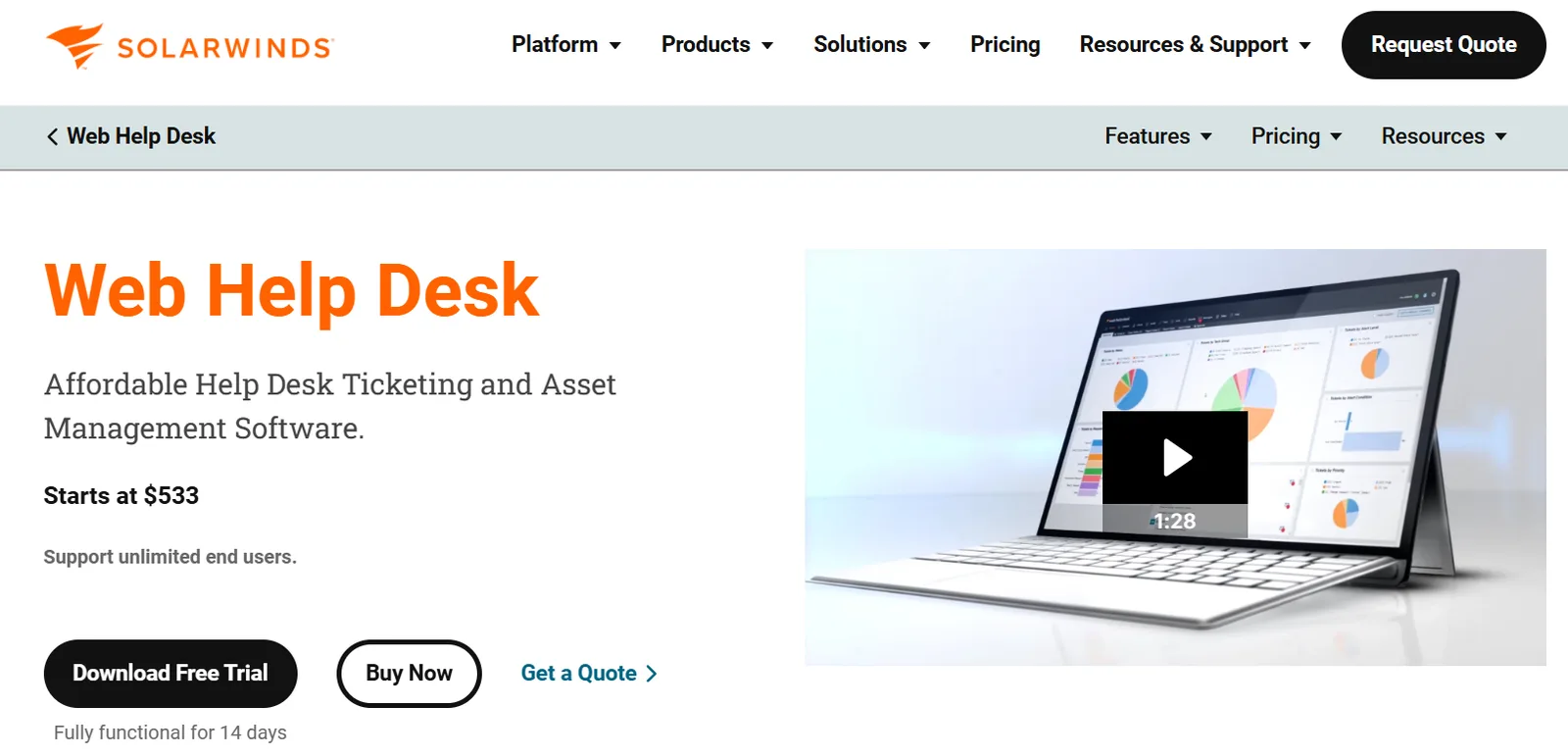
SolarWinds Web Help Desk is built around ticket flow with built-in IT asset tracking. It automates ticket intake and routing, converts email requests into tickets, and links tickets to assets so you can see service history tied to a device. It also discovers Windows assets using WMI and captures hardware, peripherals, and installed software in your network. It is a stronger pick when your biggest problem is ticket volume and SLA control. Asset Panda leans into mobile-first asset tracking, barcode, and QR scanning. But Web Help Desk leans into service management and asset-to-ticket traceability.
What SolarWinds Web Help Desk offers
- Ticket automation: Email-to-ticket conversion, routing rules, task handoffs across departments, and unattended or unassigned alerts by email or SMS.
- Asset and ticket mapping: Associate problem tickets with assets and track service requests, complaints, and history per device.
- Discovery and inventory: Scheduled discovery for Windows assets using WMI, plus inventory import from third-party discovery and network tools.
- Reporting and SLA control: Built-in reporting for tech performance and satisfaction indicators, custom reports, scheduled email delivery, SLA monitoring, escalations, and KPI-focused SLA reports.
Limitations
WHD does not include change management. Some features feel dated, the mobile view is not friendly, and there is no mobile app.
Lifecycle scope
Web Help Desk manages service operations for devices already inside your environment. It does not cover procurement, warehousing, cross-border delivery coordination, swaps logistics, retrieval, ITAD, or resale, which is where remote teams lose time and budget.
Best fit for
IT support teams that need ticket automation, SLA tracking, and asset-linked incident history in one place.
Strength & Trade-offs
Strong ticket automation with asset-to-ticket mapping and SLA control. Lacks change management, has a dated mobile experience, and no mobile app.
6. Ivanti Neurons
Ideal for: Enterprise teams unifying ITSM, endpoint, and exposure visibility
Ivanti Neurons aims to run IT service management, endpoint management, and security as one connected system. It also offers asset discovery and IT asset management modules that feed inventory data into ITAM, UEM, and CMDB processes. Asset Panda centers on asset tracking workflows, often driven through a mobile app with barcode and QR scanning. If your main gaps are endpoint control, discovery across SaaS and cloud, and exposure visibility, Ivanti Neurons targets those needs more directly than a tracking-first tool.
What Ivanti Neurons offers
- ITAM lifecycle tracking: Tracks lifecycle steps from request through purchase, receipt, deployment, and disposal, with dashboards and barcode support.
- Discovery and inventory: Active and passive scanning, source-agnostic discovery across SaaS, cloud, OT, and IoT, and legacy systems.
- Integrations and consolidation: Integrations include Google Chrome Enterprise, Azure AD, AWS, ServiceNow, and Jamf for consolidated asset data.
- Risk and software control: Aggregates vulnerability findings from tools like Tenable, Rapid7, and Qualys alongside native scans.
Limitations
A steep learning curve slows time-to-value for many teams. The modules can also feel inconsistent in look and flow, which adds friction across teams.
Lifecycle scope
Ivanti manages the digital asset lifecycle through workflows, discovery, and reporting, from procurement through disposal. Firstbase adds the physical hardware layer, procurement, global fulfillment, and recovery operations worldwide, with a published 97% hardware recovery rate.
Best fit for
Mid-market and enterprise orgs that need unified ITSM, endpoint, security, and discovery, plus governance and compliance reporting.
Strength & Trade-offs
Unified ITSM + endpoint + security platform with source-agnostic discovery. Steep learning curve and inconsistent module UX are the main trade-offs.
ITAM vs Lifecycle Operations for Remote Teams
By the time a laptop goes missing at offboarding or an auditor asks for wipe-proof, an ITAM record stops being enough. A lifecycle layer runs the real work around the device, ordering, shipping, support, retrieval, wipe, and end-of-life recovery. The difference shows up most during offboarding and audits.
| What matters | ITAM layer | Firstbase lifecycle layer |
|---|---|---|
| Offboarding trigger | Manual follow-ups when HR updates happen | HR system alert triggers the workflow. Address verification runs and return kit ships. Pickup gets scheduled. |
| Retrieval speed and success | Inconsistent timelines, higher loss risk | Devices return within 30 days on average. Average 97%+ retrieval rate. |
| Security and audit trail | Policy exists, evidence collection takes work | NIST 800-88 wipe with certificate attached to the asset record. Chain-of-custody log. SOC 2 Type II, ISO 27001, GDPR-aligned reporting. |
| End-of-life outcomes | Opaque ITAD, little visibility on value | Devices get graded, wiped, logged, then remarketed when eligible. Resale credits are issued quarterly with per-asset reporting. |
| Business impact | Costs hide in tickets, shipping spend, and unreturned devices, so ROI is hard to prove. | $125 saved per departing employee. 700+ IT hours reclaimed and $175,000+ residual value recouped. 1.8x better tracking and 1.6x faster retrieval rates. |
| Value recovery | End-of-life is usually a disposal cost with limited visibility. | 40% to 65% of asset value recovered per device. Certificate of destruction for each disposal. |
What's Next?
If you are comparing tools, decide what you are trying to fix. Better records, or fewer device problems in the first place. Asset data helps, but it will not ship a laptop, swap a failed device, or recover equipment after offboarding.
Firstbase handles those operational steps in one place, so your IT team spends less time coordinating vendors, tracking parcels, and chasing returns.
Customers report 5,000 IT hours saved per 1,000 employees each year, around $250,000 in reclaimed time. If you want to see the impact in your environment, book a 30-minute demo.
Written by
Ahmad Zakaria
Ahmad Zakaria covers IT operations, hardware lifecycle management, and distributed workforce solutions at Firstbase. His content is built from real customer data, operator interviews, and hands-on experience managing devices across 150+ countries.
Get started with
Firstbase today
Remote and hybrid work aren't going anywhere. It's our mission to make it easier to manage the assets your distributed team needs—from onboarding through offboarding and every repair, replacement, and upgrade in between.
Fill out the form and a member from our team will reach out by phone!
Get a Live Demo