Managed Service Providers in Europe: Costs, Coverage, and the Lifecycle Gap
Best Managed Service Providers in Europe for 2026 & How to Evaluate Them
 Ahmad ZakariaDecember 10, 2025
Table of contents
Europe's managed services market is at roughly $85 billion, on track to almost triple by 2033. But as IT, Finance, and HR know, growth means little when devices cross borders slowly, duties spike unexpectedly, or retrievals slip through the cracks.
MSPs keep doing what they’re good at: monitoring, patching, securing. But it’s platforms like Firstbase that handle the lifecycle logistics that they don’t: EU-aware procurement, bonded storage, 48-hour deployments and pickups in key lanes, and high retrieval success with certified ITAD, all under predictable per-seat economics.
So, how do you ensure you’ve got the right managed service provider?
In this guide, you’ll get a clear 5-factor rubric for comparing managed service providers in Europe, a breakdown of leading MSPs, and how Firstbase plugs into any contract to close the hardware gap.
TL;DR Top Managed Service Providers Europe at a glance
| Platform | Lifecycle Layer | SLAs / Uptime | Pricing Transparency | Global Coverage | Service Breadth |
|---|---|---|---|---|---|
| Bechtle AG | IMAC/RD, repair, disposal, HaaS; no cross-border logistics | SLA-backed repair, 24/7 support | Not transparent | 14 European countries | Service desk, workplace, networks, data centre, security |
| Kyndryl | Device management only; no shipping, retrievals or ITAD | Response, resolution, availability + data reliability | Not transparent | 60+ countries | Hybrid cloud, mainframe, security, app lifecycle, edge |
| DXC | HAM only; no logistics, retrievals, or ITAD | Up to 99.9% SLA compliance | Not transparent | 70 countries | Apps, automation, SAP, cloud platforms, mainframes |
| Claranet | Endpoint management; no hardware logistics | No SLA/uptime figures provided | Not transparent | 11 countries | Multicloud, cybersecurity, networks, workplace support |
| Insight (EMEA) | Device lifecycle from procurement to end-of-life | Enterprise-grade service levels with SLO tracking | Not transparent | 10 EU countries | Managed cloud environments, apps, databases, field services |
Teams using Firstbase see 1.8× better asset tracking and 1.6× higher retrieval success. Take a self-guided tour and see how without changing your MSP or existing tools.
MSPs Sound Alike. How Do You Compare Them?
Most MSPs in Europe market themselves the same way: reliable uptime, fast ticket resolution, security expertise, and a long list of certifications. On paper, it’s hard to tell them apart.
But in practice, the differences show up in places their websites barely touch: coverage across EU countries, how they handle local compliance, and whether they support real device movement rather than just remote management.
This article uses a simple, researchable 5-factor lens to compare MSPs serving Europe. Each factor is something buyers can actually verify:
• Geographic coverage and compliance: where they operate, and whether they understand EU-specific rules.
• Service breadth: what they truly manage, not just what’s listed on a capabilities slide.
• Response and uptime SLAs: the parts MSPs can control and consistently prove.
• Lifecycle and logistics capability: how far they go once hardware needs to move, an area where gaps are common.
• Cost predictability: transparency around freight, duties, add-ons, and overruns.
Europe’s Top Managed Service Providers
Let’s apply this lens to several well-known MSPs operating across Europe and surface where their strengths end, so you can compare and understand where a lifecycle partner like Firstbase fits.
Bechtle AG

Bechtle AG is one of Europe’s largest IT providers, managing more than one million IT workplaces and data-centre systems. Their managed services span service desk operations, workplace support, data-centre management, network and security services, applications, installation, and on-site engineering.
With over 100 local sites, Bechtle focuses on proximity and fast response, combining regional delivery with a multi-vendor service portfolio. They also offer maintenance and repair, Hardware-as-a-Service, and end-to-end lifecycle management, supported by ITIL-aligned processes and ISO-certified quality standards.
Key features
- Centralised service desk: A single contact point for application issues, hardware questions, user administration, and remote support with ITIL-aligned workflows.
- High-availability repair operations: Round-the-clock parts sourcing, nationwide technician access, and restore commitments backed by defined SLAs.
- Structured IMAC/RD execution: Dedicated processes for installing, moving, updating, or retiring devices, including compliant data wiping and certified disposal.
- Localised workplace management: Device imaging, configuration, rollout, and on-site assistance through regional system houses and service managers.
Limitations
Bechtle doesn’t run bonded storage or customs-ready workflows. These are the areas where teams usually rely on Firstbase. You’ll also find users not completely satisfied with their customer service and response to feedback.
Global coverage
Local presence across 14 European countries with 120 operational sites focused on regional delivery and rapid on-site response.
Lifecycle layer
Handles imaging, rollout, repairs, and compliant end-of-life processes, but not customs clearance, or time-bound retrieval SLAs, as Firstbase does.
Our rating ⭐⭐⭐⭐
It can be strong for organizations that want localised workplace support; less suitable for distributed teams requiring uniform EU-wide logistics.
Kyndryl

Kyndryl focuses on managing hybrid IT and hybrid cloud environments for large enterprises. Their services span public, private, and distributed cloud, including managed SAP, Oracle applications, IBM Z, and IBM i.
Their managed services offer Service Management SLAs for Resolution time, Response time, and Platform availability SLA. Kyndryl also brings application lifecycle support, DevSecOps engineering, cyber resilience capabilities, network and edge services, and AI-powered observability through Kyndryl Bridge.
Key features
- Hybrid and multicloud management: Support for public, private, and on-premises cloud, with full lifecycle services across Azure, AWS, GCP, and Oracle.
- Private Cloud IaaS/PaaS: Single-tenant, fully managed environments delivered as a service with strong governance and predictable OpEx.
- Cyber resilience and security: Integrated security controls, Zero Trust frameworks, and 24×7 threat monitoring to protect critical workloads.
- Application modernization: Advisory, migration, DevSecOps engineering, and modernization for ERP, CRM, and custom applications.
Limitations
Kyndryl does not provide EU-specific warehousing, bonded storage, customs-ready logistics, 48-hour cross-border deployments, or high-assurance retrieval and ITAD services.
Global coverage
Kyndryl serves thousands of enterprise customers in more than 60 countries, supporting hybrid and multicloud estates across global regions. Their footprint spans cloud, network, applications, and managed infrastructure services.
Lifecycle layer
Kyndryl offers device management, provisioning, and relationships with major OEMs, but not full global logistics. Like Rackspace, this platform also doesn’t handle customs, retrieval guarantees, or certified ITAD workflows across EU borders.
Our rating ⭐⭐⭐⭐
Excellent for hybrid cloud and security-heavy environments. Limited when teams need consistent cross-border hardware movement and EU-specific logistics.
DXC Technology
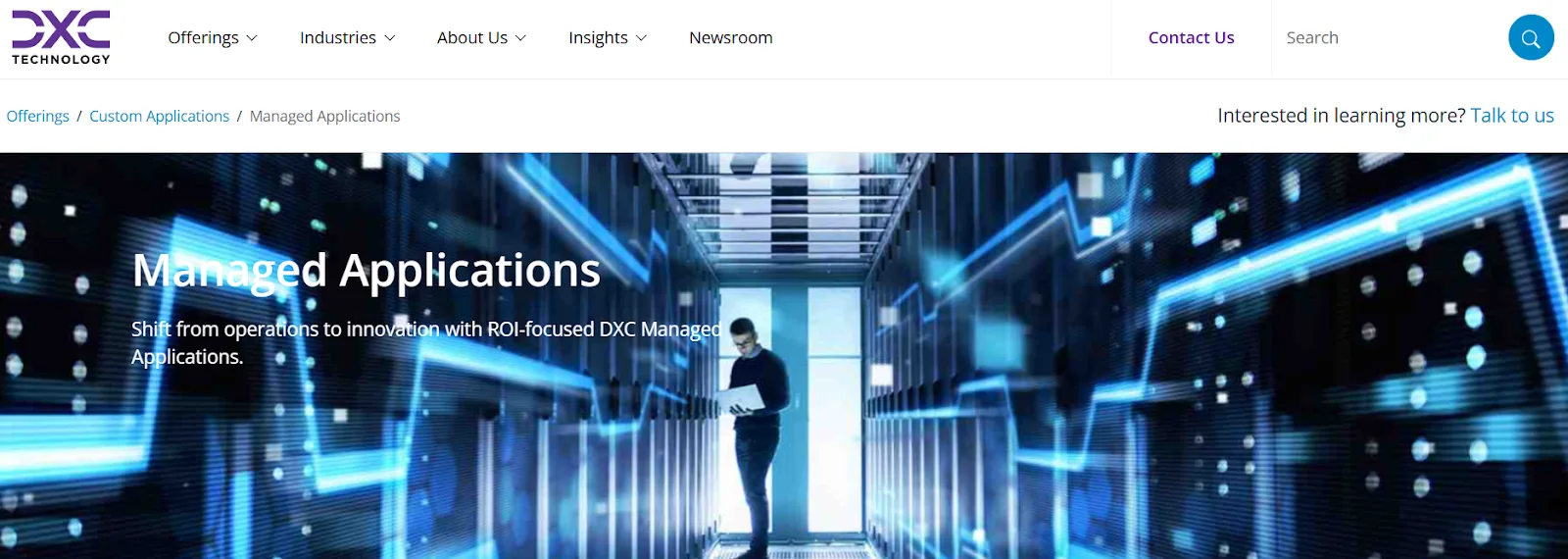
DXC Technology is known for managing large, complex application portfolios in hybrid environments. Their focus is on reducing operational costs through automation, industrialized delivery, and a transformation-led model. DXC supports custom and packaged applications, modernizes mainframe environments, and provides cloud platform services across multiple clouds.
They also offer managed container services, SAP platform support, and extensive network operations. Much of their value comes from automation using DXC Platform X™, RPA, analytics, and intelligent dashboards to improve performance and speed of releases. DXC reports up to 99.9% SLA compliance, covering application availability, response times, and platform reliability.
Key features
- Managed application operations: Cohesive oversight of large application portfolios, with automation that improves speed, stability, and release cycles.
- Cloud platform and container services: Support for agile development across clouds, Kubernetes, and SAP platforms with integrated governance.
- Mainframe modernization and MFaaS: Full-service management, hosting, resiliency, and predictable OpEx pricing for legacy systems.
- Network transformation: Modernized, software-defined networks with AI-driven analytics for reliability and hybrid-cloud performance.
Limitations
Users report limited transparency in cost breakdowns and invoicing, noting that DXC can be commercially very sharp and should be more transparent in resource management.
Global coverage
DXC operates with over 130,000 employees in 70 countries, supporting global customers with hybrid cloud, mainframe, and application operations across distributed regions.
Lifecycle layer
DXC provides hardware asset management and lifecycle tracking, but does not handle customs processes, cross‑border device movement, or high-assurance retrievals.
Our rating ⭐⭐⭐
Strong choice for enterprises with complex applications and mainframes. It can be less suitable for teams that need predictable, EU-wide hardware movement and end-to-end device logistics.
Claranet

Claranet is a global technology services provider offering cloud, cybersecurity, connectivity, applications, data/AI, and workplace solutions. Their model centres on adaptive, region-specific delivery with local teams operating across multiple countries. Claranet supports public, private, and hybrid cloud environments and provides managed networks, managed detection and response, workplace productivity services, and consulting for regulated industries.
The platform offers uptime-backed services such as 99.99% availability on specific network protections and 24/7 managed response for cloud and security operations, depending on the service tier. With two decades of operational history, Claranet helps organisations modernise securely and scale IT services at a measured pace.
Key features
- Multicloud management: Support for AWS, Azure, private cloud, and hybrid environments with CloudOps, FinOps, backup, and disaster recovery services.
- Full-spectrum cybersecurity: MDR, threat detection, penetration testing, and compliance consulting for GDPR, PCI DSS, ISO 27001, and sector-specific regulations.
- Network and connectivity services: Managed LAN, WAN, SD-WAN, Wi-Fi, and secure network foundations for distributed workplaces.
- Workplace and application services: Endpoint management, Microsoft 365 operations, telephony, collaboration tools, and application optimisation.
Limitations
Customer feedback highlights inconsistent service quality during transitions, unexpected service interruptions, and support teams that struggle with complex queries. Some users report issues with domain handling, email reliability, and unclear communication during provider changes.
Lifecycle layer
Claranet handles endpoint management and user support, but its services stop at the software layer. They don’t manage hardware movement, device storage, shipping timelines, or end-of-life disposal, which can create gaps for global teams.
Our rating ⭐⭐⭐
A strong option for cloud, networks, and cybersecurity, but operational reliability varies, and hardware logistics fall outside their scope.
Insight Enterprises (EMEA)
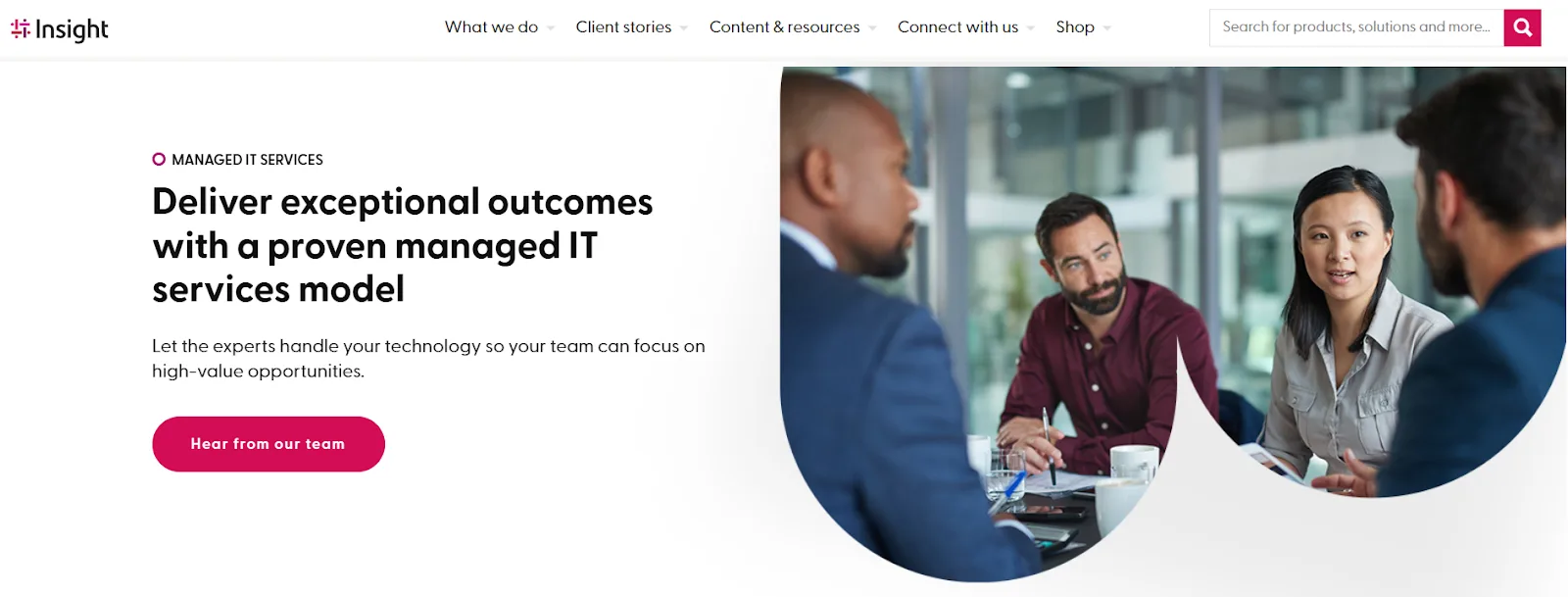
Insight delivers managed IT services across cloud, infrastructure, network security, workplace, applications, and data platforms. Its model is built around service-based and configuration-based pricing delivered through OpEx consumption.
The platform positions itself as a solutions integrator that brings together hardware, software, and managed services into unified delivery. It operates managed cloud environments, managed endpoint services, and enterprise infrastructure platforms designed to reduce CapEx pressure and simplify operations for large organisations.
Key features
- Managed cloud environments: Fully managed IaaS with burst capability into public cloud, built-in security, DR options, and integrated patch, change, and systems management.
- Managed endpoint administration: Cloud-based endpoint configuration, security policy management, OS updates, scripting, and application deployment for Windows, macOS, iOS, Android, and Windows 365.
- Managed security and networks: Patch management, monitoring, event management, governance, and cyber response across enterprise environments.
- Enterprise service governance: Defined SLO tracking, incident resolution workflows, reporting, roadmap reviews, and enterprise-grade service levels.
Limitations
Users point to slow approvals due to internal hierarchy, onboarding friction, and higher pricing depending on project scope. These factors can delay rollout and increase cost unpredictability for distributed teams.
Global coverage
Insight operates in 22 countries across the Americas, Europe, Asia, and Australia, with clients transacting in over 180 countries worldwide.
Lifecycle layer
Insight supports the device lifecycle from procurement through end-of-life readiness, but it does not run customs workflows, bonded warehousing, cross-border retrieval guarantees, or time-bound EU logistics.
Our rating ⭐⭐⭐⭐
Excellent for integrated endpoint, cloud, and infrastructure operations at scale. Less predictable for fast international growth due to cost variability and slower internal execution.
Computacenter
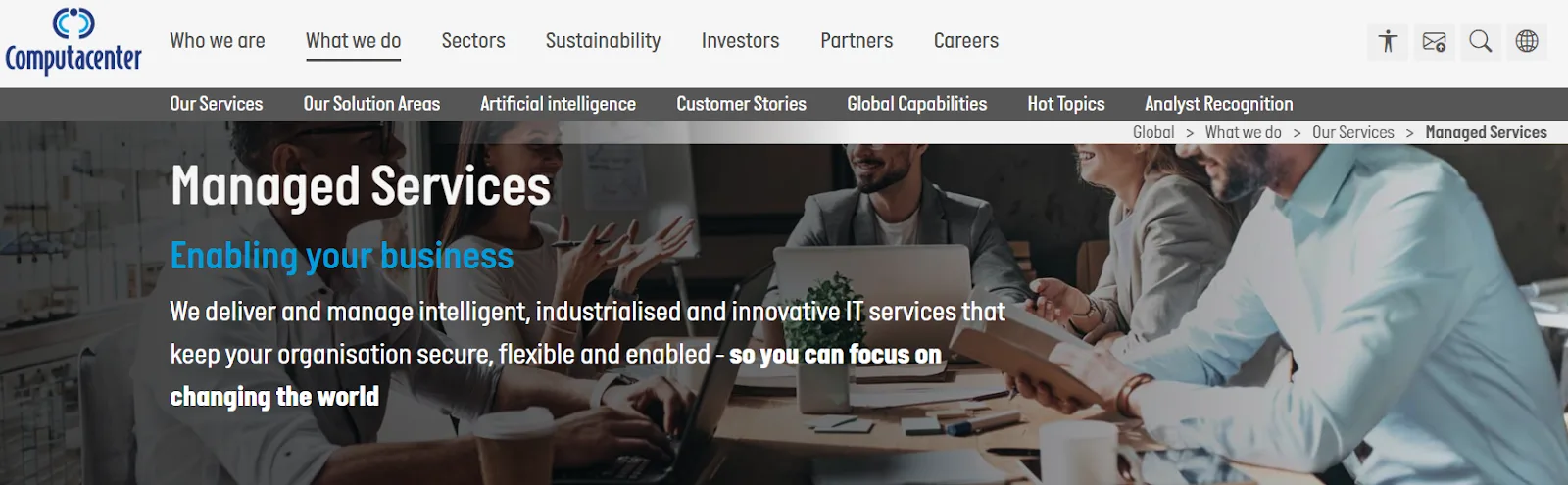
Computacenter’s portfolio spans intelligent service desk operations, field and on-site support, network lifecycle management, endpoint management, managed print, cloud strategy, and infrastructure transformation.
The company emphasizes repeatable, industrialised delivery supported by analytics, automation, and AI through its “Triple A Approach.” Computacenter also focuses on improving employee experience through proactive issue detection, cross-channel support models, and continuous optimisation.
With advisory, design, build, and run capabilities, it supports enterprises looking for scalable, stable, and long-term managed services partnerships.
Key features
- Intelligent support operations: Multi-channel service desk, virtual agents, analytics-driven issue prediction, and experience management capabilities.
- Field and on-site engineering: Next-day, same-day, event-based, and VIP support delivered at offices, campuses, homes, or production sites.
- Hybrid platform and cloud services: Advisory-to-run support for public cloud, hybrid cloud, and modern infrastructure setups.
- Network lifecycle management: End-to-end network advisory, design, deployment, monitoring, optimization, and secure connectivity services.
Limitations
Customer feedback shows concerns with device replacement quality, long turnaround times, and inconsistent support experiences. There are also reports of unhelpful interactions and repeated hardware failures. These suggest gaps in handling device-related issues that require quick response and reliable follow-through.
Global coverage
Computacenter supports customers in more than 70 countries, delivering sourcing, transformation, and managed services at a global scale.
Lifecycle layer
Computacenter offers device lifecycle management, but its execution depends heavily on logistics partners and internal processes. It does not manage customs, bonded storage, or time-bound retrieval workflows across EU borders.
Our rating ⭐⭐⭐
Strong for workplace support and network operations, but inconsistent hardware service experiences and limited logistics depth reduce suitability for remote-first, multi-country teams.
The hidden costs MSPs don’t quote
You’ll often see large players in MSP talk about day-rate, headcount, and SLA tiers. But they rarely spell out what happens once hardware crosses a border or leaves your office.
First, there are duties, taxes, and customs fees. Import duties and VAT change by device type and country. Misclassified laptops or monitors can trigger holds, extra inspections, and monetary penalties, while one missing certificate can stall an entire shipment at the border. Those delays come with storage, demurrage, and re-delivery fees, plus the cost of users sitting idle or IT scrambling for emergency replacements.
Second, compliance risk is almost never priced in. Under GDPR, regulators can fine up to €20 million or 4% of global turnover, and total fines have already passed €5.6 billion.
For hardware, WEEE and local e-waste rules add another layer; non-compliance can mean fines up to €100,000 per violation and even product bans in markets like Germany.
Finally, failed retrievals become ghost assets. 25% of IT budgets are wasted on assets that can’t be located or no longer deliver value, with around 30% of assets not properly catalogued.
None of these show up in a standard MSP quote, but they absolutely show up in your P&L when devices move, disappear, or retire without a controlled lifecycle.
Customer insights
“Before, I spent 80% of my time just managing equipment. Now, it’s maybe 10%, and it’s all through Firstbase. It went from fully hands-on to completely hands-off and automated.”
— Amesha Mehta, IT Systems Administrator, Brightwheel
How Firstbase plugs into any MSP contract
The hidden costs we discussed above all point to the same gap: MSPs manage cloud and infrastructure well, but the physical lifecycle still sits on spreadsheets and courier hacks.
This is the layer Firstbase adds back into the stack.
Instead of IT teams spending 500 hours a year just coordinating gear for 100 remote employees, Firstbase absorbs that work through a unified logistics platform covering 150+ trade lanes.
The result is predictable device movement: 48-hour delivery or pickup windows across major regions, backed by audited workflows and pre-set regional playbooks.
Customers routinely eliminate abandoned devices with Firstbase’s 97% retrieval success rate.
In a typical rollout, Firstbase saved IT staff 5,000+ hours a year simply by automating shipping, customs, and device tracking. For finance, it’s true budget predictability: Firstbase offers transparent, per-seat pricing with no surprise duty or shipping overruns; a CFO can audit every line, with built-in tools for cost control and forecasting.
Firstbase fills the lifecycle and global logistics gap left by MSPs, delivering Day-1 readiness, compliant offboarding, and truly transparent costs.
Customer voice
We chose Firstbase as our equipment management solution because they’ve offered the best package of services to suit our needs in our effort to cover all NAM and EU locations. This streamlines the process by both making it more user-centric and adherent to our security requirements.
Martin Kalista, Sr IT Ops Specialist, Productboard
Here’s your 30-day integration playbook
Week 1: Import your data.
IT exports the CMDB and active user list. Firstbase cleans the records, flags missing devices, and sets the baseline for procurement, retrieval, and ITAD workflows. HR/Finance confirm locations and cost centres.
Week 2: Configure logistics.
EU duty rules, shipping lanes, warehouse coverage, and carrier preferences are synced. Procurement models (buy/lease/BYOD) and setup templates are mapped so every shipment is compliant and predictable.
Week 3: Run a single-country pilot.
A small group of new hires or replacements flows through the full process: device prep, kitting, and 48-hour delivery. IT validates setup, HR checks Day-1 readiness, and Finance reviews cost transparency.
Week 4: Turn on automated retrievals.
Offboarding workflows go live with scheduled pickups, 97% retrieval success, certified ITAD, and real-time asset reporting. Finance gets clear per-seat spend; IT gets clean lifecycle data.
By Day 30, Firstbase operates as the logistics and lifecycle layer alongside your MSP without changing your existing tools or processes.
What next?
MSPs help run your systems, but they can’t guarantee devices move, return, or stay compliant across borders. Firstbase closes that gap with a lifecycle layer built for distributed teams with consistent logistics, predictable costs, and full visibility from order to delivery.
Customers get clearer SLOs, stronger SLAs, and a logistics model they can finally track end-to-end. The operational lift is real: for every 1,500 employees, teams save $163,000 and 2,300 hours a year after adopting Firstbase.
Book a 30-minute demo to see how quickly those wins compound across your EU workforce.
Written by
Ahmad Zakaria
Ahmad Zakaria covers IT operations, hardware lifecycle management, and distributed workforce solutions at Firstbase. His content is built from real customer data, operator interviews, and hands-on experience managing devices across 150+ countries.
Get started with
Firstbase today
Remote and hybrid work aren't going anywhere. It's our mission to make it easier to manage the assets your distributed team needs—from onboarding through offboarding and every repair, replacement, and upgrade in between.
Fill out the form and a member from our team will reach out by phone!
Get a Live Demo