Managed Service Providers Brazil: Coverage, Costs and Lifecycle Insights
Top Managed Service Providers in Brazil 2025
 Chris HerdJanuary 18, 2026
Table of contents
From my research, I see that all managed service providers in Brazil offer strong IT support, help desks, and network monitoring. But most stop short of handling the physical side of IT: shipping, tracking, and refreshing devices. Reviews from Head of End-User Services state, ‘We close tickets in minutes, then lose the laptop for weeks once it hits customs.’
Most Brazilian MSPs nail remote monitoring, yet leave the last-mile grind, shipping, duties, and retrieval on your desk.
That blind spot sidelines Day-1 productivity, torpedoes budgets with surprise ICMS, and keeps IT stuck on courier calls instead of strategy. That’s where the gap appears, and it’s a real pain point for IT teams trying to stay efficient.
A quick snapshot of how Brazil’s leading MSPs differ and where Firstbase steps in to close the hardware-lifecycle gap.
- Stefanini: A large-scale MSP with broad IT, cloud, and cybersecurity coverage, ideal for enterprises needing an all-in-one operations partner.
- Logicalis LATAM: A cloud + network–focused MSP with strong security capabilities, best suited for organizations prioritizing hybrid/cloud integration.
- NTT DATA Latin America: A global player offering end-to-end IT infrastructure and managed services, strong for enterprises needing scale and stability.
- Unisys Digital Workplace: A workplace-focused MSP specializing in device subscription, service desk, and endpoint management for distributed teams.
- Firstbase: The platform designed to manage the physical device lifecycle end-to-end: shipping, retrieval, inventory, refurbishment, and cross-border logistics across 150+ countries, filling the exact gap MSPs leave open.
Let's look at the top Managed Service Providers in Brazil in a complete picture.
TL;DR Top Managed Service Providers Brazil: A Quick Overview
| Platform | Lifecycle layer | SLAs and uptime | Pricing | Global coverage | Service breadth |
|---|---|---|---|---|---|
| Stefanini | Device provisioning and asset management via Hybrid Cloud and Infrastructure Services. | No published SLA/uptime; offers 24×7 service desk | Not transparent | 41+ countries, strong presence in Latin America. | Service desk and field support, integration/SI services, intelligent automation, testing and QA. |
| Logicalis Latam | Cloud, network, and IT infrastructure lifecycle services; offers platform for managed services. | No public SLA/uptime; provides SOC managed services | Not transparent | 30+ countries across the Americas, EMEA, APAC; strong in Brazil and Mexico. | Managed security, vendor partnerships (AWS, Microsoft), platform operations. |
| NTT DATA Latin America | Full IT lifecycle: planning, deploying, operating, maintaining, and optimizing IT environments. | No published SLA/uptime; offers managed cloud, device and network services | Not transparent | 150+ data centers across 20+ countries. | Managed cloud operations, network and connectivity, automation and AI, data and analytics. |
| Unisys Digital Workplace | Full IT and workplace lifecycle: Device Subscription, UEM, DEX, support, and ITSM platform. | No published SLA/uptime; 24×7 AI-enabled service desk | Not transparent | Offices and delivery centers across the Americas, EMEA, and APAC. | Device Subscription Service, 24×7 AI service desk, UEM, field services, employee experience tools. |
In the first year alone, Firstbase automatically retrieves and returns devices, helping users cut lost-asset costs by over 30%. Try our self-guided demo to see how your IT team could benefit.
Quick-Scan Buyer Checks: The 3 Things Everyone Asks
- How much will this cost us?
- Pricing stays predictable. One seat covers devices, shipping, duties, warehousing, and certified wipe-and-resale. No weird add-ons later.
- Will our compliance teams be satisfied?
- Yes. SOC 2 Type II + ISO 27001 documentation is available under NDA. Every device returns with a NIST-grade wipe certificate. Nothing moves without audit-ready documentation.
- Can you really move devices everywhere we hire?
- Yes. Duties are handled in advance, and 48-hour delivery or pickup, zero-touch deployment is supported in 150+ countries with 97% on-time delivery. Internal data shows near-perfect completion, even in tricky customs routes.
MSPs Can Sound the Same. Here’s How to Spot the Differences
Every MSP in Brazil promises the same things: 24×7 support, solid security, and a long list of certifications.
If marketing pages decided the winner, every provider would tie for first place. But the moment devices need to move between states, taxes pop up across borders, or LGPD audits start, the similarities disappear fast. That’s where true MSP performance becomes measurable.
To make comparisons practical, this guide looks at five verifiable factors:
- Geographic coverage and compliance: Brazil is huge, with state-level tax and data regulations (like LGPD). Can the MSP easily operate across multiple states while remaining compliant?
- Service breadth: Beyond remote monitoring, do they truly manage end-user devices, apps, and on-site needs?
- Response and uptime SLAs: What can the MSP consistently guarantee, and how transparent are they about local performance metrics?
- Lifecycle and logistics capability: Moving hardware between São Paulo, Manaus, or Porto Alegre can be tricky. Who handles shipping, setup, and retirement without costly surprises?
- Cost predictability: Brazilian import taxes, freight, and state fees can add up. Are pricing and extra charges clear upfront?
Brazil’s Top Managed Service Providers
Inside scoop on some of the leading Managed Service Providers in Brazil.
Stefanini
Stefanini offers a broad portfolio including cloud-based consulting, cybersecurity, digital workplace and infrastructure, application services, and managed service solutions.
From service desk to endpoint support, Stefanini simplifies IT operations for organizations operating across regions. This range allows companies to centralize software, infrastructure, and security support through a unified partner rather than managing multiple vendors individually.
Key features
- Service desk and field support: 24×7 omnichannel support, on-site field technicians, and self-service portals for distributed teams.
- Integration and SIAM expertise: Coordinating multiple providers and complex IT environments.
- Automation and ITSM: AI-assisted automation, event management, and service integration for smoother operations.
- Digital transformation support: Cloud, applications, cybersecurity, and workflow modernization for enterprises.
Limitations
Stefanini provides device provisioning, HaaS, and asset management, covering some aspects of the hardware lifecycle. However, there’s no public evidence that they offer full-scale global logistics, warehousing, or cross-region device refresh and retrieval services.
Global coverage
Stefanini operates in 41 countries worldwide, offering multilingual support and delivery across Latin America, EMEA, APAC, and North America. Its global scope supports large-scale enterprise operations, but it does not extend to physical device logistics.
Lifecycle layer
Stefanini handles device provisioning, configuration, and asset management through HaaS/Daas offerings. Global shipping, storage, and retrieval fall outside their scope, leaving a gap for comprehensive hardware logistics.
Our rating ⭐⭐⭐⭐
Strong, full-service MSP with global reach; ideal for IT operations but best paired with a lifecycle partner for distributed hardware logistics.
TIVIT
TIVIT is a Brazilian multinational and a technology services provider operating across several Latin American countries. With more than two decades of experience, TIVIT delivers a comprehensive set of managed services. It covers cloud (public, private, and hybrid), infrastructure, network, data center management, cybersecurity, and digital workplace support.
Businesses rely on TIVIT to manage their critical operations and IT environments, while its specialists monitor, support, and optimize them 24/7. By consolidating infrastructure, cloud, security, and support under one provider, TIVIT supports companies to shift from complex, fragmented vendor ecosystems to a single, reliable managed-services model.
Key features
- Automation and AIOps platform: Integrated automation platform for centralized visibility, process mapping, automatic alerts, configuration, and incident management.
- Immutable backup and disaster recovery: backup-as-a-service and immutable-backup solutions, with real-time monitoring and anti-ransomware protection.
- Legacy and mainframe systems support: Management of mainframe environments, integration, system monitoring, and performance support.
- ITSM, service desk, and workplace services: End-user device support, multilingual service desk, device patching/configuration, remote assistance, and workplace IT services.
Limitations
As with any managed‑services/outsourcing provider, handing over infrastructure (mainframes, storage, production environments, backups) to an external vendor means your organization sacrifices some direct control.
If your business needs frequent customizations, quick changes, or very granular control, the standardized processes of an MSP may be limiting.
Global coverage
TIVIT operates in 10 Latin American countries and has 200+ specialists in Brazil and Latam. Following its 2025 acquisition by Almaviva, the combination helps TIVIT expand its global reach, leveraging Almaviva’s broader international track while maintaining TIVIT’s regional strength.
Lifecycle layer
TIVIT manages the full IT infrastructure lifecycle, including mainframe and legacy system support, storage, cloud hosting, and operational monitoring. They do not handle hardware logistics or end-user device management. Combining with Firstbase adds device procurement, global shipping, and full asset lifecycle management, creating a complete end-to-end IT and workplace solution.
Our rating ⭐⭐⭐⭐
TIVIT delivers strong expertise in legacy systems, cloud, storage, and operational monitoring, making it ideal for enterprises managing end-to-end IT. But to get devices to employees, track them, and manage their complete lifecycle, you would need to pair it with Firstbase.
Logicalis LATAM
Logicalis Latam provides managed IT, cloud, cybersecurity, data center, and hybrid cloud services for companies that want an external partner to run and secure their infrastructure.
Logicalis Latam emphasizes a “cloud lifecycle + managed-services + consulting” approach: they don’t just offer products or one-time projects. They support clients end-to-end, from designing solutions to deploying them, and then managing, monitoring, and updating over time, including security and operational continuity.
Key features
- Managed security with SOC monitoring: Threat detection/response, managed firewalls, hybrid‑cloud security, and global threat intelligence.
- Vendor partnerships: AWS, Microsoft, and Cisco; hybrid cloud and multi-vendor integration.
- Connectivity and network services: SD‑WAN, secure network design, hybrid‑cloud connectivity, SASE/SSE, and data‑centre networking.
- Digital-fabric platform: Real-time tracking, performance analytics, sustainability insights, connectivity overview.
Limitations
As Logicalis Latam relies on a limited set of strategic vendors and a relatively narrow customer base (at least in some segments), changes in vendor terms, vendor availability, or the loss of a major customer can disproportionately affect its operations.
Global coverage
Logicalis operates in over 30 countries worldwide, with offices across the Americas, EMEA, and APAC regions. It provides multilingual support and manages enterprise IT operations at scale, serving more than 10,000 clients globally.
Lifecycle layer
Logicalis oversees the lifecycle of cloud, network, and IT infrastructure, from design and deployment to ongoing management. End-user hardware provisioning, logistics, and storage are not part of their service offering.
Our rating ⭐⭐⭐
Strong global MSP with deep expertise in cloud, security, and network services; ideal for enterprises seeking managed IT infrastructure. However, hardware lifecycle support requires a complementary partner.
NTT DATA Latin America
NTT DATA provides a broad set of services to clients across Latam.
Through this structure, NTT DATA Latam offers consulting, digital‑transformation services, cloud and infrastructure management, application development and maintenance, and end-to-end managed services. Clients across industries, including enterprises, governments, telecom, and finance, use their services.
Key features
- Managed cloud operations: Multicloud environments with run operations, SRE/DevOps support, automated cloud infrastructure maintenance, and optimization.
- Managed network and connectivity services: LAN/WAN, SD-WAN, data centre to cloud connectivity, edge to cloud networking.
- Global infrastructure: Global data centre infrastructure, offering colocation and cloud-hosted infrastructure, and managing data centre services for clients.
- Full lifecycle and workplace IT support: Infrastructure consulting and lifecycle management, virtual workplace services, managed data centre, and cloud hosting.
Limitations
NTT DATA delivers managed services through a global delivery model, which ensures consistent standards. However, it may limit the ability to tailor services to specific Latin American client needs.
Local IT environments, regulations, or infrastructure differences might require adaptation, and global-standard processes could slow things down or make them less agile.
Global coverage
NTT DATA runs one of the world’s largest data centers and IT services solutions. It has 150+ data centers across 20+ countries/regions, offering global‑scale hosting, cloud infrastructure, and connectivity.
Lifecycle layer
NTT DATA Latam manages the full IT infrastructure lifecycle, from planning to delivering data center environments. Services include colocation, cloud hosting, and operational support. But they do not handle physical hardware logistics or end-user device management.
Our rating ⭐⭐⭐⭐
Reliable global MSP with broad infrastructure reach and full‑lifecycle support; suits enterprises requiring cloud/data‑center/cloud + connectivity managed services. Best suited when you don’t need device‑level or regional logistics lifecycle coverage.
Unisys Digital Workplace
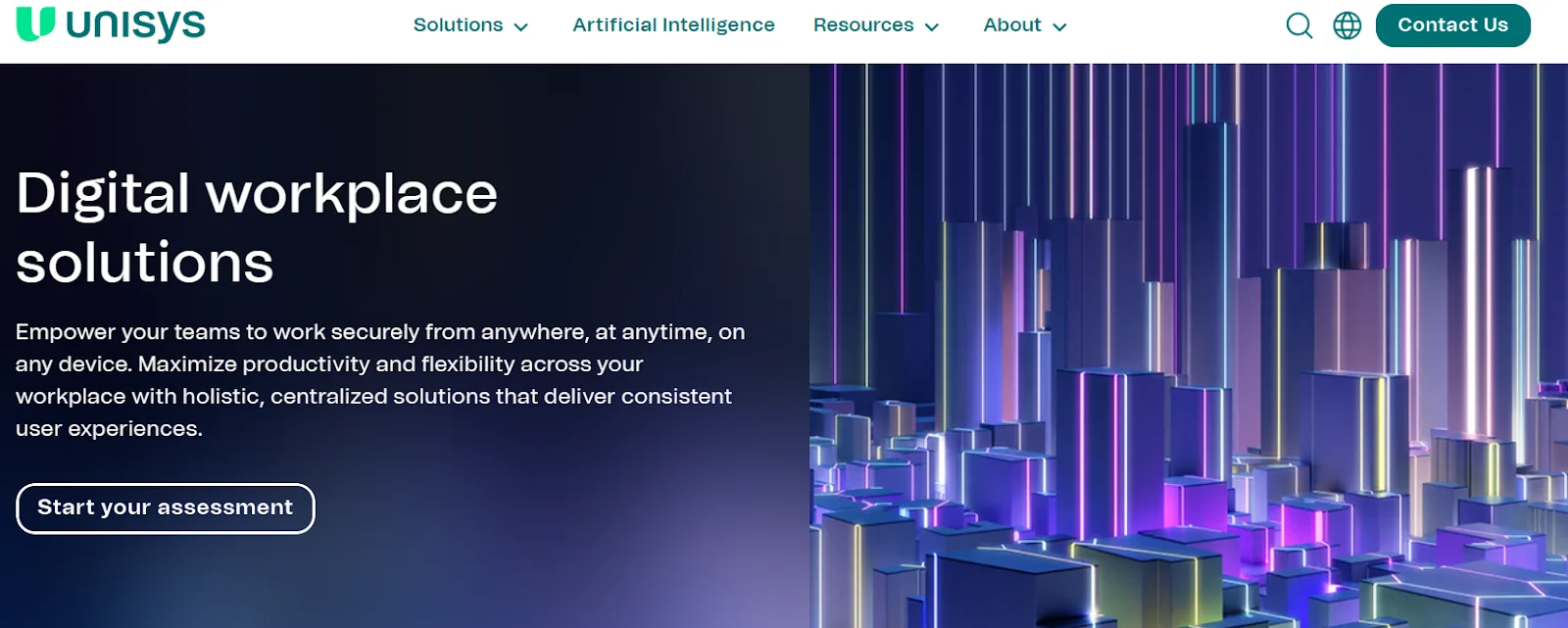
Unisys Digital Workplace offering includes hardware, service desk, endpoint or enterprise service management, workplace experience, and lifecycle support. Major analysts and industry watchers have repeatedly recognized Unisys as a global leader in the “digital and managed workplace services” space.
Key features
- Lifecycle device management: Device Subscription Service delivers hardware on subscription and manages the full device lifecycle from procurement to retirement.
- 24×7 AI-enabled service desk: Next-Gen Service Desk provides omnichannel support, AI-powered ticket resolution, and on-site field technicians for installations and maintenance.
- Unified endpoint and remote-work handling: Centralized management of all endpoints for VDI and other devices, supporting secure remote-work environments.
- End-to-End service management: A unified enterprise service management that manages IT services, field services, facilities, and workplace support.
Limitation
For smaller organizations or those with lean IT budgets, the full-service MSP model from Unisys (covering devices, analytics, 24×7 support, workplace transformation) may come with relatively high recurring costs. It eventually makes it less suitable compared to simpler, pay-as-you-go, or partial-service models.
Global coverage
Unisys maintains a broad global network with multiple offices and delivery centres worldwide, from the Americas to Asia-Pacific and Europe. Its “Digital Workplace” and enterprise services offerings are not limited to a single region. This means clients with a multinational presence can expect support and managed services delivery across multiple geographies.
Lifecycle layer
Unisys delivers full lifecycle management for IT infrastructure and workplace services: they offer device subscription and lifecycle management (device procurement, provisioning, support, and retirement), centrally manage endpoints and digital workplace tools, and handle cloud, data center, and hybrid cloud workloads through managed infrastructure services.
Our rating: ⭐⭐⭐⭐
Unisys is a global MSP with strong infrastructure, a digital workplace, and end-user support. It manages the device lifecycle, from procurement and provisioning to maintenance and retirement, but does not handle physical hardware logistics.
Combined with Firstbase, clients can extend Unisys services to include full end-to-end device shipping and inventory management for distributed teams.
SONDA

SONDA is a Chile‑based multinational IT services company, founded in 1974. Since then, it has grown to become one of the largest IT service providers in Latin America, operating across multiple countries and serving thousands of clients.
It supports a wide variety of industries, including banking and insurance, government, healthcare, retail, mining, manufacturing, education, utilities, and smart cities and mobility.
Key features
- Cloud and datacenter services: Public, private, hybrid‑cloud, and traditional data‑center hosting/colocation. Runs certified data centers (Tier‑III and Tier‑IV), with reliable infrastructure for compliance and uptime.
- IT infrastructure and IaaS/DaaS: Supports full infrastructure management, networking, and flexible infrastructure-as-a-service offerings.
- Risk/compliance services: Managed security, threat detection, infrastructure protection, and compliance support for clients across regulated industries.
- Workplace and Managed Device Services: Procurement, management, support, and lifecycle services for end‑user devices and peripherals.
Limitations
SONDA is actively looking for a strategic partner and evaluating its stakes in certain subsidiaries, which could affect continuity or availability of services outside its core Cloud and Data Center business.
Data coverage
SONDA operates in 13 countries in Latin America and beyond. Its track includes Chile (headquarters), Brazil, Argentina, Colombia, Mexico, Peru, Ecuador, Costa Rica, Panama, and Uruguay. According to a past annual report, SONDA has “direct presence” in 10 countries and coverage across more than 1,500 cities.
Lifecycle layer
SONDA manages the full lifecycle of IT infrastructure and end-user devices within Latin America, including device procurement, deployment, on-site support, maintenance, and end-of-life management.
Publicly available information does not indicate support for global logistics, cross-border shipping, or customs clearance. Partnering with Firstbase fills these gaps by providing global device delivery and end-to-end hardware lifecycle coverage.
Our rating ⭐⭐⭐⭐
SONDA is a strong MSP with extensive feature offerings across cloud, data center, network, security, and workplace services. It offers a comprehensive lifecycle layer that covers device procurement, deployment, support, and maintenance across the region.
It also provides regional coverage, full-stack IT services, and integrated device management, making it ideal for enterprises operating within the region.
The Costs MSPs Leave Out of the Proposal
MSP proposals in Brazil usually list support fees, day rates, and device costs, but they ignore what happens when companies import hardware, move it across states, or replace it. Those gaps are where real costs start.
When companies import devices, they pay several taxes: the federal Import Duty (II), IPI, PIS/COFINS-Import, and the state-level ICMS. The final amount depends on the product’s NCM/HS classification and the state of entry.
A basic quote that shows only device cost, freight, and MSP margin does not reflect the full landed cost. If a laptop is misclassified or missing required documentation, customs can hold the shipment, and the company ends up paying storage, demurrage, and re-delivery fees during the delay.
Compliance adds another layer. Many MSP engagements involve handling employee devices that contain personal data. Under Brazil’s LGPD (Law 13.709/2018), the client remains responsible if an MSP retrieves, repairs, wipes, or disposes of a device without proper security controls in place.
Violations can lead to fines of up to 2% of annual revenue in Brazil, capped at R$50 million.
How Firstbase Complements MSPs in Brazil
MSPs handle networks and cloud operations efficiently, but managing physical devices across Brazil is still mostly manual. Firstbase takes over that work.
Devices reach employees anywhere within 2-5 days and recover 40–65% of the original value when clients return devices through refurbishment or resale programs.
Firstbase gives IT teams 1.8 times clearer visibility into their device fleets, showing live warranty, lifecycle status, and location across 150+ countries. Also, automated logistics and retrieval workflows reduce IT workload by over 500 hours per 100 employees every year, freeing teams to focus on higher-value tasks.
In one year working with Firstbase, Cresta doubled its global headcount from 160 to 300 while keeping only three IT team members. Firstbase automated device shipping, retrieval, returns, and QA, saving the IT team 270 hours over the year.
HR gained real-time visibility into device status, and employees could self-service their laptop and accessory orders. Global device management for new hires and offboarding across countries such as Canada, Germany, India, and Romania became easier, allowing IT to focus on strategic projects rather than logistics.
Customer insights
User onboarding - my team was able to select devices and peripherals before they started, and it all arrived on time. Eliminated the forms I used to fill out as a manager to indicate what device that often got delayed/missed in process. Support issues - when the screen broke on a team members laptop, they managed a loaner laptop When employees leave, they sent a custom box, labels, emails to make it easy for packing and dropping off.
Paul F Director, Customer Success.
Your 30-Day Integration Playbook
Week 1: Import and verify your data
Your IT team exports the existing device inventory and active user list. Firstbase cleans up the records, identifies missing or unregistered hardware, and creates a baseline for procurement, returns, and IT asset‑disposition (ITAD). HR and Finance confirm employee locations (state/city) and cost centers to align shipping and tax planning.
Week 2: Configure logistics and compliance
Firstbase maps logistics using key Brazilian entry and distribution hubs: São Paulo. The team defines preferred carriers. Teams configure procurement options: buy, lease, or BYOD. This happens alongside standardized setup templates to ensure each shipment follows internal processes and remains predictable for IT and finance.
Week 3: Run a single-state pilot
A small group of new hires receives devices through the full workflow. It includes device preparation, kitting, and 48-hour delivery. IT validates device setup, HR confirms Day-1 readiness, and Finance reviews costs for transparency.
Week 4: Launch automated retrievals
Offboarding workflows begin with scheduled pickups. Firstbase manages secure wiping, LGPD-compliant disposal, and real-time asset tracking. Finance receives clear per-seat spend reporting. IT gains clean lifecycle data and early visibility into redeployable hardware.
By the end of Day 30, Firstbase operates as the logistics and lifecycle layer alongside your MSP, maintaining compliance with Brazilian duties, taxes, and state regulations while keeping existing IT and HR systems intact.
What’s Next?
MSPs manage your networks and cloud efficiently, but they can’t fully control how devices move, return, or comply with Brazilian regulations across states. Firstbase adds a lifecycle layer built for distributed teams, delivering predictable logistics, transparent costs, and full visibility from procurement to return.
With Firstbase, IT, HR, and Finance achieve measurable operational wins: optimized device tracking, consistent offboarding, and a logistics model that works with your MSP stack.
Book a 30-minute demo to see how these efficiencies scale across your Brazilian workforce.
Written by
Chris Herd
Chris Herd is the visionary founder and CEO of Firstbase, recently acquired by AppDirect, who pioneered the end-to-end hardware provisioning platform now used by tens of thousands of remote employees. Including employees from Spotify, UI Path, Verint and WeWork. With roots in fintech, Chris experienced firsthand the logistical pains of remote hardware management. His company has since scaled, backed by top-tier investors like Andreessen Horowitz and Kleiner Perkins, before its recent strategic acquisition. As an outspoken champion of remote-first culture, Chris continues to shape how companies equip, empower, and trust their distributed teams.
Get started with
Firstbase today
Remote and hybrid work aren't going anywhere. It's our mission to make it easier to manage the assets your distributed team needs—from onboarding through offboarding and every repair, replacement, and upgrade in between.
Fill out the form and a member from our team will reach out by phone!
Get a Live Demo