The Complete Guide to IT Asset Discovery and Lifecycle Automation
The Best IT Asset Discovery Tools in 2026 & What They Miss
 Chris HerdDecember 1, 2025
Table of contents
If you know where your devices are, does that mean you are in control of what happens next?
No. That’s what the modern workforce looks like, spread across offices, homes, and multiple countries, often stretching across IT and network infrastructure. Your firm may deploy an asset-discovery tool, but you could still be flying blind even after.
Globally, enterprise IT spending is heading toward $6 trillion in 2026, driven by device and infrastructure growth.
As spending climbs, the gap between what organizations know and what they act on widens. Without a clear process, you’ll see assets accumulate (both physical and virtual machines), workflows clog up, and teams scramble to deploy, retrieve, or retire devices.
This is where organizations lose money, expose themselves to compliance risk, and frustrate users. In this article, we’ll cover why discovery alone falls short, review six major discovery tools (including how they compare), and then show how Firstbase closes the loop by automating the lifecycle from procurement through retrieval and certified retirement.
Disclaimer: We built Firstbase to address the complex, real-world aspects of IT asset management. While we’re proud of what we’ve built, this guide aims to give a fair, research-backed overview of the best tools in the space. Our goal is to help you understand where each platform excels, and where lifecycle-focused automation platforms like Firstbase can add extra value.
TL;DR Top IT asset discovery tools at a glance
| Platform | USP | Rating | Best for | Transparent pricing |
|---|---|---|---|---|
| Firstbase | Connects discovery to global 48-hour ship/retrievals + lifecycle logs | 4.7 | Distributed teams that need device lifecycle logistics + governance | Yes, per-seat pricing |
| ServiceNow | Single data model with agentless + client-based discovery | 4.4 | Enterprises standardizing workflows across IT, security, and compliance | No |
| SolarWinds | Agent + agentless scanning with Asset Map and service mapping | 4.3 | Mid-market IT teams tying discovery to service desk and patching | Yes, $39/technician/month |
| Flexera | Technopedia normalization gives clean, audit-ready software inventory | 4.6 | Large orgs focused on license, audit, and EOL/renewal optimization | No |
| FreshService | Discovery Hub (agent + probe) plus multi-cloud inventory | 4.6 | Mid-market teams wanting ITSM + discovery with modern UI | Yes, Starter $29/user/month |
| CrowdStrike | Exposure Management with unified agent, attack-path mapping (Asset Graph), and AI-driven prioritization. | 4.5 | Security-led orgs prioritizing attack surface/risk visibility. | No |
On average, Firstbase customers save $163,000 and 2,300 IT hours each year by automating procurement, deployment, and recovery. Take a self-guided tour to see how lifecycle automation looks in action.
Why IT asset discovery alone won’t suffice?
Let’s look at the major pain points you’ll see across IT, Finance, and HR teams.
- Incomplete discovery = security risk: When assets aren’t tracked, they can’t be optimized. For example, 48% of organizations admit that unmanaged device access increases the risk of data breaches, unauthorized usage, or compliance failures.
- Idle and underused assets drive cost: When devices sit unused, you still pay for depreciation, support, licence management systems, and refresh cycles. Just five extra laptops a quarter, at $1,200 each, equals $24,000 a year in needless spending. This matters especially for finance leads: you need a predictable cost per seat, not surprise device glut and excess refresh.
- Operational and logistical challenges: Discovery only reveals what exists. It doesn’t ship a laptop to remote users, retrieve it when someone leaves, or dispose of it safely in another country. Often, teams discover devices, but still manually manage the subsequent logistics. And that creates backlogs, delays, and uncertain costs.
- Multi-stakeholder impact: The burden doesn’t fall solely on IT. Finance needs audit trails, predictable cost control, and avoidance of surprise disposal or freight spend. HR needs devices ready for day-one onboarding and consistent offboarding workflows when staff depart or move. Yet most discovery tools stop at listing assets; they don’t link the asset information to logistics and lifecycle processes.
Top IT asset discovery tools compared
Most IT teams already use some kind of discovery tool. But what you must be looking for is a tool that also helps teams act on what they find. Here are such tools we’ve reviewed extensively over the past few months.
Firstbase
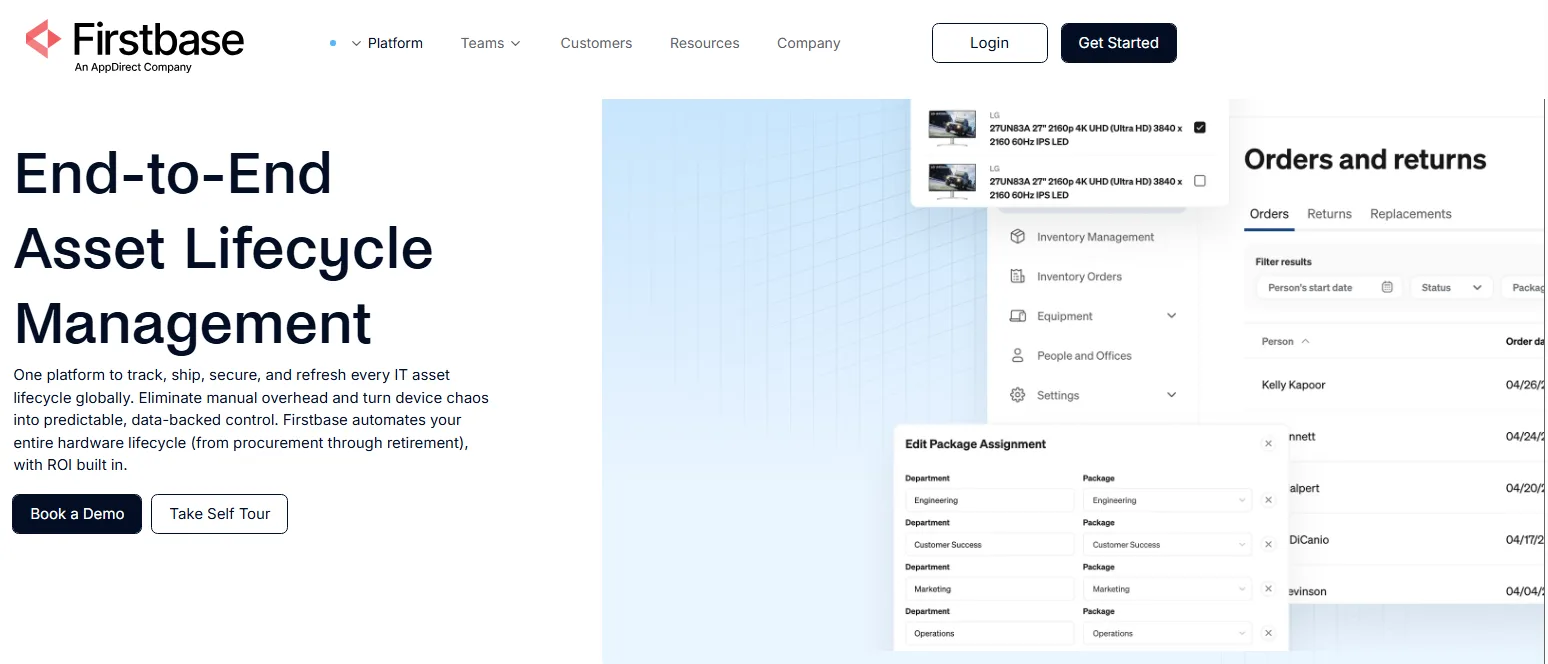
Firstbase is an IT asset discovery and lifecycle platform that helps companies not just find devices but manage everything that happens after. It connects discovery data with real-world actions like shipping, retrieval, repair, and recycling, all from one dashboard.
It’s built for distributed teams that need speed, visibility, and compliance across borders. With delivery coverage in 150+ countries and two-day SLAs, Firstbase helps IT, Finance, and HR teams handle onboarding, offboarding, and asset recovery without delays.
The platform connects with systems you already use (like ServiceNow, Intune, or Workday) and automates every step. Customers like Cresta and Docebo have saved hundreds of IT hours and recovered devices that would have been lost.
Key features
- Automated retrieval workflows: Customers have reduced the number of uncollected laptops from offboarded employees by over 700 devices.
- Reduced manual IT workload: Cuts IT labor on device logistics by 75% through automated labeling, MDM syncs, and pre-configured shipping kits.
- Global SLA-backed logistics: Supports 48-hour deployment or pickup in major markets via secure warehouses on multiple continents.
- Legacy fleet ingestion: Ingests existing devices, tags, and redeploys them, improving asset visibility by 1.8× over baseline ITAM tools.
- Compliance-grade audit trail: Logs every lifecycle event with exportable SOC 2, HIPAA, GDPR, and CCPA records.
- Role-based storefront: Self-service Virtual IT Closet lets employees order pre-approved hardware globally; IT simply clicks “approve.”
- End-to-end ITAD compliance: NIST 800-88 data wiping and certified recycling with auto-matched Certificates of Destruction.
- Resale and remarketing credits: Remarket eligible hardware; returns proceeds as quarterly credits that offset future procurement.
See your potential ROI
Global teams choose Firstbase because automation and in-house logistics save real time and money. With guaranteed SLAs and worldwide coverage, companies consistently see measurable results:
- $100,000 saved in annual shipping costs
- 5,000 hours saved each year in IT labor
- 99% customer satisfaction across active users
Use our ROI calculator to see what these savings look like for your own team.
ServiceNow
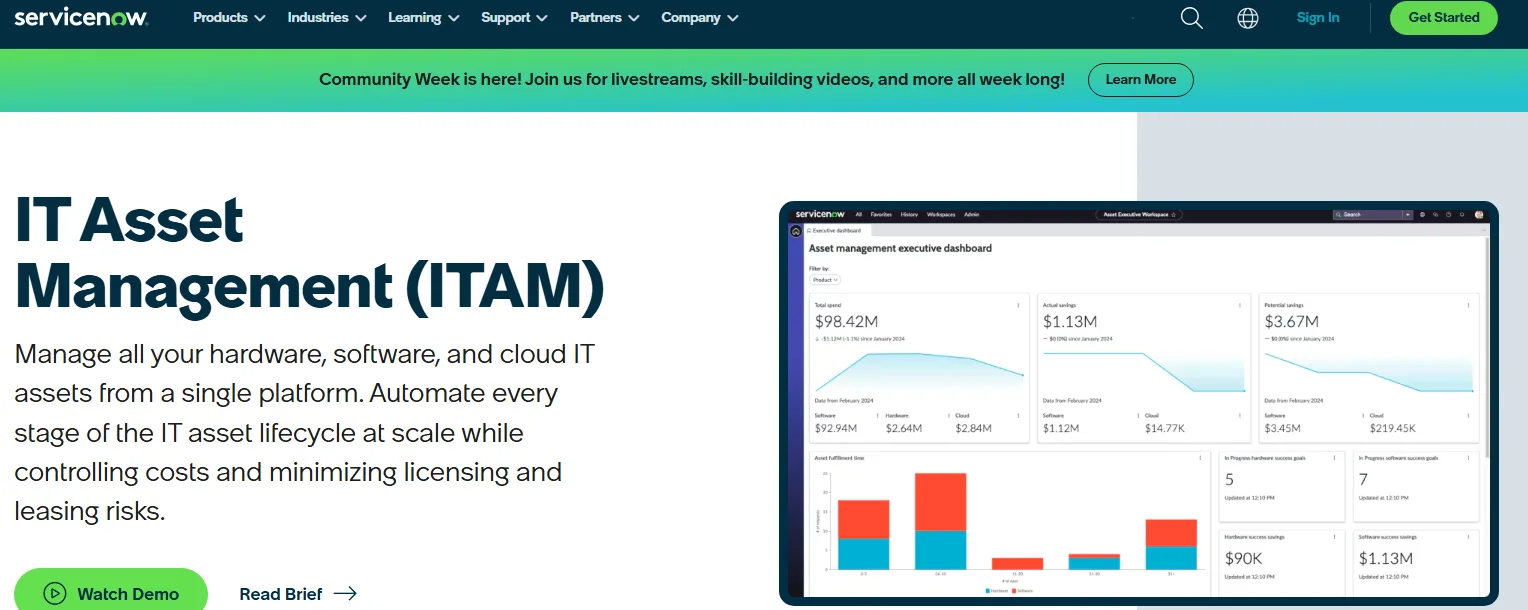
ServiceNow is a full IT asset management and discovery platform built around a single cloud data model. It gives companies visibility across on-prem, hybrid, and cloud environments, helping them identify devices, software, and configuration changes in real time.
Its agentless and client-based discovery methods provide continuous updates on IT infrastructure health, certificates, and endpoints. The system connects asset data to IT, finance, and security workflows through its AI-powered Now Platform.
Where ServiceNow ends at digital discovery, Firstbase takes over with physical lifecycle management, automating the shipment-to-reuse process for those same assets in the real world.
Key features
- Automated discovery: Maps physical, virtual, and cloud assets using agentless scans and Service Graph Connectors for accuracy.
- Event-driven updates: Tracks configuration events in real time, including TLS certificates and firewall data, reducing audit gaps.
- Unified data model: Runs hardware, software, and cloud asset data on one platform, eliminating silos between IT and finance.
- Integrated ITAM suite: Combines software, hardware, and SaaS license management with built-in cost and risk dashboards.
Limitations
ServiceNow’s pricing scales with the number of assets, which can make large deployments expensive. Some features, like advanced Hardware or Software Asset Management (HAM/SAM Pro), require separate licenses. Users also report that integrations with custom vendor systems can be challenging, and setup takes time to fine-tune.
SolarWinds
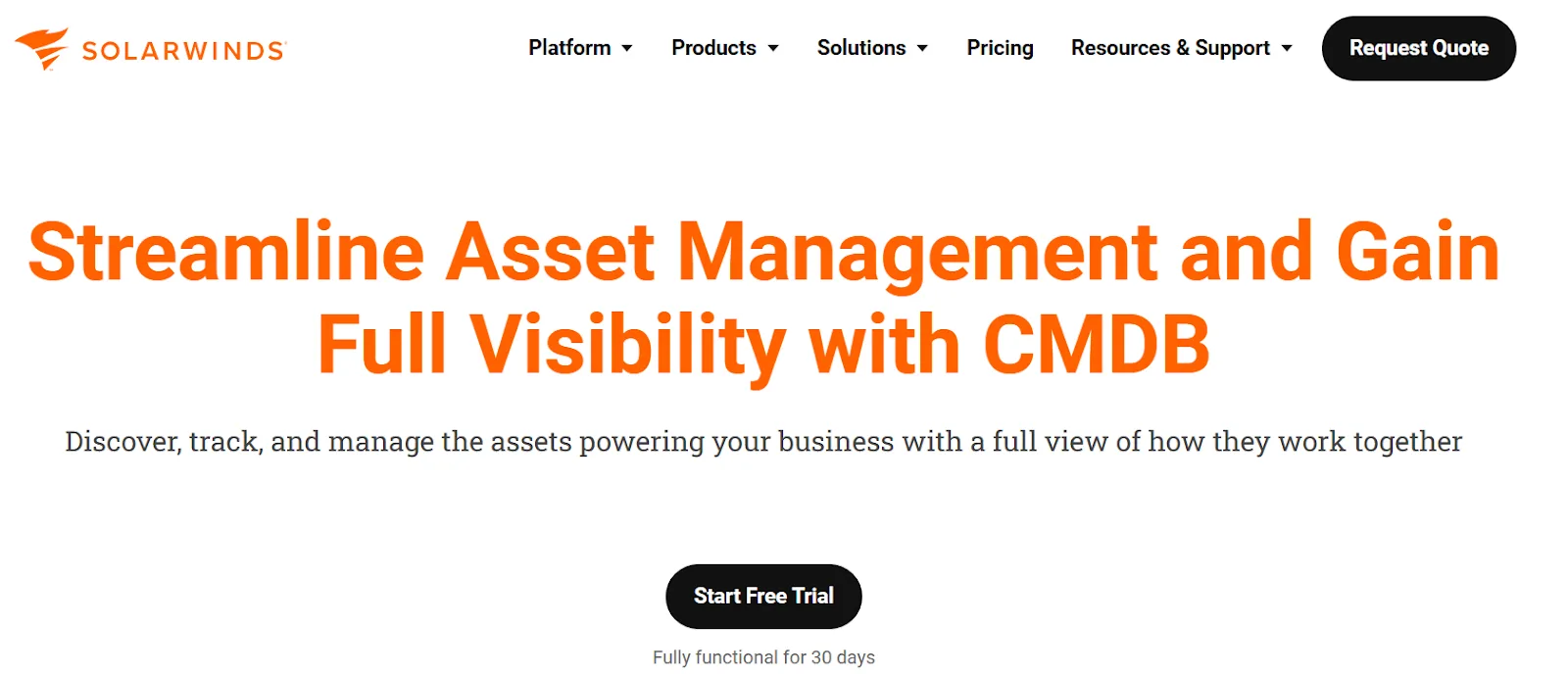
SolarWinds is a cloud-based IT management platform that includes built-in asset discovery. It scans networks using both agent and agentless methods to identify every connected device across on-prem, hybrid, and cloud services.
The Discovery Scanner updates inventories, while the Discovery Agent captures deeper hardware and software data for each device. Its Asset Map tool lets teams see ownership, location, and system dependencies at a glance.
SolarWinds gives IT departments strong visibility for troubleshooting, compliance, and cost control. It helps them reduce overspending and minimize risks tied to untracked or outdated assets.
Key features
- Comprehensive discovery: Scans every IP-connected device daily to keep the asset list accurate and current.
- Cross-platform coverage: Works with Windows, macOS, and Linux, reducing compatibility issues across diverse fleets.
- Configuration mapping: Links assets as configuration items (CIs) to show how systems depend on one another.
- Integrated reporting: Generates detailed cost, usage, and lifecycle reports to support audits and budgeting decisions.
Limitations
SolarWinds focuses heavily on discovery and monitoring. It doesn’t cover global logistics, retrievals, or device reuse workflows. Some users mention that initial configuration can be complex in large networks and that maintaining integrations with other tools requires manual oversight.
Flexera
Flexera helps large organizations map and clean up complex IT environments by combining discovery, normalization, and market intelligence. Its strength lies in identifying all software, hardware, SaaS, and cloud assets across hybrid infrastructures and presenting them in a single, reliable inventory.
The platform’s Technopedia catalog, one of the largest technology reference databases, standardizes data from multiple sources so every system speaks the same language. This normalized view helps companies reduce unmanaged device risk, prepare for vendor audits, and make smarter renewal and migration decisions.
Flexera is used heavily in enterprise environments where visibility and accuracy are top priorities.
Key features
- Comprehensive discovery: Automatically inventories on-prem, cloud, and SaaS assets to eliminate blind spots.
- Technopedia data normalization: Cleans and standardizes IT data for better CMDB quality and audit readiness.
- Regulatory compliance tools: Tracks end-of-life and end-of-support products to help avoid penalties and downtime.
- SaaS usage tracking: Monitors both free and paid applications to identify waste and optimize license spending.
Limitations
Flexera’s setup and learning curve can be challenging for new users. Some reviews mention slow report loading and a dated interface. License reconciliation and version tracking (e.g., for Java) still require manual review, and splitting licenses between cost centers can be cumbersome in large deployments.
Freshservice (Freshworks)
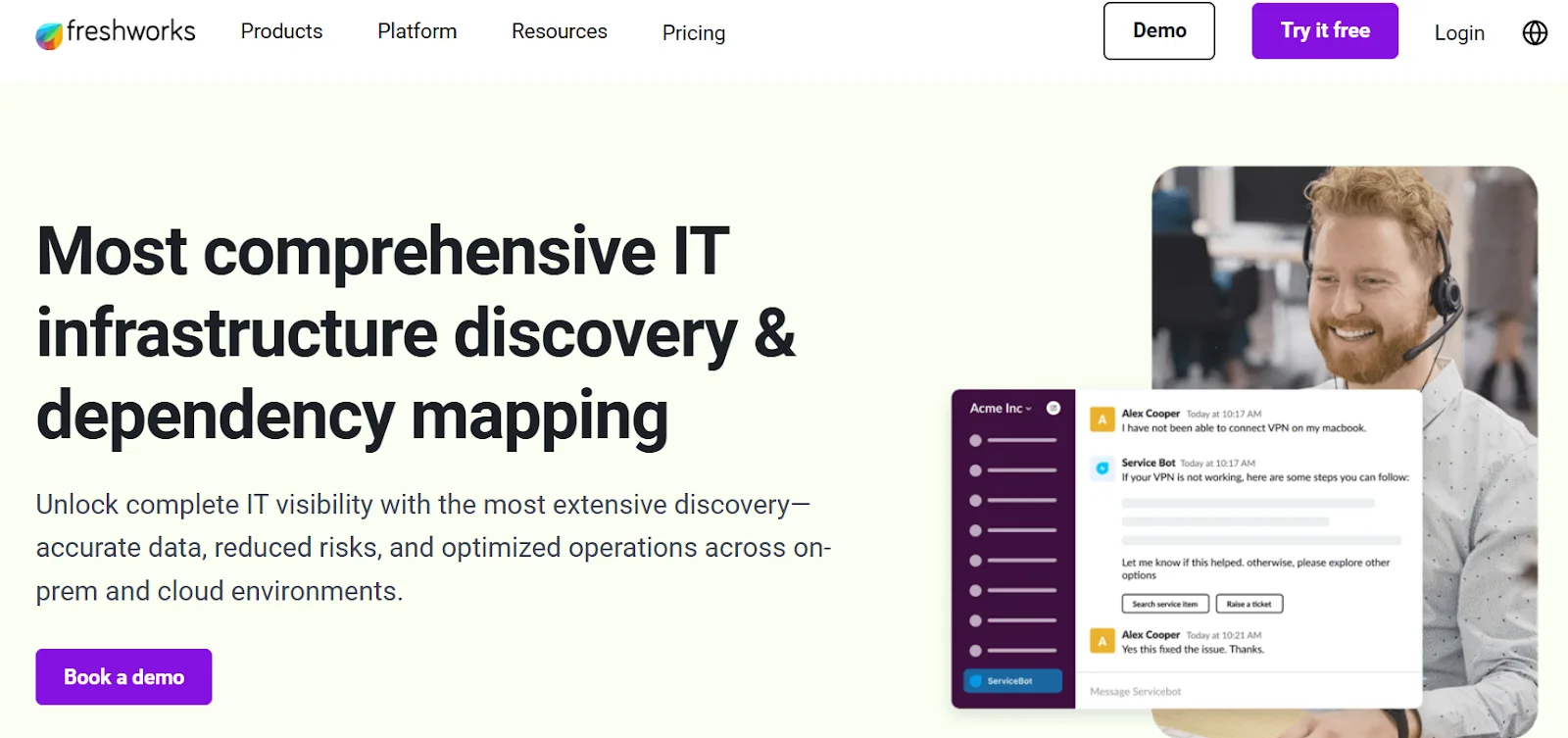
Freshservice by Freshworks combines IT service management with strong asset discovery and cloud management. Its Discovery Hub scans all connected devices, laptops, printers, servers, and network equipment, using both agents and probes. It keeps asset data current through automated and scheduled scans, integrates with Microsoft SCCM and Active Directory, and extends visibility to cloud resources across AWS, Azure, and VMware.
Freshservice also includes dependency mapping and a built-in CMDB, giving IT teams real-time visibility into how systems connect and impact one another. This helps prevent service disruptions, improves audit readiness, and keeps asset records consistently accurate.
Key features
- Dual discovery tools: Discovery Agent tracks individual endpoints, while Discovery Probe scans entire networks for assets.
- Cloud management: Manages and automates provisioning across multiple cloud providers within one dashboard.
- Integrated CMDB: Links configuration items (CIs) and their dependencies to improve change and impact analysis.
- Data enrichment: Automatically deduplicates, categorizes, and normalizes asset data for cleaner reports and compliance tracking.
Limitations
Users report that support responses can feel generic and take time for complex issues. Advanced workflow customization has limits, and performance can lag with large asset inventories. The reporting interface lacks flexibility; exporting data or running granular reports often needs manual work.
CrowdStrike
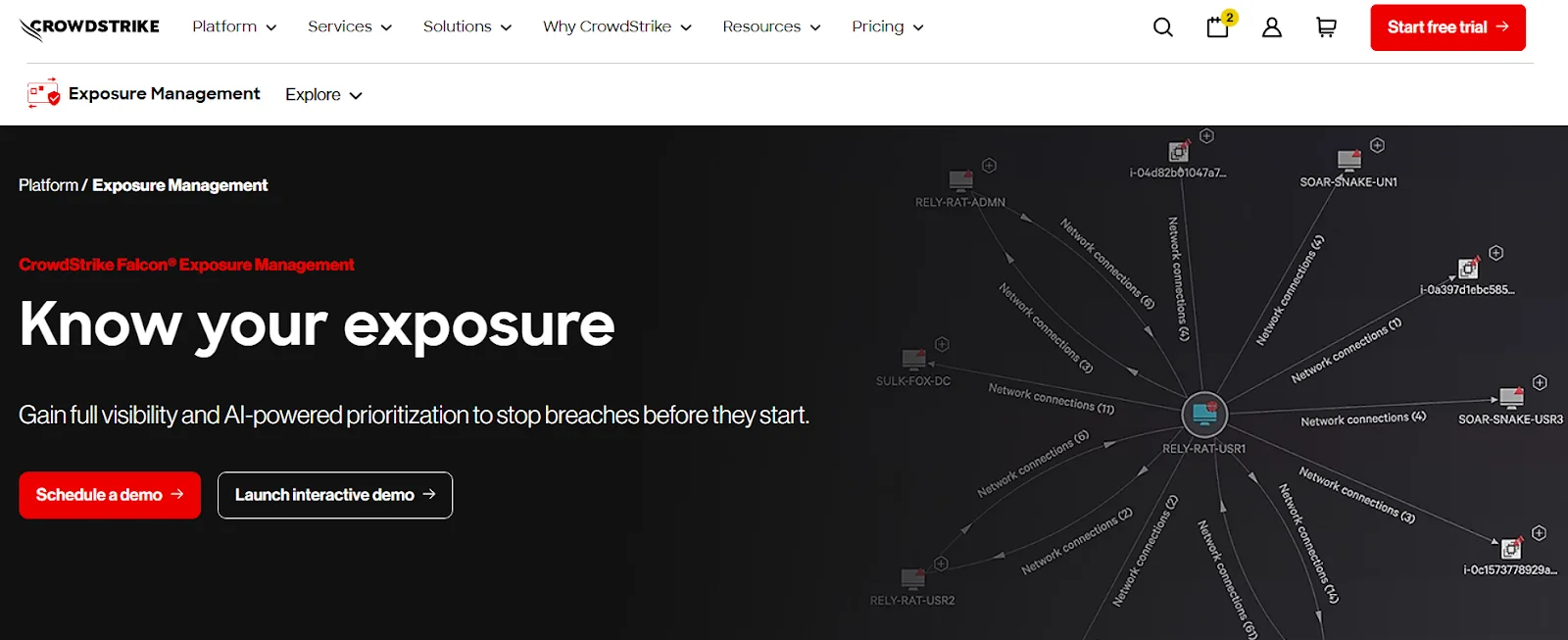
CrowdStrike Falcon Exposure Management helps organizations find every asset that could expose them to risk. It combines active, passive, and third-party discovery to monitor endpoints, cloud workloads, and even shadow IT in real time.
The platform’s main strength lies in context: it finds devices and shows how they connect, where vulnerabilities exist, and how attackers might exploit them.
With AI-assisted analysis, Falcon takes exposure data and converts them into actionable steps for remediation. It’s a strong fit for enterprises that prioritize proactive security visibility rather than periodic scans.
Key features
- Unified discovery: Detects managed and unmanaged devices without relying on manual network scans.
- Contextual risk mapping: Uses Falcon Asset Graph to visualize interdependencies and attack paths.
- AI-driven triage: ExPRT.AI validates and ranks vulnerabilities based on asset criticality and exploit likelihood.
- Integrated automation: Falcon Fusion SOAR enables automatic isolation, patching, and ticket creation for faster response.
Limitations
CrowdStrike’s licensing costs are higher than most IT discovery tools. Some users note false positives that require fine-tuning, and managed detection options can introduce privacy considerations since external teams may access sensitive data.
The missing layer in IT asset discovery tools
Most IT asset discovery solutions we’ve discussed can scan networks, identify devices, and show usage patterns, but they don’t handle what comes next. That gap leaves IT, HR, and Finance teams managing manual shipping, customs, and resale workflows that discovery tools never automate.
But Firstbase connects discovery data directly to global lifecycle operations, from procurement to ITAD. It’s the only IT asset platform that combines global discovery with 48-hour SLA-backed logistics across 150+ countries. That means once an asset is discovered, it can be shipped, replaced, or retrieved from anywhere, all with tracked custody and proof of compliance.
- Procure: Firstbase manages end-to-end IT procurement through local warehouses and vendor partnerships, with zero hidden costs and transparent pricing. Over 200,000 devices have been deployed globally, maintaining 97-98% on-time delivery. Procurement teams get full cost visibility, keeping both CapEx and OpEx within budget.
- Deploy: Devices are 100% zero-touch configured and customs-cleared on arrival. Through integrations with JAMF, Kandji, Okta, and Workday, new hires get equipment ready before day one. No imaging or manual setup. Deployment can scale from 50 to 5,000 devices in a matter of days.
- Support: Employees use a self-service IT portal to order or swap gear without creating tickets. This model cuts IT support queues by 60% and saves 10-15 hours per week in manual tasks. Inventory dashboards and MDM integrations prevent shadow IT and automate replenishment.
- Retrieve: When employees are offboarded, Firstbase handles retrievals globally, from pickup to audit trail, with a retrieval rate of 97% or higher in tier-one countries. Devices are secured, tracked, and wiped per NIST 800-88 standards. HR and Finance automatically receive full custody of logs and cost reporting.
- ITAD (Disposal and Remarketing): Retired assets are wiped, refurbished, or resold, recovering 40-65% of asset value per device. Every disposal generates a Certificate of Destruction, ensuring compliance with ESG and sustainability regulations. Customers often recover capital instead of paying disposal fees.
How to evaluate a discovery + logistics partner
Use this checklist to assess if a platform goes beyond discovery and truly automates the lifecycle:
✅ Global 48-hour shipping and retrieval SLAs across 150+ countries
✅ Zero-touch deployment with HRIS and MDM integrations
✅ Real-time inventory management and full audit trail visibility
✅ NIST 800-88–certified data destruction with proof of compliance
✅ Predictable per-seat pricing and no hidden freight costs
✅ Integrated ITAD and resale workflows to recover device value
✅ Self-service employee portal to cut IT ticket volume
If a provider can’t meet these benchmarks, it’s not built for lifecycle automation at scale.
Extend discovery into full lifecycle control with Firstbase
We’ve reviewed multiple IT asset discovery tools and found that the real operational value begins when that visibility connects to logistics, compliance, and recovery. Firstbase stands apart by unifying asset discovery with worldwide logistics, certified data wiping, and resale automation. It turns what most tools identify into actions that save time, money, and compliance risk.
Companies using Firstbase save $125 per offboarded employee, reclaim over 700 IT hours that would otherwise be spent on logistics, and recoup over $ 175,000 annually through device reuse and redeployment.
See what these numbers look like for your organization. Book a demo to understand your ROI with Firstbase today.
Written by
Chris Herd
Chris Herd is the visionary founder and CEO of Firstbase, recently acquired by AppDirect, who pioneered the end-to-end hardware provisioning platform now used by tens of thousands of remote employees. Including employees from Spotify, UI Path, Verint and WeWork. With roots in fintech, Chris experienced firsthand the logistical pains of remote hardware management. His company has since scaled, backed by top-tier investors like Andreessen Horowitz and Kleiner Perkins, before its recent strategic acquisition. As an outspoken champion of remote-first culture, Chris continues to shape how companies equip, empower, and trust their distributed teams.
Get started with
Firstbase today
Remote and hybrid work aren't going anywhere. It's our mission to make it easier to manage the assets your distributed team needs—from onboarding through offboarding and every repair, replacement, and upgrade in between.
Fill out the form and a member from our team will reach out by phone!
Get a Live Demo