Best IT Service Management Software
Best IT Service Management Software: What Actually Works.
 Ahmad ZakariaFebruary 10, 2026
Table of contents
For IT leaders at scaling, remote-first companies with 500 to 3,000 employees, complexity grows faster than visibility. Service requests multiply: access issues, hardware failures, onboarding delays, and offboarding risks that cover customs, time zones, and compliance needs.
The promise of modern IT is speed and reliability, yet many teams still manage incidents, assets, and workflows across disconnected systems, creating gaps between requests and real-world execution.
We ship internationally to Canada and Germany, and we didn’t have an IT presence there. We had to ship everything out of the U.S., which made things quite difficult.
Jared Allenbrand, Head of IT, Cresta
TL;DR Best IT Service Management Software (At a Glance)
| Tool | Best suited for | SLA / Uptime | Lifecycle Coverage |
|---|---|---|---|
| Firstbase | Distributed teams needing IT requests executed, not just tracked. | 97%+ delivery/retrieval success | Full physical lifecycle: procure → deploy → retrieve → ITAD. |
| ServiceNow ITSM | Enterprises needing a centralized IT system of record. | Standard SLA tracking | ITSM-governed lifecycle; execution via partner ecosystem. |
| SolarWinds | Scaling teams needing fast, cloud ITSM with asset tracking. | SLA management included | Ticket-centric lifecycle with basic asset tracking. |
| ManageEngine | SMBs needing flexible ITIL workflows and deployment options. | SLA tracking included | ITSM + asset records; limited execution depth. |
| Freshservice | Lean IT teams needing quick setup and ease of use. | Configurable SLA policies | ITSM-managed asset lifecycle (no physical execution). |
| BMC Helix ITSM | Large enterprises prioritizing AI-driven ITSM workflows. | SLA management as part of ITSM features | End-to-end ITSM lifecycle; physical IT handled externally. |
The Hidden Logistics Layer
Most IT service management discussions stop at ticketing and device support. In reality, the highest operational cost sits underneath: global device logistics across procurement, deployment, retrieval, and IT asset disposition (ITAD). This hidden layer determines how much an organization actually spends per employee.
| Stage | What actually happens | Costs / risk triggers |
|---|---|---|
| Procure | Hardware sourcing, accessories, tax handling | 20–30% TCO overhead beyond device price |
| Deploy | Imaging, kitting, international shipping | Duties, VAT/GST, customs delays |
| Support | Replacements, repairs, spares | Ticket volume + logistics coordination |
| Retrieve | Offboarding recovery | Device loss, write-offs, data risk |
| ITAD | Data wipe, resale, recycling | Compliance exposure + missed recovery value |
See it in action
Take a self-guided tour of Firstbase
See how Firstbase aligns with ITSM processes and removes the physical logistics gaps most tools leave behind.
Take the Tour →Evaluating ITSM Tools in 2026
We'll review the leading IT service management tools for 2026 and see how they perform across service workflows and actual operational fit.
Firstbase
Ideal for: IT leaders at remote-first, high-growth companies with 50–5,000 employees in SaaS, fintech, and global services.
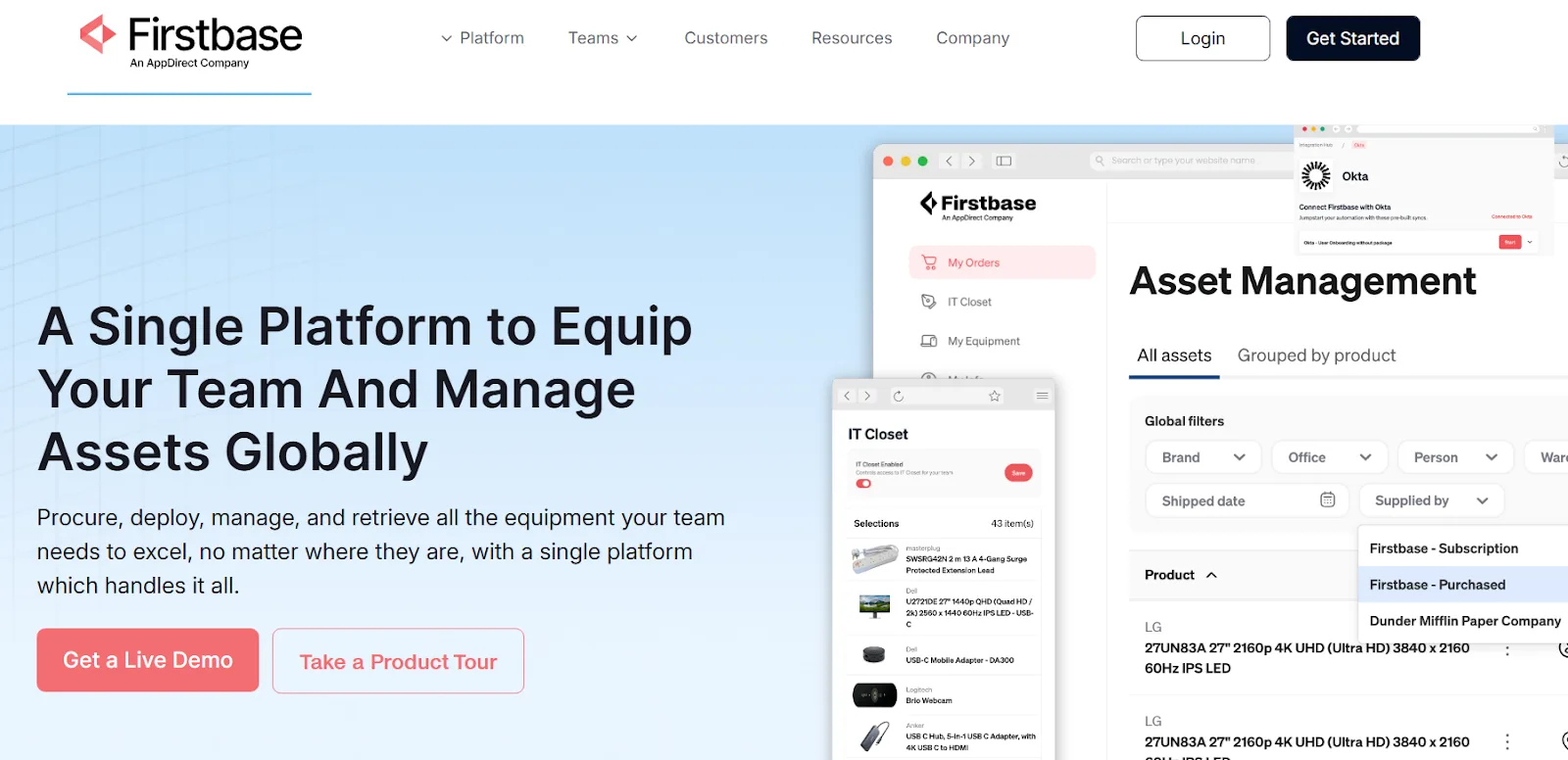
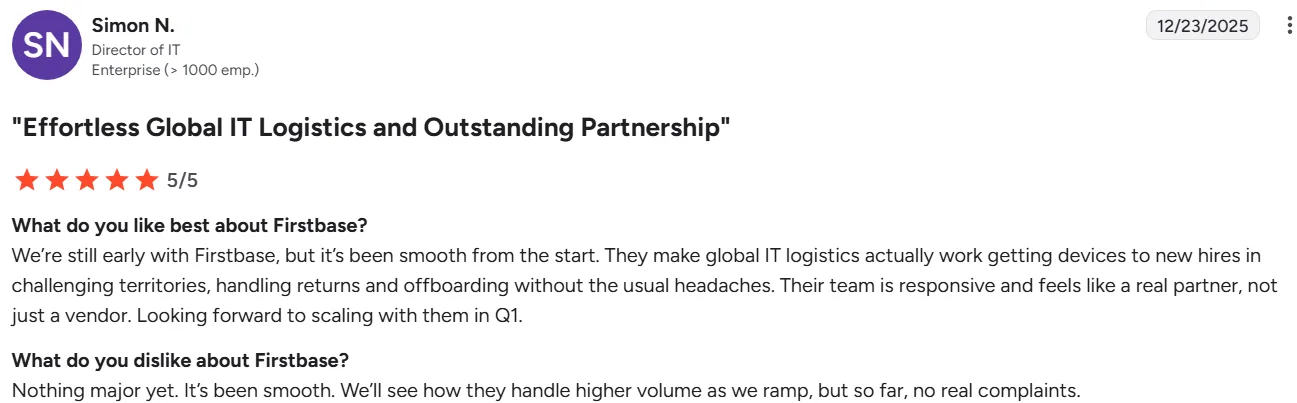
Firstbase isn't a traditional IT service management tool, and that's precisely the advantage. While most ITSM platforms focus on tickets and workflows, Firstbase operates at an additional layer, handling the physical IT lifecycle that determines whether those tickets are ever resolved. With 70,000+ devices deployed across 150+ countries and 97–98% on-time delivery, it works for distributed teams managing employees across multiple countries.
Key offerings:
- ITSM-integrated asset execution: Bi-directional integrations sync asset ownership and lifecycle status with ITSM tools.
- Automated onboarding and offboarding: HRIS- and ITSM-triggered workflows automate device shipping, returns, and status changes, achieving 97%+ hardware recovery rates.
- Self-service hardware requests: Role-based portals let employees request, track, and replace equipment without manual tickets.
- Centralized asset visibility: Audit trails to support compliance and stop the 30% budget drain from ghost assets.
Strength and Trade-offs
Firstbase reduces friction between IT, finance, and HR teams by standardizing hardware workflows as teams scale globally. However, it focuses on asset execution rather than service desk depth and works best alongside a core ITSM platform.
ServiceNow ITSM
Ideal for: Organizations with complex IT environments needing a centralized system of record for incidents, changes, requests, and configuration data.
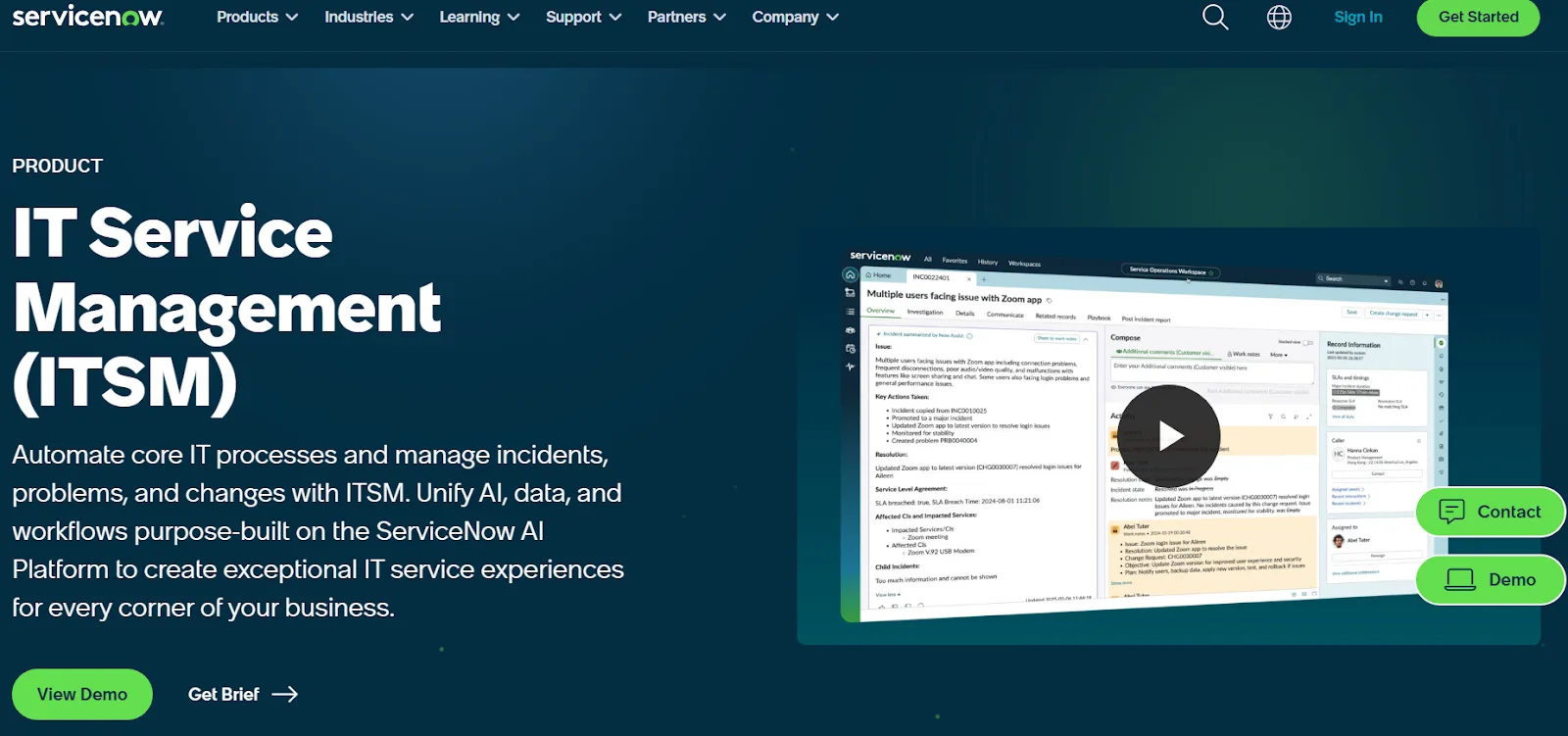
ServiceNow ITSM is an ITIL-aligned service management platform built to standardize and automate IT service delivery across complex and distributed environments. At its core is the ServiceNow CMDB, which maps relationships between services, infrastructure, and applications to support impact analysis and controlled change management.
Key offerings:
- Knowledge management: Centralized articles to support self-service and reduce repeat tickets.
- Performance analytics and reporting: Dashboards for tracking KPIs, service trends, and delivery performance.
- Walk-up experience and agent workspace: Interfaces for walk-in support and agent task management.
- Asset and cost management: Visibility into hardware and software assets with linked cost data.
Strength and Trade-offs
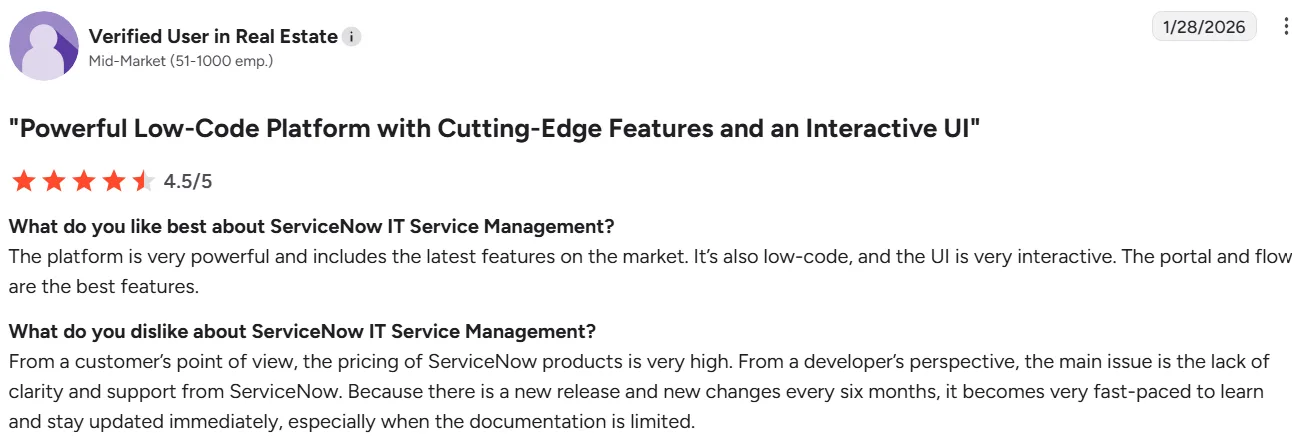
A long-term system of record for IT operations, for organizations that prioritize process consistency and centralized control. However, it comes with a higher total cost of ownership and longer setup cycles.
SolarWinds
Ideal for: Scaling organizations needing an integrated, cloud-hosted ITSM solution with asset visibility, service catalog functionality, and automation.
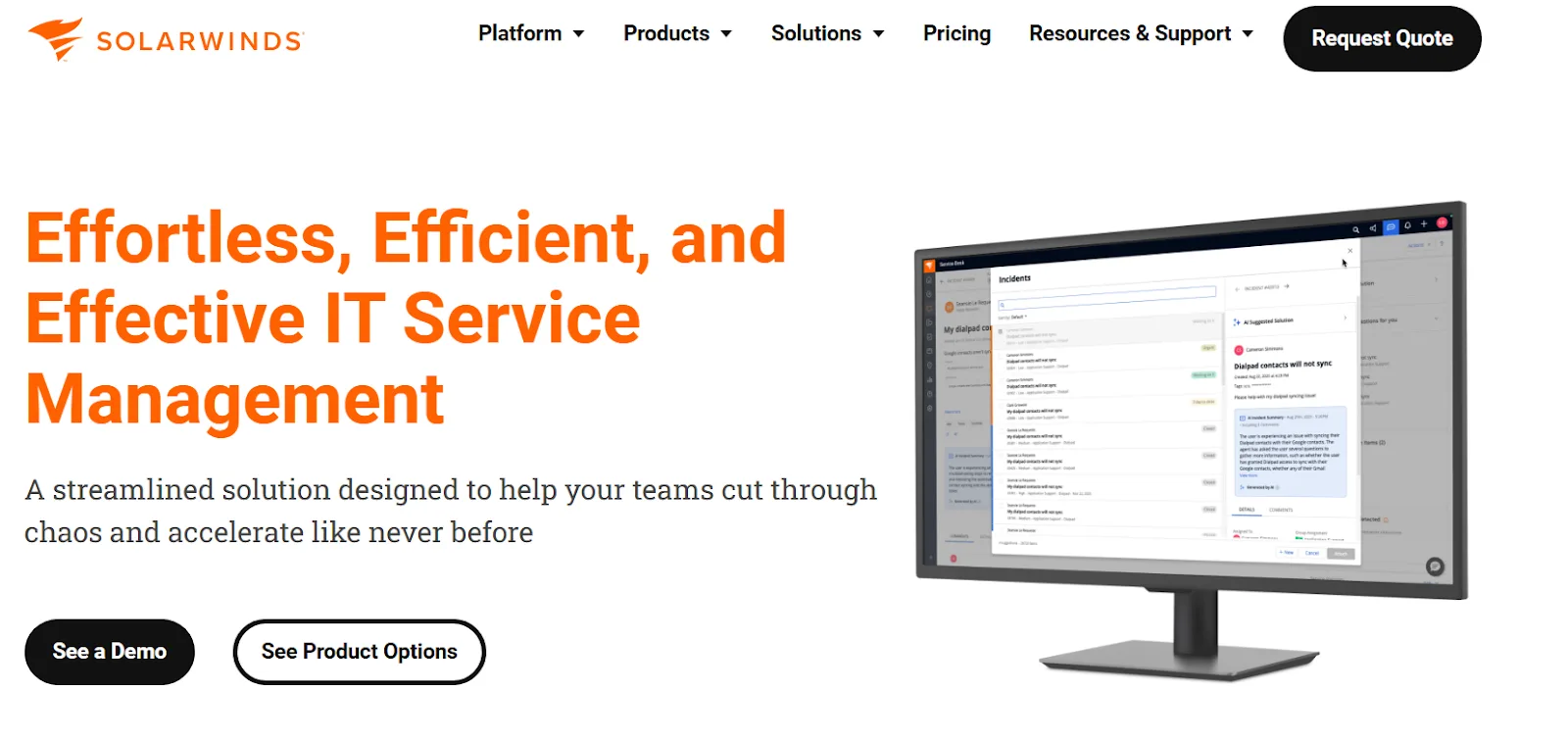
SolarWinds is a cloud-based ITSM platform that centralizes incident, problem, change, and service request management using ITIL-aligned workflows. It integrates service desk functions with asset management and a CMDB.
Key offerings:
- Incident and problem management: Centralized tracking and resolution to minimize downtime.
- Change management: Planning and approval workflows to control IT changes.
- Service request and catalog: Self-service portal to standardize requests and improve end-user experience.
- Automation and AI-assisted support: Workflow AI-driven features that optimize ticket routing and responses.
Strength and Trade-offs
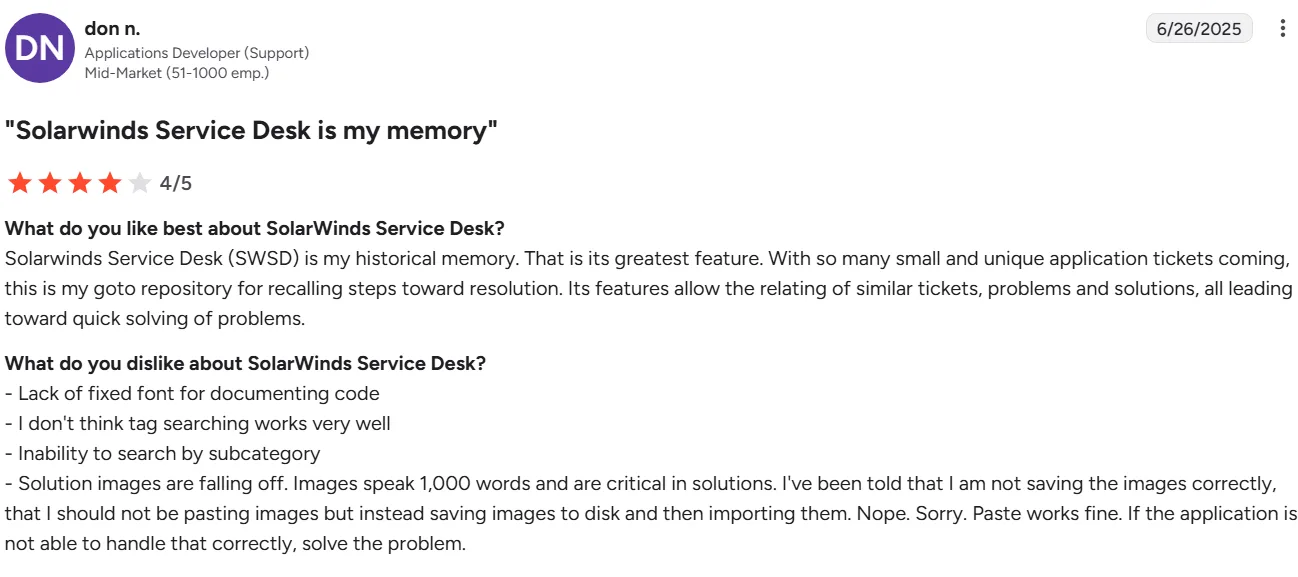
Faster time-to-value with core ITSM and asset visibility on a cloud platform easier to deploy than enterprise tools. However, asset and automation capabilities are lighter-weight.
ManageEngine
Ideal for: Small to mid-sized and scaling organizations looking for a single platform that integrates help desk ticketing with tracking and basic ITIL processes.
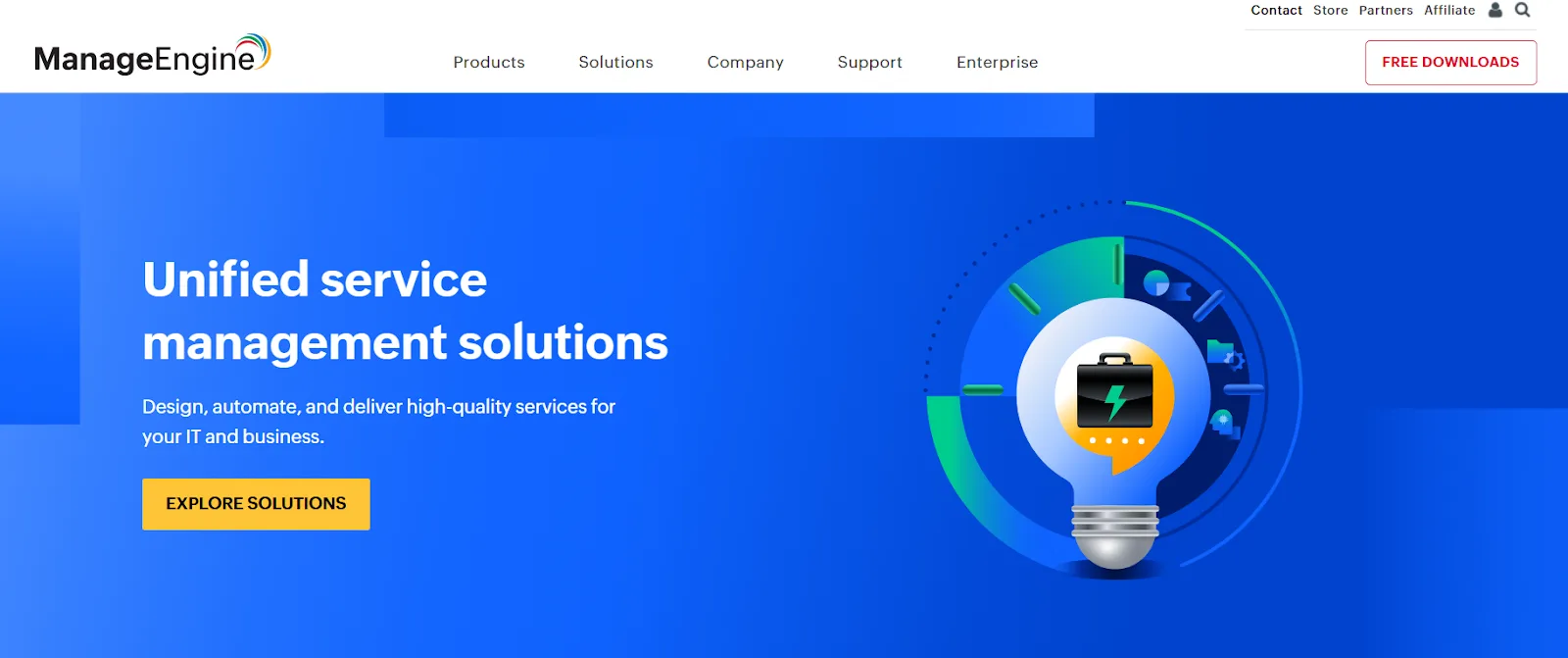
ManageEngine helps organizations that want ITIL-aligned service management with strong deployment and configuration flexibility. Available in cloud, on-premises, and hybrid deployments, making it suitable for teams with specific data residency or security requirements.
Key offerings:
- Configurable incident and request workflows: Customizable workflows to align ITSM processes with internal policies.
- Change and release management with approvals: Structured planning aligned with ITIL practices.
- Integrated CMDB: Configuration items and dependency tracking for impact analysis.
- Knowledge base and self-service portal: Reduce repetitive tickets and improve resolution efficiency.
Strength and Trade-offs
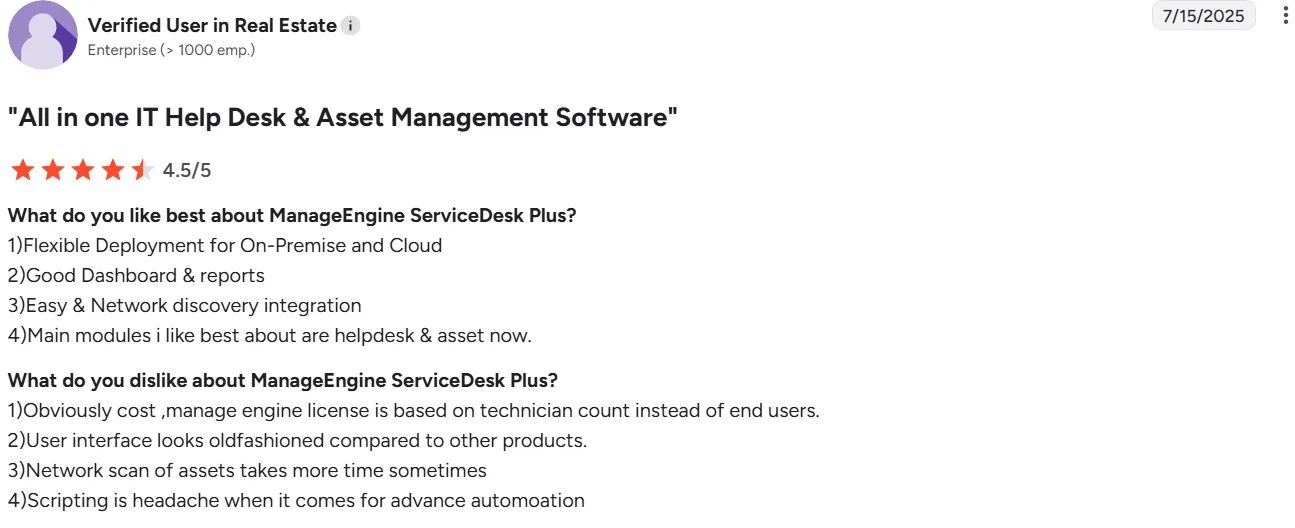
Provides deployment flexibility and a modular ITSM approach. Advanced automation and large-scale customization typically require higher editions.
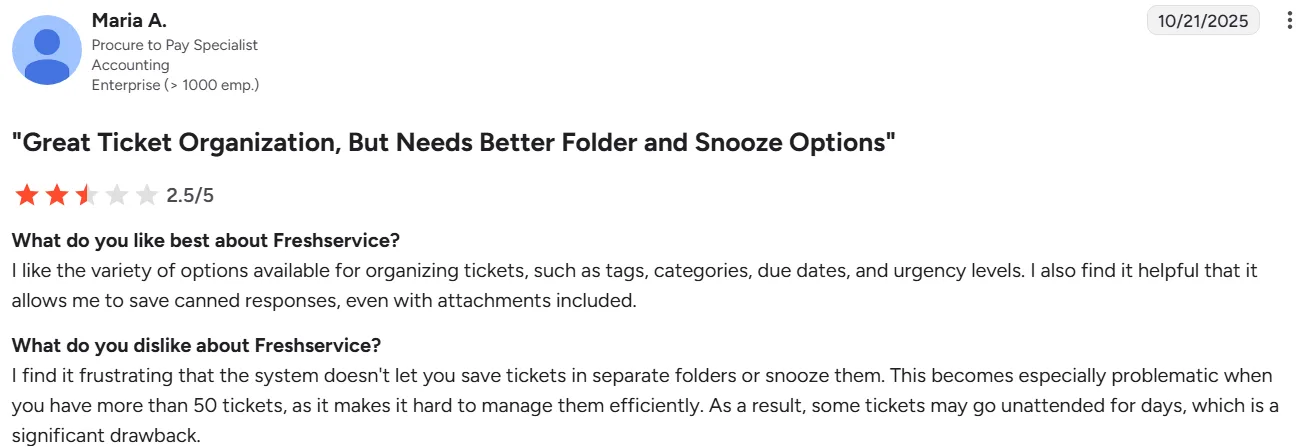
Freshservice
Ideal for: Teams requiring an ITSM platform that balances enterprise capabilities with ease of use and quick deployment.
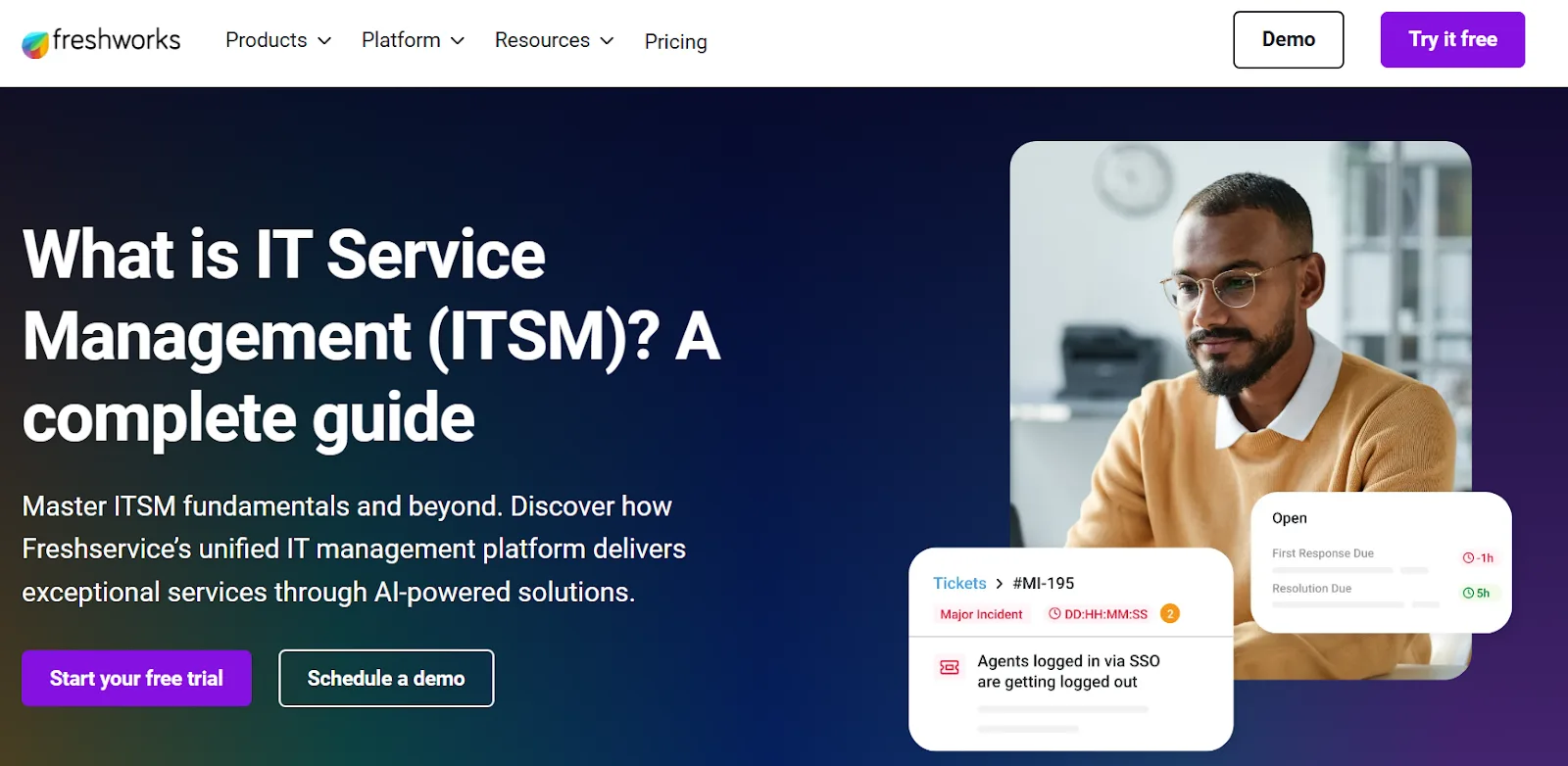
Freshservice, developed by Freshworks, helps IT teams manage service requests, incidents, changes, and assets through a unified interface. It provides faster onboarding with ITIL-aligned workflows and automation that reduces setup effort compared to more heavily customized ITSM platforms.
Key offerings:
- AI-powered automation: Freddy AI automates repetitive tasks and routes issues intelligently.
- Unified service catalog and omnichannel support: Portal, email, Teams/Slack support with a consistent employee experience.
- Integrated asset management and CMDB: Hardware and software asset tracking linked to service activities.
- Self-service portal and knowledge base: Deflect routine requests and improve first-contact resolution.
Strength and Trade-offs
Flexible integrations and asset tracking linked to tickets, supporting mid-market ITSM needs. Limitations in reporting depth affect visibility as service operations mature.
BMC Helix ITSM
Ideal for: Teams looking for enterprise-level automation, cognitive workflows, and predictive problem resolution.
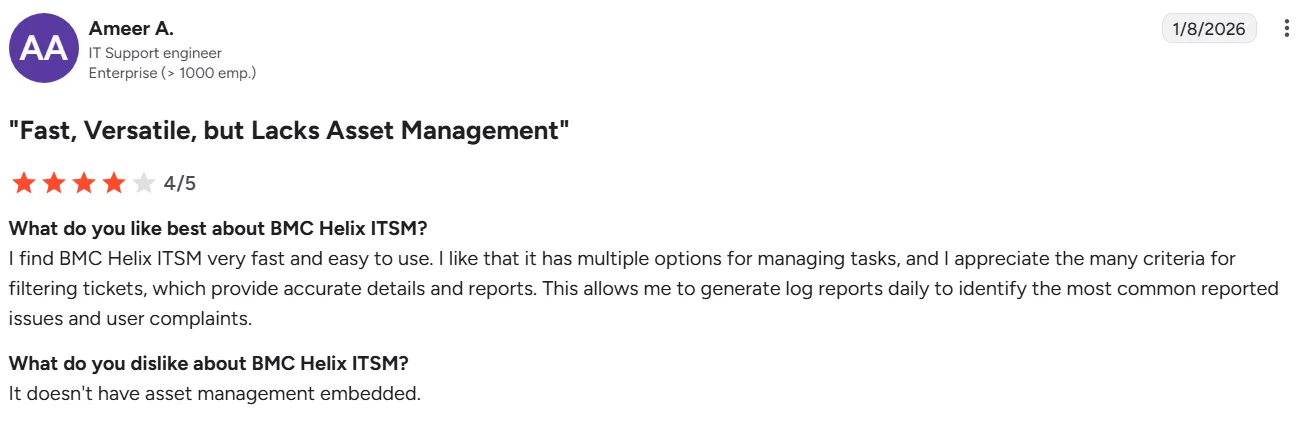
BMC Helix ITSM standardizes, automates, and scales IT operations across incident, problem, change, request, and asset management. It offers traditional ITSM capabilities with AI-assisted automation, predictive insights, and multi-cloud support.
Key offerings:
- AI-assisted service operations: Automates routine tasks and suggests next-best actions to improve efficiency.
- Conversational self-service: Natural language interactions to lower ticket volume and support workload.
- Intelligent change risk analysis: Evaluates potential impact of changes to reduce service disruptions.
- AI-enabled collaboration and swarming: Cross-team coordination during complex incidents.
Strength and Trade-offs
AI-driven service operations with deep ITSM maturity. However, its enterprise depth translates into higher implementation effort and operational overhead.
The Overlooked Cost of In-House Device Logistics
When you “ship it yourself,” the cost doesn’t show up as logistics spend. It shows up as lost time, asset leakage, and delayed productivity — areas that most ITSM tools can record but cannot resolve.
Shipping, duties, and handling: Cross-border shipments typically add customs duties, import taxes (often up to 18%), insurance, and brokerage fees — all of which sit outside standard IT budgets.
Unreturned or written-off devices: Each unrecovered device adds replacement cost while remaining invisible to ITSM workflows once the offboarding ticket is closed.
End-of-life handling and compliance risk: Only 22% of electronic waste is formally collected and recycled, leaving an estimated $62 billion in recoverable material unused each year.
How Firstbase Fits in the ITSM Stack
Firstbase closes the loop by turning ITSM records into completed device actions:
- Operational savings: $100,000 saved annually in shipping costs and 5,000+ IT labor hours returned.
- Documented, auditable ITAD: Certified data wiping (NIST 800-88) with chain-of-custody records.
- IT workload reduction: 250+ IT admin hours saved annually.
- Global fulfillment: Operations in 150+ countries, with 2–5 day device delivery in major markets.
- System integration: Native integrations with HRIS, MDM, and ITSM platforms.
A Practical ITSM Alignment Framework
Step 1: Connect ITSM and HR systems with Firstbase
Connect your ITSM platform (ServiceNow or Zendesk) and HRIS to Firstbase. The ITSM system continues to manage service requests, approvals, and asset assignment, while Firstbase handles the physical device lifecycle.
Step 2: Synchronize identity and organizational data
Link employee and organizational data from the HRIS into Firstbase — company structure, departments, locations, and employee records. This shared identity layer allows ITSM requests to reference consistent employee and cost-center information.
Step 3: Align ITSM and Firstbase data models
Map requesters, catalog items, ticket states, and asset records to employees, hardware SKUs, lifecycle stages, and device identifiers in Firstbase.
Step 4: Execute approval requests through Firstbase
Once approved, Firstbase handles execution: device allocation or procurement, provisioning, shipping, assignment, and return handling. Execution details are reflected back into the ITSM system.
What’s Next?
Most IT asset management still breaks down at the execution layer. Tickets get approved, policies exist, but devices go missing, retrievals slip, and compliance becomes reactive — especially for distributed teams.
Adding Firstbase introduces an execution layer that turns asset records into outcomes. From procurement and zero-touch deployment to retrieval and ITAD, Firstbase manages the physical lifecycle alongside your existing ITSM and finance stack. Teams using Firstbase automate 75%+ of manual asset lifecycle tasks and achieve 97–98% on-time delivery.
Written by
Ahmad Zakaria
Ahmad Zakaria covers IT operations, hardware lifecycle management, and distributed workforce solutions at Firstbase. His content is built from real customer data, operator interviews, and hands-on experience managing devices across 150+ countries.
Get started with
Firstbase today
Remote and hybrid work aren't going anywhere. It's our mission to make it easier to manage the assets your distributed team needs—from onboarding through offboarding and every repair, replacement, and upgrade in between.
Fill out the form and a member from our team will reach out by phone!
Get a Live Demo