What ‘Firstbase Alternatives’ Get Wrong About Remote IT
Looking for Firstbase alternatives? What You Should Know First
 Chris HerdOctober 31, 2025
Table of contents
Hybrid work has permanently redrawn the boundaries of IT operations: in 2025, 53% of roles now operate on hybrid schedules, 27% are fully remote, and only 21% stay on-site.
Every one of those distributed roles needs a device delivered, tracked, and reclaimed without adding more tickets or risk.
That’s where the confusion begins. Search interest in Firstbase alternatives has surged, but not for the reason you might think. The market is flooded with vendors that look similar on the surface. Some handle shipping, others offer partial procurement tools, but few solve the operational pain beneath it.
But Firstbase guarantees global SLAs, transparent per-seat pricing, and end-to-end lifecycle coverage that others still struggle to match. It’s what sets the benchmark for what IT, HR, and Finance teams should expect from any platform.
In this blog, you’ll get a clear look at the device management market:
- Why are so many companies rethinking their approach
- Where common “alternatives” fall short
- What makes Firstbase fundamentally different
- And how to actually evaluate the right platform for scale
TL;DR: What teams should evaluate before choosing any alternative
When comparing device management platforms, use this checklist to see what actually matters at scale: It’s
- Built for: IT, HR, and Finance leaders managing 50-5,000 employees across multiple countries.
- Not for: Single-office teams shipping fewer than 50 devices a year.
| Criteria | What to look for |
|---|---|
| Delivery SLAs and global reach | Are delivery and retrieval timelines guaranteed in each region? |
| Visibility and reporting | Does the platform give real-time status of every device across the fleet? |
| Cost predictability | Is pricing per seat and fully inclusive (shipping, duties, storage)? |
| Retrieval and asset reuse | What percentage of devices are actually recovered and reused? |
| Integration depth | Does it connect with your HRIS, MDM, and finance systems? |
Short on time? Take a self-guided tour and see how every one of these criteria works in minutes.
The traditional ITAM model is broken
Take traditional IT asset management costs. The average support team handles 10,675 tickets a month, each taking about 8.6 minutes of agent time. That’s over 1,500 hours lost every month to troubleshooting, logistics, and basic handoffs.
Multiply that by the real cost of IT labor ($45.65 per hour) and you’re spending close to $70,000 a month just reacting to problems, not solving them. That’s $840k of wasted IT labor every year for a 1 000-person team, money your CFO could point at product, not parcels.
The old model also spikes unpredictably. During rollouts, 46% of IT pros say new software deployments drive up ticket volume. A modest 10% surge at the averages above adds 1,067 tickets, 153 hours, and $6,985 in extra labor that month — again, before logistics overhead.
The traditional model relies on spreadsheets, endless shipping labels, and a patchwork of vendors. And each handoff multiplies risk, delays, and overhead. That’s a drag on business, and it only gets worse as your workforce grows.
What Firstbase alternatives offer (and miss)
You know the gaps. Now it’s time to see if the top Firstbase alternatives close them as they claim to.
Workwize
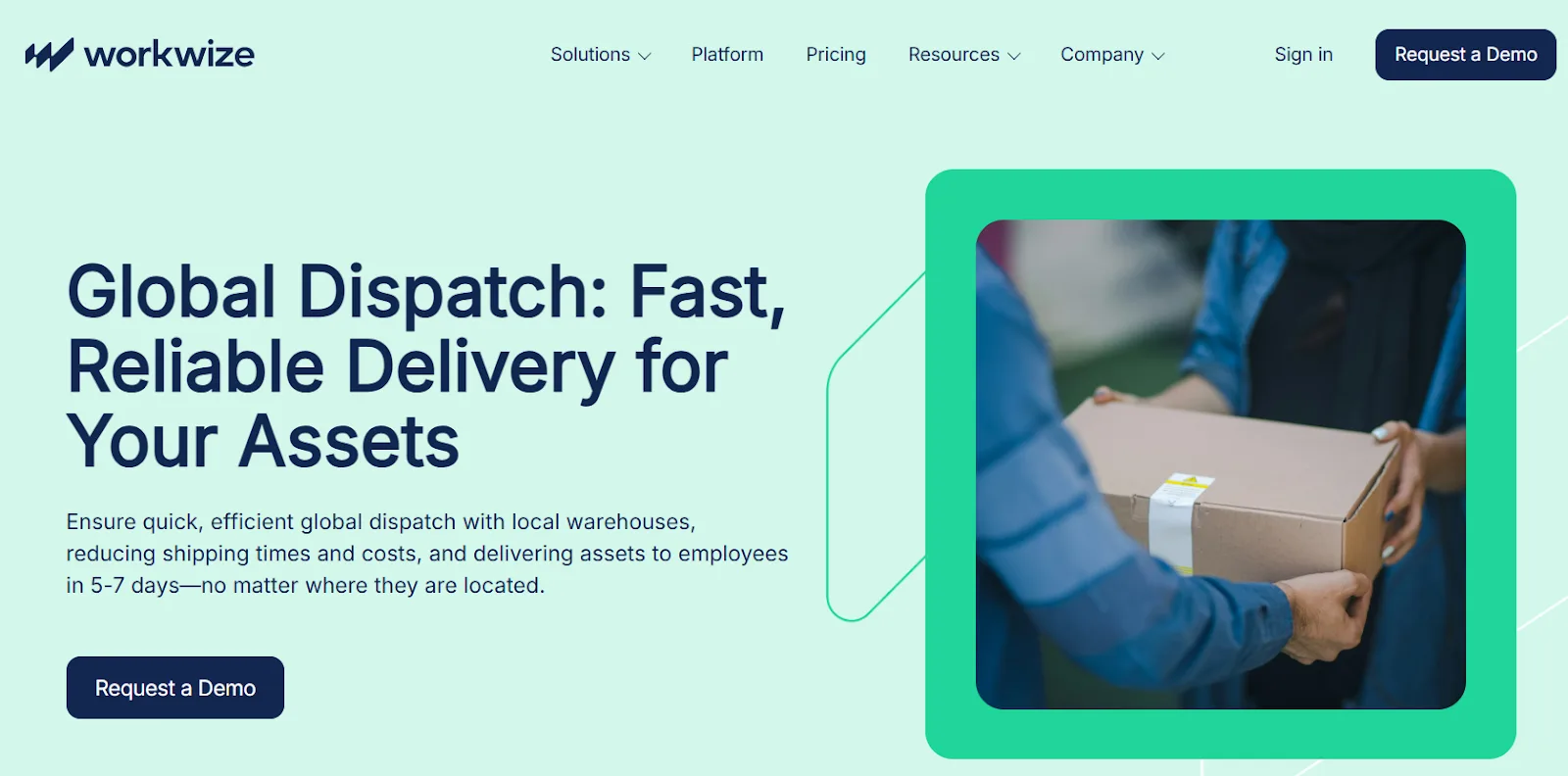
Workwize positions itself as a global IT hardware management platform across 100+ countries from one dashboard. It leans on local warehousing and quick global delivery for dispatched devices. It publishes per-seat pricing and reserves its public API for Enterprise tiers.
Where does it fall short?
Workwize’s 5-7-day delivery claims prove useful, but do not provide an SLA-level commitment. Users report setup and onboarding taking months longer than expected, with global SLAs often missed. Deliveries outside the U.S. (particularly in the EU, Australia, India, and South America) face frequent delays, sometimes stretching into weeks.
The customer portal offers limited visibility, so teams often rely on their account rep for shipment updates. Device collection and secure destruction processes also lack consistency across regions, adding more manual coordination for IT.
Workwize performs adequately in single-region setups, but its global execution and transparency gaps remain a challenge for distributed operations. Fast, 48-hour delivery and pickups are now the baseline (and that’s proven at scale across more than 150 countries).
Deel IT
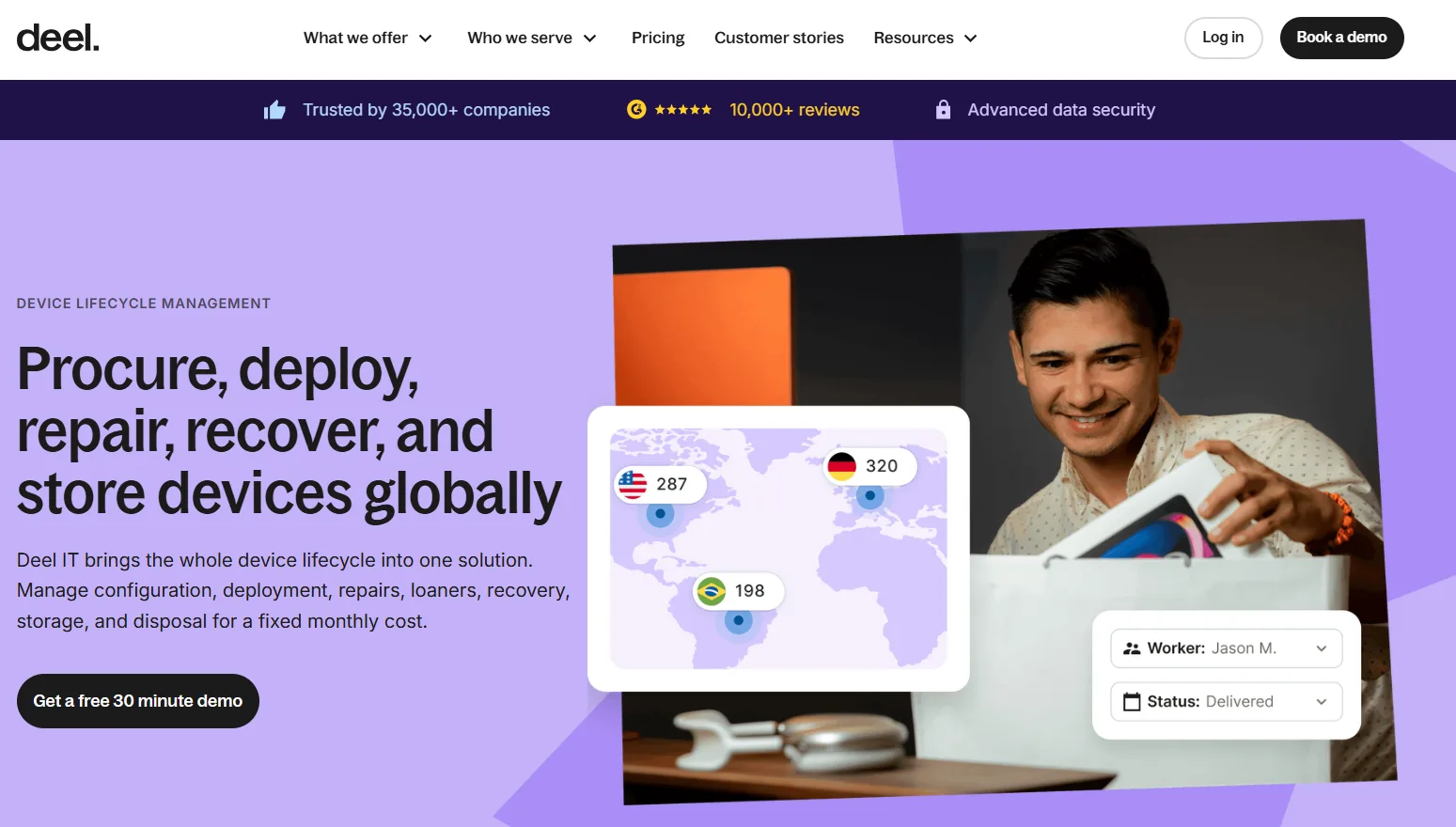
Deel IT extends its HR and payroll ecosystem into device lifecycle management. The platform lets companies manage the entire lifecycle under a seat-based model that spans 130+ countries. Deel handles MDM enrollment, certified data erasure, and retrieval coordination.
It’s a natural extension for companies already running payroll or compliance on Deel. All that gives HR visibility into who has what equipment without adding another vendor to manage.
Where does it fall short?
Deel’s seat model ties hardware to individual contracts, meaning businesses often pay for idle seats when employees leave early or return devices mid-term.
SLA transparency is also limited. There’s no public commitment to a fixed global delivery or retrieval window. Hardware repairs and replacements sit behind tiered service levels rather than standardized coverage.
Deel IT works for HR-led programs. Firstbase wins when IT needs operational depth. It’s what you need if your priorities are 48-hour global delivery, predictable per-seat pricing, and a solid workflow connecting HR, IT, and Finance.
Growrk
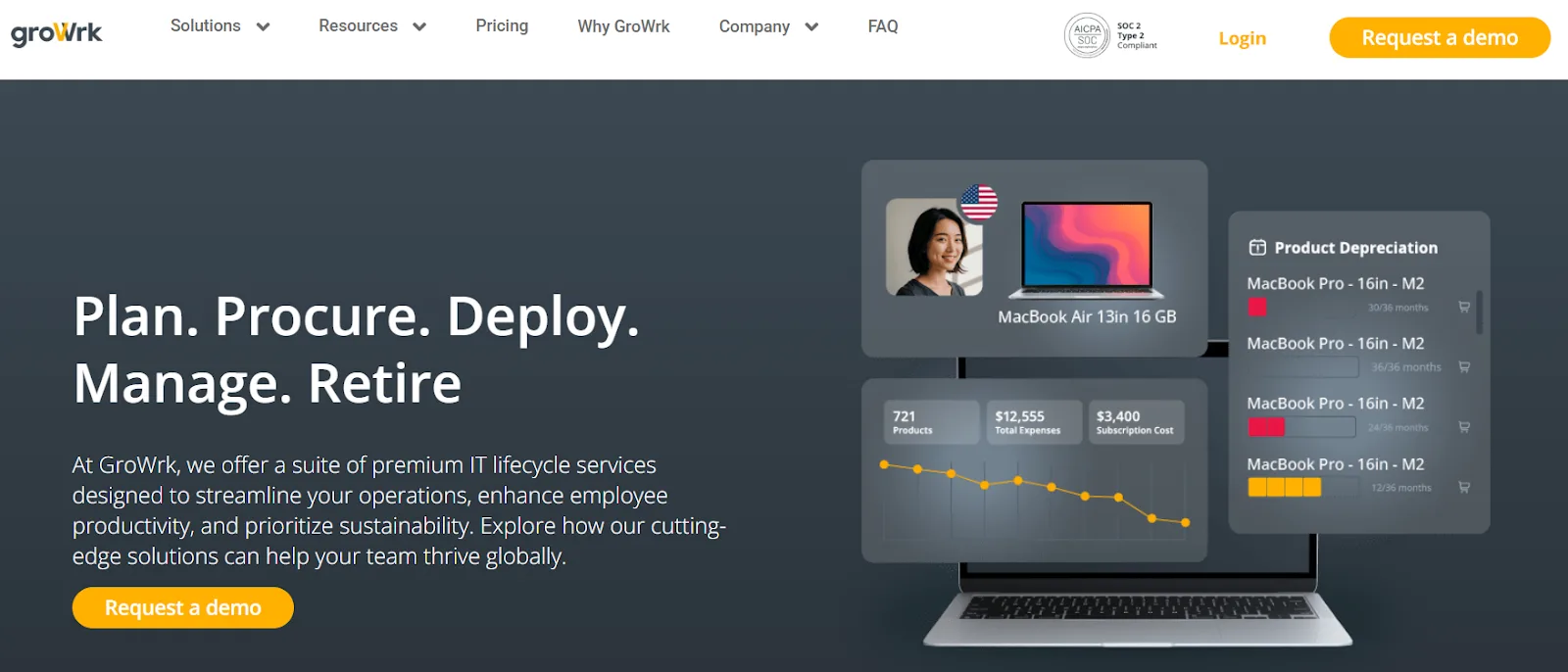
Growrk is a global device management platform that lets companies procure, deploy, monitor, and retrieve IT equipment across more than 150 countries.
It combines procurement logistics with MDM integrations, offers a polished UI, and provides employees with a self-service portal to order and return hardware. For teams looking to centralize procurement quickly, Growrk can feel like an easy entry point.
Where does it fall short for Firstbase buyers?
Growrk’s pricing runs on a subscription-style model, meaning customers continue paying recurring fees even when devices sit unused or idle between employees. That’s a frustration voiced by users who prefer a true pay-for-what-you-use approach.
Its “global delivery” promise also depends heavily on third-party logistics partners, which can introduce inconsistent timelines across regions. While the interface looks clean, users say it isn’t a must-have.
Growrk works for companies that need basic logistics. Firstbase fits teams that expect operational precision, transparent billing, and a system that scales without hidden costs.
Allwhere
Allwhere brands itself as an “all-in-one IT hardware lifecycle platform,” handling all the stages via regional depots and a unified dashboard. They also emphasize zero-touch deployment, HRIS/MDM integrations, and “accelerated delivery” to remote employees.
They offer global logistics backed by regional warehouses and support for full lifecycle workflows, including secure data erasure and chain-of-custody tracking.
Where does it fall short?
Allwhere’s pricing model is a major concern. Costs are often higher than peers, with no publicly available pricing, and some customers report unexpected rate changes mid-contract. All that makes budgeting unpredictable.
The user experience can feel cumbersome because it adds multiple devices, or managing existing inventory often requires extra steps.
While Allwhere claims global reach, users have flagged shipping restrictions in certain countries even after signing agreements. Integrations are limited primarily to HR systems, leaving IT and Finance teams without unified visibility.
Allwhere fits companies that want HR-driven control of hardware workflows. Firstbase, by contrast, is built for cross-functional scale. It gives IT, HR, and Finance shared automation, compliance tracking, and financial predictability across the entire device lifecycle.
SHI
SHI is one of the largest global IT resellers and service providers, with more than three decades in lifecycle support. Its Device Lifecycle Management offering covers hardware sourcing, imaging, deployment, and recovery for large organizations across industries like healthcare, finance, and education.
SHI’s vendor-agnostic model lets IT teams source from multiple OEMs through one provider, supported by managed logistics and training services.
Where does it fall short?
Speed and visibility are recurring pain points. Customers report delivery timelines stretching up to six weeks for hardware that could arrive the next day elsewhere. It’s a costly delay for remote onboarding. Imaging support is another pain point; even when clients send servers for configuration, setups often return incomplete.
Pricing can also trend higher than direct vendors, with little transparency into freight or handling fees.
SHI is a solid procurement partner, but it operates more like a reseller than an automation layer. Firstbase is built for real-time device visibility, faster fulfillment, and closed-loop lifecycle tracking that removes IT from daily logistics altogether.
CDW
CDW is a long-standing IT reseller and services integrator operating across the US, UK, and Canada. It brings together procurement, project-based deployments, and lifecycle management, backed by relationships with major OEMs and cloud vendors.
Its value lies in scale: staging, imaging, integration with ERP and PunchOut systems, and dedicated account management for enterprise-level spend control.
Where does it fall short?
Users say the model depends heavily on account representatives, and when those change, continuity often suffers. Delivery times can stretch into weeks, with some customers citing waits of up to 60 days for hardware.
CDW is built for large procurement projects, not agile device operations. Firstbase fits modern distributed teams without relying on rotating reps or multi-week fulfillment cycles.
The New Standard for IT Operations: How Firstbase Closes the Gaps Others Leave
The modern IT landscape has outgrown the old reseller and logistics models. What CIOs need is an operations infrastructure layer to unite IT, HR, and Finance through automation, visibility, and control. That’s exactly where Firstbase sets a new benchmark.
A single system for people and equipment
IT teams spend close to 500 hours a year for every 100 remote employees on shipping, tracking, and retrieval. With Firstbase, all of it runs through one platform that gives real-time visibility into what’s deployed, what’s in transit, and what’s back in storage.
Customers report 1.8× better asset tracking and 1.6× higher retrieval rates than their previous setups. The retrieval rate alone is telling. Most companies recover only half their devices. Firstbase customers average over 97%. The result is fewer lost assets, faster redeployments, and cleaner audits for Finance.
Designed for IT, HR, and Finance together
Every other platform serves one team well and leaves the others behind. Deel IT works for HR, SHI works for procurement, and CDW works for finance departments that just want quotes. None closes the loop between systems.
But with Firstbase,
- IT gains automation: provisioning, imaging, repairs, and retrievals all executed within SLA windows, freeing them from ticket triage.
- HR gains visibility: every hire and exit automatically triggers equipment workflows, creating seamless onboarding and compliant offboarding experiences.
- Finance gains predictability: standardized per-seat pricing, consolidated reporting, and audit-grade asset logs remove guesswork from forecasting and depreciation.
Zero-touch as a standard, not an upgrade
Zero-touch, for Firstbase customers, is the baseline. Through integrated SaaS and physical operations, every stage of the device lifecycle (from procurement to disposal) happens automatically.
Here, devices arrive pre-imaged, fully configured, and policy-compliant. Retrievals are triggered with a single click and completed within 30 days end-to-end, tracked in real time.
For IT, that means fewer manual tickets and faster resolution times. HR sees consistent Day-1 readiness across every region. And Finance gets predictable costs with no surprise freight or idle-seat spend.
Simplified migration
Moving your equipment process to the cloud shouldn’t be a heavy lift. Firstbase streamlines migration by centralizing existing device data, connecting your current vendors, and automating the switch without disrupting live operations.
Waiting for gear and access interrupts productivity and signals dysfunction, and replacing a salaried employee can cost up to $45,000. That’s why you’ll need a migration process with zero downtime. And Firstbase gives you just that: employee devices stay in use while IT gradually transitions workflows into Firstbase.
From day one, teams will have real-time inventory visibility, automated shipping and retrieval, and integrated HR and Finance data.
Building a more sustainable IT lifecycle
Firstbase can ingest your existing backstock, retrieve currently deployed laptops, and return them to circulation through managed repair and reuse programs. This extends each device’s lifespan, lowers hardware spend, and supports ESG commitments.
Through its Hardware-as-a-Service (HaaS) model, Firstbase aligns financial and environmental goals: lease holders resell returned devices whole, so they get a sustainable second life beyond your active fleet.
It’s a closed-loop approach that helps IT, Finance, and Sustainability teams meet compliance and carbon-reduction targets without extra process or overhead.
Quantifiable business impact
The ROI of IT automation becomes obvious very early with the implementation. Firstbase data across customer case studies show:
- 75% time savings across the equipment lifecycle, allowing IT to reclaim thousands of hours per year
- A 50% cut in IT tickets within six months of rollout
- 5,000 IT hours saved per 1,000 employees each year, roughly $250,000 in reclaimed time
The biggest difference is structural. Firstbase connects procurement, HR, and Finance, so every event (be it a hire, a departure, or a device refresh) automatically triggers the right operational workflow.
That’s the point of the “Ops Infrastructure Layer.” It’s the foundation that lets modern companies run distributed work without losing time, money, or visibility. See how much time and money your teams can save with our ROI calculator before you decide.
Why Firstbase is the only real alternative worth your time
If this market proves anything, it’s that shipping faster or adding another dashboard doesn’t fix the problem. The real challenge is operational: too many tools, too many vendors, and too little accountability across IT, HR, and Finance.
Firstbase was built to fix that. It replaces fragmented device management with one connected workflow that cuts admin work, locks in cost visibility, and delivers consistency across every region.
Customers have saved 250+ IT hours and two times the global headcount in 12 months. If that’s what you want for your teams, book a quick 30-minute demo today.
Written by
Chris Herd
Chris Herd is the visionary founder and CEO of Firstbase, recently acquired by AppDirect, who pioneered the end-to-end hardware provisioning platform now used by tens of thousands of remote employees. Including employees from Spotify, UI Path, Verint and WeWork. With roots in fintech, Chris experienced firsthand the logistical pains of remote hardware management. His company has since scaled, backed by top-tier investors like Andreessen Horowitz and Kleiner Perkins, before its recent strategic acquisition. As an outspoken champion of remote-first culture, Chris continues to shape how companies equip, empower, and trust their distributed teams.
Get started with
Firstbase today
Remote and hybrid work aren't going anywhere. It's our mission to make it easier to manage the assets your distributed team needs—from onboarding through offboarding and every repair, replacement, and upgrade in between.
Fill out the form and a member from our team will reach out by phone!
Get a Live Demo