Allwhere Alternatives
6 Allwhere Alternatives For Global IT Logistics
 Ahmad ZakariaNovember 1, 2025
Table of contents
The logistics model you had in the office-era IT doesn’t work today. Because teams work across five time zones.
Simple internal tickets, say, “Ship a new laptop to Berlin,” now mean you’ll have to navigate customs codes, freight handoffs, and border taxes that can delay your new hire’s onboarding for weeks.
IT, HR, and Finance teams spend hours fixing issues that their vendors should’ve solved. Yet even platforms like Allwhere, which market “global coverage,” often can’t deliver that in practice. One customer even notes that Allwhere accepted their contract, then later admitted certain countries weren’t supported.
In this blog, we’ll look at why these failures keep happening, what IT, HR, and Finance teams actually need, and which Allwhere alternatives can back their claims with real performance data.
Who this comparison is for (and who it isn’t)
It’s best suited for:
• IT, HR, and Finance leaders supporting mid- to large-scale distributed teams, typically 50 to 5,000 employees across 30+ countries.
• Companies that need hardware delivery, retrieval, and compliance reporting handled through one global system with verified SLAs.
Not the right fit for:
• Small, single-office setups managing only a few dozen devices a year.
• Teams focused solely on software license tracking or SaaS optimization. Those use cases align better with ServiceNow or SHI.
TL;DR: 6 best Allwhere alternatives at a glance
We shortlisted each vendor’s performance across three proven metrics (delivery SLAs, retrieval success rates, and cost consistency) using customer-reported data and verified documentation from the past 12 months. Only after confirming operational reliability did we compare pricing, integrations, and usability.
| Platform | USP | Best for | Global coverage | Pricing |
|---|---|---|---|---|
| Firstbase | Full device lifecycle platform with 48-hour SLAs | IT, HR, and Finance teams that need predictable remote IT ops | 150+ countries (SLA-backed 48-hour delivery) | Transparent per-seat pricing; freight and returns included |
| Deel IT | Integrated HR + IT suite with device provisioning | Teams using Deel for HR/payroll | 130 countries | From $10/device/month + add-ons ($9–$99) |
| GroWrk | Automated device lifecycle with 40+ integrations | Distributed teams that are scaling fast | 150 countries | Tiered plans; pricing not public |
| Retriever | Secure laptop retrieval and data destruction | Companies needing fast, certified hardware retrieval | Primarily across the USA, UK, and Canada | $75–$195 per return |
| ServiceNow | Enterprise ITAM with unified CMDB and workflow automation | Large enterprises managing IT/Cloud assets | 65+ locations | Not transparent |
Firstbase reduces IT equipment stock levels by 30%, cutting storage waste and keeping devices moving instead of sitting on shelves.
“Firstbase helps us expand into new regions and manage existing ones, making our operations across eighteen time zones seamless.”
- Ryan Bacon, IT Manager, JumpCloud
Take the self-guided tour and see how that workflow operates for your team.
Where Allwhere and peers fall short (price hikes, coverage, and missing returns)
Let’s get specific about how those promises break down in real, measurable ways that cost IT, HR, and Finance time, money, and credibility.
Surprise costs and rising per-seat spend
Remote-era shipping compounds. Organizations commonly spend about $100 per remote worker per year on shipping alone; scaled to 1,000 people, that’s $100,000 annually just for freight.
Those headline numbers hide smaller (but frequent) upsells for finance teams. That includes rush surcharges, re-routings, brokerage fees, and local duties that vendors don’t always surface up front.
Over time, these add up to unpredictable per-seat spend that can fluctuate each quarter. It erases the budget consistency that global teams depend on.
Customs and warehouse friction that slows onboarding
When a warehouse or carrier needs extra paperwork, delivery times explode. Best practice for well-run warehousing is 24-48 hours dock-to-stock, but many routes routinely miss that window because of local paperwork, carrier cutoff times, or re-routing.
The downstream effect you’ll find is that your new hires wait days (sometimes weeks) to be fully productive, and IT teams spend hours chasing status updates.
Retrieval breakdowns and asset loss that hit budgets
Asset recovery is a chronic leak. Enterprises recoup only 30-50% of laptops from remote workers; even generous recovery assumptions still leave dozens of missing devices each year.
Using commonly accepted averages (15% churn on 1,000 employees; $1,500 per laptop), that shortfall translates into tens of thousands of dollars lost annually. It’s a recurring, avoidable line on the balance sheet.
Service gaps: slow repairs, limited coverage, and wasted IT hours
Legacy partners and fragmented vendor stacks force IT to spend time on logistics instead of strategy. In the field, teams report five hours of logistics work per remote worker (address checks, packing, follow-ups).
At scale, that becomes hundreds to thousands of wasted hours — work that adds cost and delays strategic projects.
Run the math and you’ll understand why it’s important to find platforms that handle your asset lifecycle end-to-end.
Comparing the 6 best Allwhere alternatives
Here are the top Allwhere alternatives you must look into if you’re planning to upgrade your asset management.
Firstbase
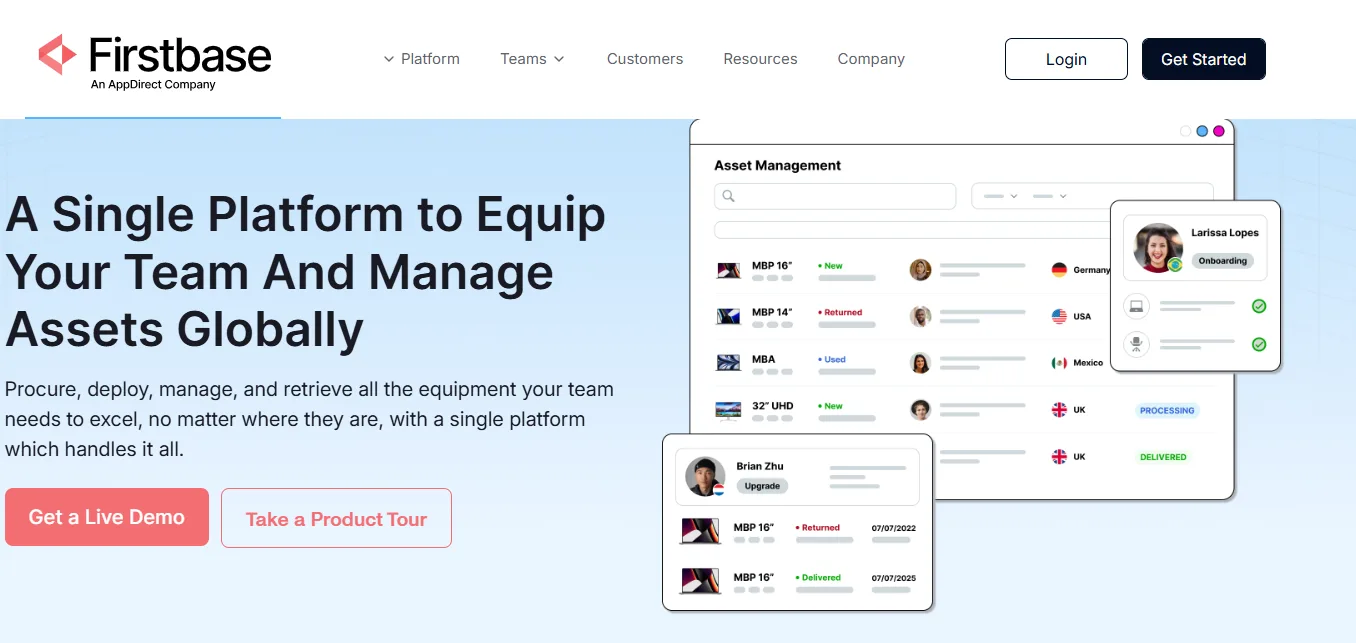
Firstbase combines a cloud asset-management portal with a global physical operations engine to remove routine IT friction for distributed teams. Customers report major, measurable wins: automated lifecycle workflows cut manual equipment work by roughly 75%, and consolidation into a single platform yields time-and cost savings.
Operational outcomes are specific. Firstbase’s retrieval workflows and return kits lift device recovery well above industry averages. The platform also offers chain-of-custody logs, certified wipes, and resale credits that create traceable value and reduce both compliance and e-waste risk.
Key features
- Virtual IT Closet (self-service ordering): Role-based catalogs let employees order approved devices and peripherals without tickets; IT retains spend control and visibility.
- Fast retrieval program: Return kits, automated address confirmation, and tracked pickups drive a 97%+ recovery rate and under-30-day turnaround from offboarding to warehouse.
- Zero-touch provisioning + MDM readiness: Devices ship regionally provisioned and ready to enroll in MDM, reducing manual imaging and onboarding time.
- Global warehousing and routing: Localized stock and carrier relationships reduce routing surprises and support a consistent delivery experience across regions.
- Certified data sanitation and ITAD: NIST-level wipes, chain-of-custody records, and licensed destruction partners produce audit-ready disposal certificates.
- Flexible procurement models: Buy, lease, or bring-your-own devices. Firstbase supports multiple acquisition paths to preserve capital and avoid vendor lock-in.
- Expedited loaners and repairs: Loaner devices and on-backend repairs keep employees productive while vendors troubleshoot.
- Rich integrations (HRIS, ITSM, IAM): Out-of-the-box connectors (Workday, Okta, ServiceNow, and more) automate onboarding triggers and sync asset state across systems.
- Resale credits and ESG reporting: Grading, refurbishment, and remarketing recover value, while CO₂ and recycling logs support ESG audits.
Why Firstbase is a better alternative to Allwhere
Allwhere’s common, customer-reported problems include hidden or changing prices, a clunky ordering flow, gaps in certain regions after contracts are signed, and limited integrations. These are operational failures that create predictable work for IT, HR, and Finance.
Firstbase addresses each point with concrete controls you can verify:
- Transparent regional readiness: Firstbase validates new markets with test shipments and standard operating procedures before accepting live orders, and maintains dedicated regional warehousing to reduce last-mile surprises.
- Direct integrations that remove manual steps: Prebuilt connectors (Workday, Okta, ServiceNow, among others) trigger provisioning and deprovisioning events automatically, cutting the manual imports that create ticket backlogs.
- User flow that reduces exceptions: A Virtual IT Closet and role-based catalogs let employees self-order within approved policies, which eliminates many multi-item order errors and approval workarounds.
- Returns and compliance as standard ops: Firstbase issues return kits and home pickup, performs NIST-level wiping, and routes retired hardware to licensed ITAD partners with custody logs for audits.
If budget predictability, fewer manual handoffs, and auditable returns matter to you, these are the operational checks you’ll need.
Firstbase customers cut IT support tickets by 50% in just three months by using automated swaps and self-service ordering. Use the ROI Calculator to find out what that would mean for your own team’s workload and spend.
Deel IT
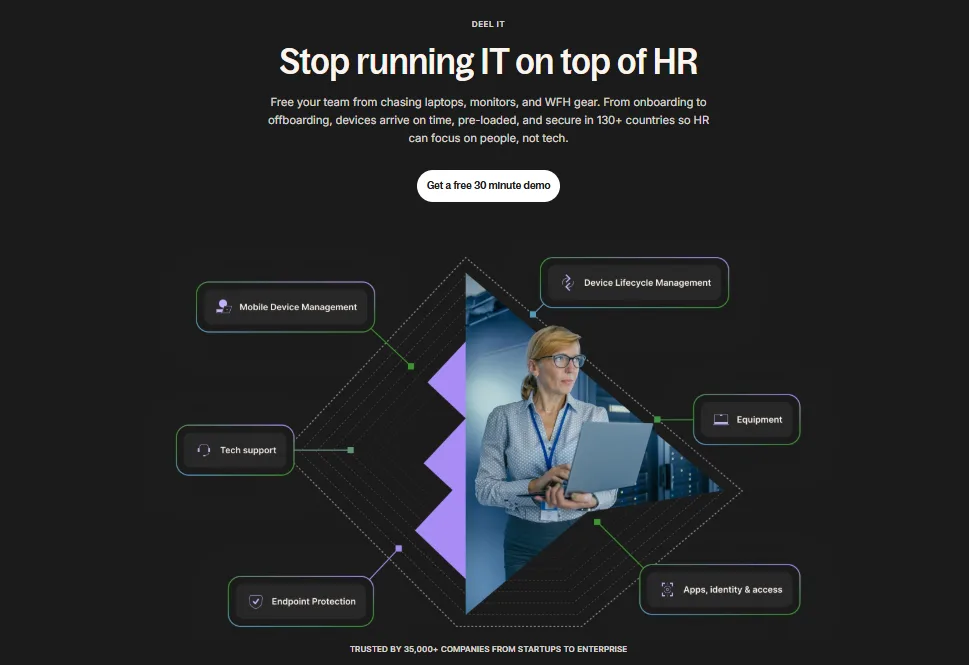
Deel IT is the device-management layer added to Deel’s global payroll and HR suite after its acquisition of Hofy. The platform combines equipment delivery, lifecycle tracking, and security management for distributed teams. Its integrated repair routing and loaner workflows keep employees productive: repairs, temporary replacements, and return logistics run from one ticket.
Teams can buy or lease hardware, ship from regional suppliers, and manage existing fleets through a single console. Deel IT also includes mobile-device-management integration, pre-configuration options, and certified data erasure when hardware is returned.
Key features
- Permissions and approval controls: Fine-grained rules let admins require approvals at the kit, role, or team level and enforce spend limits before orders route to procurement.
- Personal storefront allowances: Configure per-role allowances so employees select approved devices (and accessories) from a curated catalog without ad hoc exceptions.
- Lifecycle automation: Covers deployment, repair, loaner management, and certified data erasure upon return, and reduces manual intervention.
- Certified returns and secure staging: Returned hardware goes through certified data-erasure and secure storage processes before refurbishment, reuse, or long-term warehousing.
GroWrk
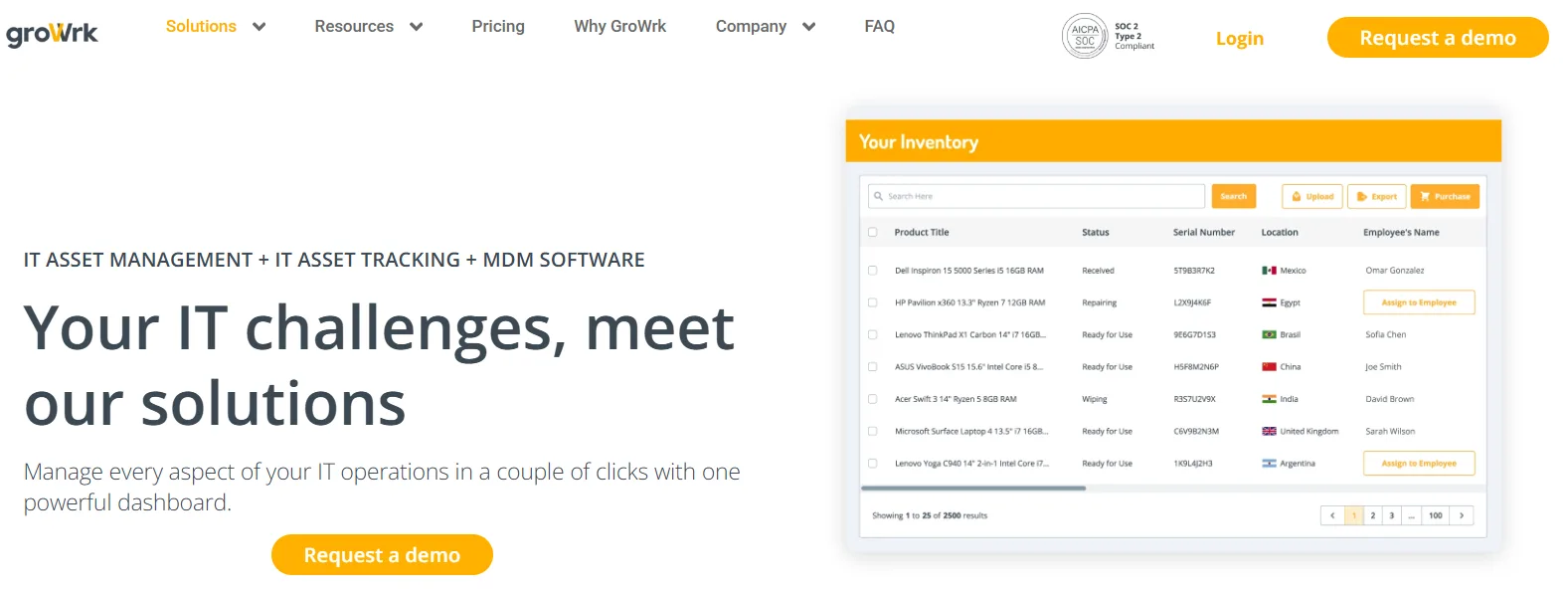
GroWrk gives you one platform to manage company devices across 150+ countries without needing local entities or regional vendors. It covers the entire operational cycle and standardizes delivery times globally. The platform’s main draw is speed and predictability: hardware reaches employees in under seven business days.
It does all that with consistent customs handling and transparent pricing across all regions. Companies can run their global inventory from one dashboard while staying compliant through SOC 2 Type II–certified security practices and automated reporting that keeps audit preparation fast and verifiable.
Key features
- Centralized real-time asset control: The dashboard gives IT teams instant visibility into device status, location, and lifecycle stage without manual spreadsheets.
- Role-based automation: Custom rules decide who receives which device or accessory, with automatic approvals and fewer coordination steps.
- Extensive software integrations: Over 40 built-in connectors and open API access sync GroWrk with HR, procurement, and ITSM tools to keep data consistent.
- Tiered, transparent pricing: Three plan levels with flat regional rates and no hidden fees help finance teams forecast device costs with precision.
Retriever
Retriever is a laptop returns and data-destruction service built for companies that need to recover hardware securely at scale. You can eliminate the manual effort of coordinating return shipments, follow-ups, and compliance tracking.
Devices are collected directly from employees through prepaid, eco-friendly boxes that arrive within one business day, with automated reminders to ensure timely pickup. Once received, hardware is processed in a controlled facility under SOC 2 Type 2 standards. Retriever aligns with GDPR, SOX, GLBA, and HIPAA requirements with downloadable certificates for every completed data wipe.
Key features
- Centralized return dashboard: A web portal that lets IT teams monitor shipment status, confirmations, and certificate uploads without using spreadsheets.
- Bulk-scale coordination tools: Enterprise workflow options handle thousands of simultaneous returns with pre-scheduled pickups and location-based routing.
- Reward credit system: Customers earn retrieval credits for every securely retired laptop and offset future disposal costs.
- 24/7 support line: Dedicated staff respond to employee or admin questions during the retrieval window, so no devices stall in transit.
ServiceNow
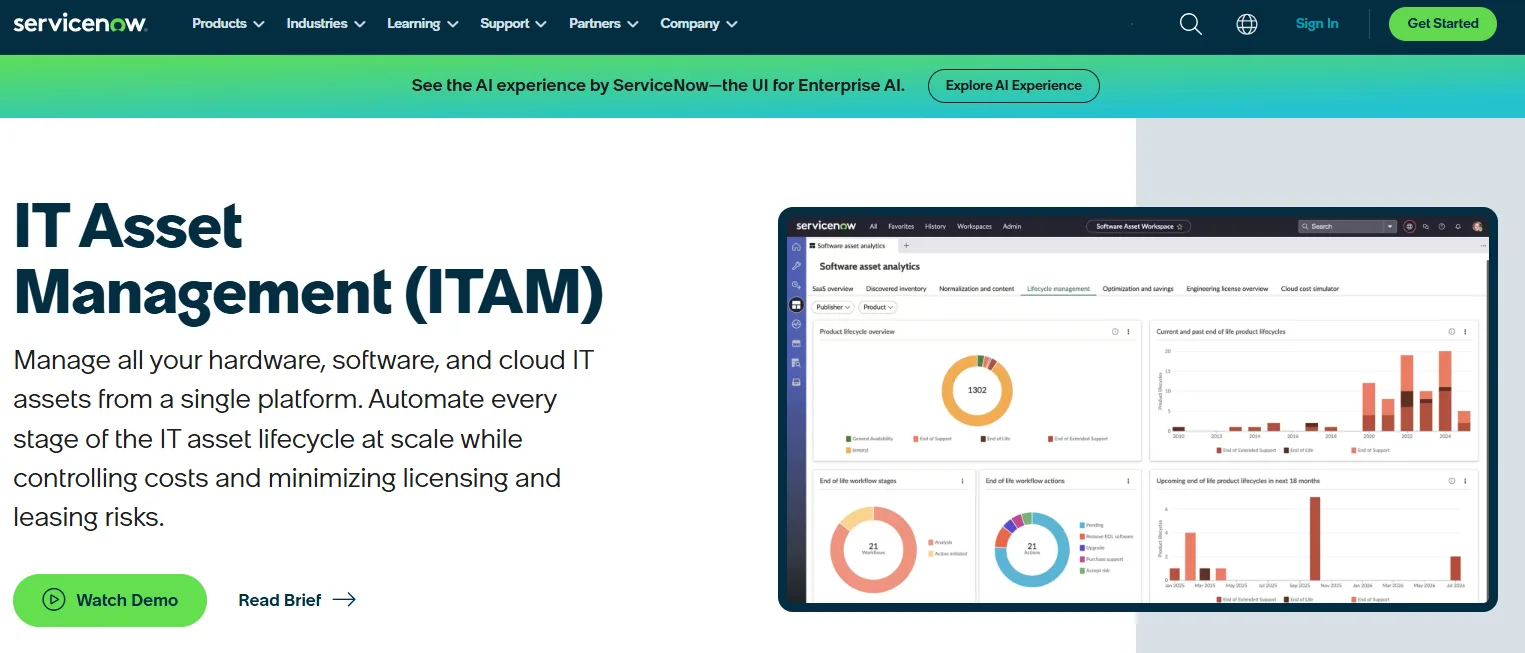
ServiceNow IT Asset Management (ITAM) consolidates hardware, software, and cloud assets into a single control platform built on its unified data model. It automates each stage of the asset lifecycle while also tracking usage, spend, and risk across departments. The platform controls costs and governance by optimizing license consumption and preventing technology waste.
The platform integrates asset tracking with ServiceNow’s IT service, operations, and security modules. Companies use it to identify shadow IT, control unused subscriptions, and maintain unified audit records across departments.
Key features
- Unified data model (CMDB integration): All asset records feed into a single configuration management database, which removes duplication and enables accurate lifecycle tracking.
- AI-powered optimization: Built-in analytics surface underused software, excess licenses, and idle cloud resources to bring down ongoing technology costs.
- Cross-platform workflow builder: No-code playbooks automate provisioning, maintenance, and disposal tasks, all while linking to ITSM and procurement workflows.
- Integrated cost governance: Real-time budget tracking across cloud, software, and hardware assets helps finance and IT align on CapEx and OpEx decisions.
SHI
SHI’s IT Asset Management (ITAM) services focus on cost optimization, compliance, and sustainability for large enterprises managing complex software portfolios. Its Software Asset Management (SAM) practice oversees more than 1,000 software titles and helps organizations track deployment, entitlements, and usage to identify compliance risks and overspend.
The platform also provides SaaS cost optimization and audit management to align licensing with real-world utilization. Its consultants identify unused or over-licensed software, enforce de-provisioning policies, and reduce penalties tied to audit exposure. Combined with eco-friendly asset programs, SHI helps enterprises lower software costs and meet both financial and ESG goals.
Key features
- Optimized License Position (OLP): Analyzes deployment, entitlement, usage, and risk to show exactly where organizations overspend or face non-compliance.
- 365 Insights for Microsoft environments: Tracks provisioning, adoption, and inactive accounts to right-size Microsoft 365 and enforce clean deprovisioning policies.
- Vendor-specific SAM expertise: Dedicated teams for Oracle, SAP, IBM, and Microsoft licensing guide customers through audits and renewal negotiations.
- Sustainable ITAM initiatives: Integrates lifecycle management with carbon-reduction goals, combining financial savings with measurable environmental impact.
Buyer Checklist: 8 Questions to Ask Any Vendor
Now, to make your decision-making process easier, we’ve compiled a checklist. It’s exactly what you need before locking in your Allwhere alternative.
| # | Question | Why does it matter? |
|---|---|---|
| 1 | Can you show average delivery and retrieval times by country? | Real logistics data proves consistency. “Global” without SLAs is a red flag. |
| 2 | What percentage of returned devices are successfully redeployed? | Retrieval and redeployment rates determine your ability to save costs through reuse. |
| 3 | Do you validate each new country with a live shipment and SLA test? | Many vendors claim coverage without operational capability—this weeds them out. |
| 4 | How do you price freight, duties, and brokerage? | Predictable pricing eliminates surprise logistics costs and TCO increases. |
| 5 | Which HRIS, ITSM, and IAM platforms do you integrate with? | Tight integrations remove manual imports and reduce human error across systems. |
Upgrade to Firstbase for Scalable IT Logistics
If the checklist raised concerns or doubts about your current provider’s reliability, look at what proven operations actually deliver. Firstbase maintains 99.98% uptime, runs on SOC 2 Type II–audited infrastructure, and applies verified ITIL workflows across every region.
The infrastructure supports global hardware deployment, with built-in compliance into each handoff and zero reported data breaches across its managed fleet.
In large-scale transitions, clients have saved $125 per departing employee, reclaimed 700+ IT hours, and recouped $175,000 in asset value through secure redeployment. That’s what operational maturity looks like (at scale). See the operational impact yourself; book a demo with Firstbase and benchmark these results against your own workflows.
Written by
Ahmad Zakaria
Ahmad Zakaria covers IT operations, hardware lifecycle management, and distributed workforce solutions at Firstbase. His content is built from real customer data, operator interviews, and hands-on experience managing devices across 150+ countries.
Get started with
Firstbase today
Remote and hybrid work aren't going anywhere. It's our mission to make it easier to manage the assets your distributed team needs—from onboarding through offboarding and every repair, replacement, and upgrade in between.
Fill out the form and a member from our team will reach out by phone!
Get a Live Demo